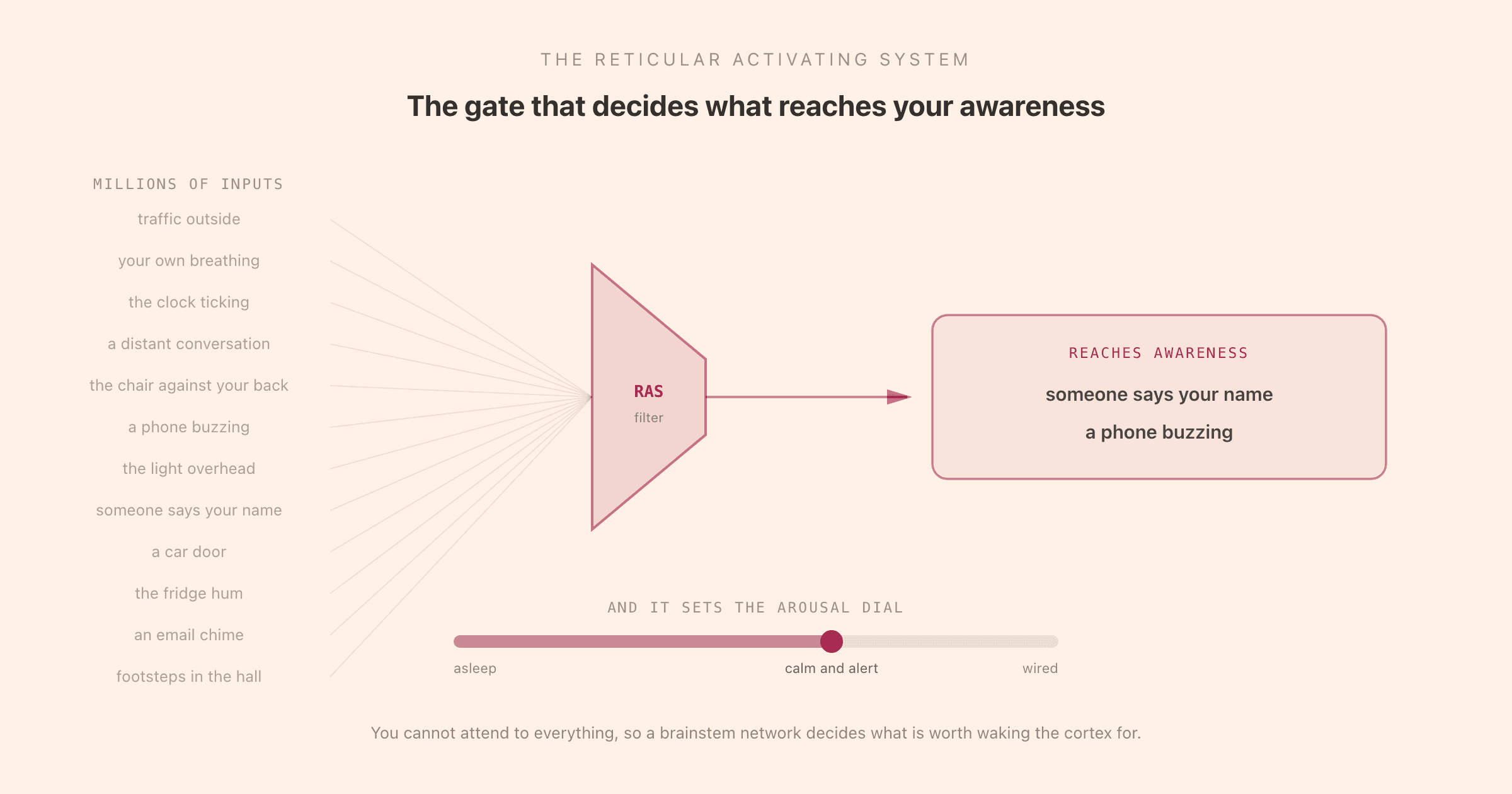
The reticular activating system is the reason you can read this sentence while ignoring the hum of the room, the feeling of the chair against your back, and a dozen other signals your senses are picking up right now. It is a network of neurons in the brainstem that does two jobs so fundamental you never notice them: it decides which of the millions of incoming signals are worth passing up to your conscious brain, and it sets your overall level of alertness, from deep sleep to wired. Almost everything you experience as attention and wakefulness runs through this system first. Understanding the reticular activating system, or RAS, is understanding the gate that all your focus has to pass through.
This article explains what the reticular activating system is, its two core functions of filtering and arousal, why it is the structure that decides whether you can concentrate, and how to work with it instead of against it. The RAS is not something you consciously control, but it is profoundly shaped by your environment, your stress, and your sleep, which means the practical levers are real even though the machinery is automatic.
What Is the Reticular Activating System?
The reticular activating system is a diffuse network of neurons running through the brainstem, from the medulla up through the midbrain, with projections reaching widely into the thalamus and the cortex above. The name captures its structure and its job: "reticular" means net-like, describing the mesh of interconnected neurons, and "activating" describes what that net does, which is to activate, or arouse, the rest of the brain.
It is not a single discrete organ with a sharp boundary. It is better understood as a functional system built from several brainstem nuclei, including the noradrenaline-producing locus coeruleus, the serotonin-producing raphe nuclei, and cholinergic and dopaminergic centres, all feeding a common purpose: regulating the arousal and readiness of the brain as a whole. When neuroscientists talk about the "ascending reticular activating system," they mean this upward flow of arousal signals from the brainstem to the cortex, the current that keeps the thinking brain switched on.
Because it sits so low in the brain and so early in the processing chain, the RAS is upstream of almost everything else. The higher regions responsible for deliberate attention, like the prefrontal cortex, can only work on the material the RAS has already decided to let through and only at the level of alertness the RAS has set. That upstream position is what makes it so important and so easy to overlook.
Function One: The Filter That Decides What You Notice
Your senses gather far more information every second than your conscious brain could ever process. The RAS, working closely with the thalamus, acts as the filter that decides what is worth your awareness and what can be safely ignored. Most of what your ears and skin and eyes report never reaches consciousness at all, not because you failed to sense it, but because the gate held it back.
The classic demonstration is the "cocktail party effect." In a noisy room full of overlapping conversations, all of which your ears are physically registering, you can hold a single conversation and tune the rest into background hum. Then someone across the room says your name, and it cuts straight through. That is the RAS at work: it had been filtering out the other voices as irrelevant, but your name is tagged as significant enough to push through the gate and grab your attention. The same system explains why a new parent sleeps through traffic but wakes instantly at the smallest sound from the baby. The RAS learns what matters to you and calibrates the filter accordingly.
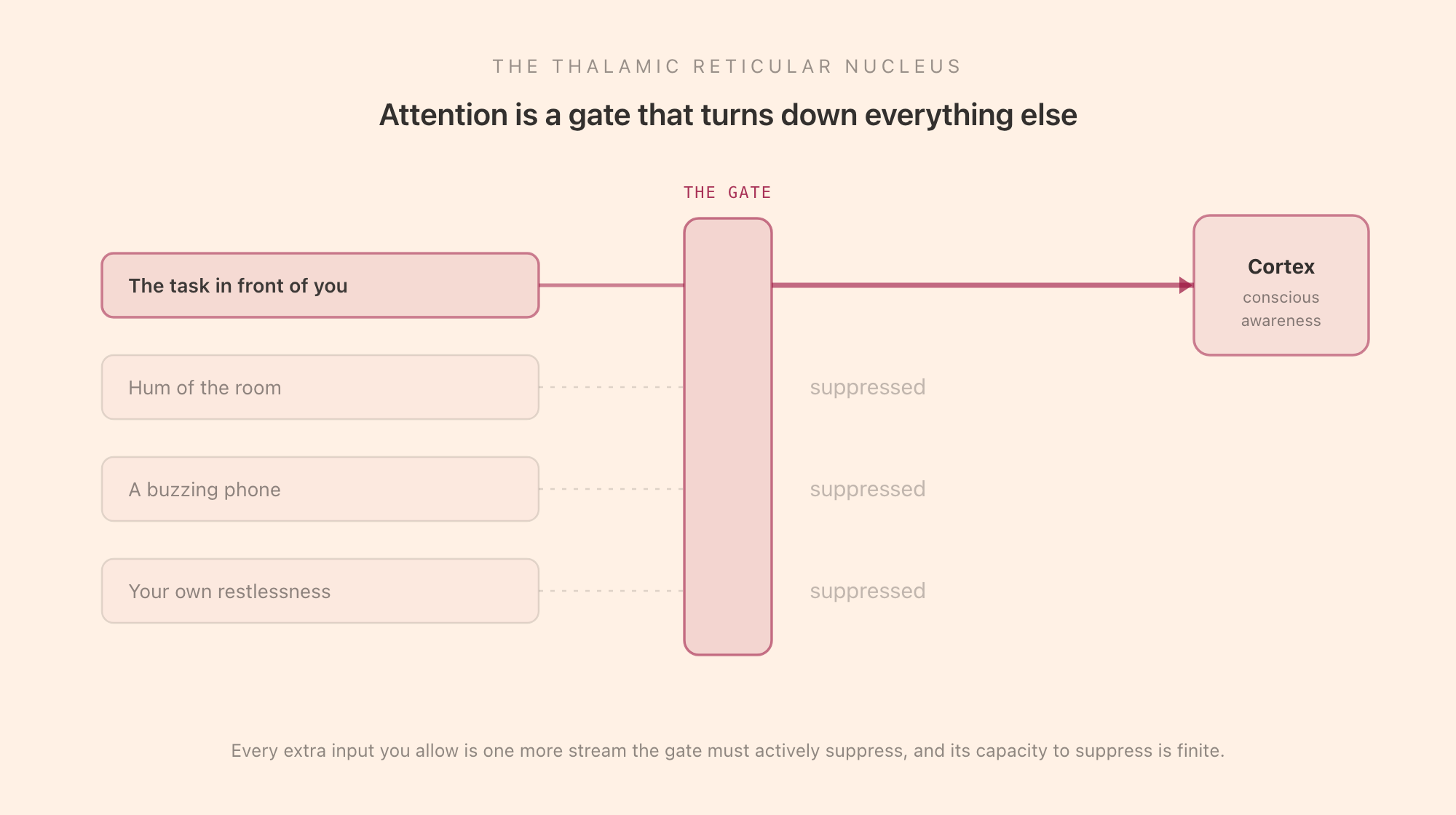
For focus, the key implication is that filtering has a cost. Suppressing an input is not free; the gate has to actively hold each irrelevant stream down, and that capacity is finite. Every additional thing in your environment that could plausibly matter, a phone in view, a notification badge, a half-heard conversation, is one more stream the RAS must work to suppress. Reduce the number of things competing for the gate and you free up the very capacity that focus depends on.
Function Two: The Dial That Sets Your Alertness
The RAS's second job is to set the overall level of arousal in the brain, the dial that runs from deep sleep at one end through drowsiness, calm alertness, and up to anxious over-arousal at the other. It does this largely through the brainstem nuclei that flood the cortex with neuromodulators, above all noradrenaline from the locus coeruleus. When the RAS ramps up its output, the cortex becomes more active and you feel more awake; when it quiets, you drift toward sleep. Damage to the ascending RAS can cause coma precisely because it is the system that keeps the cortex switched on.
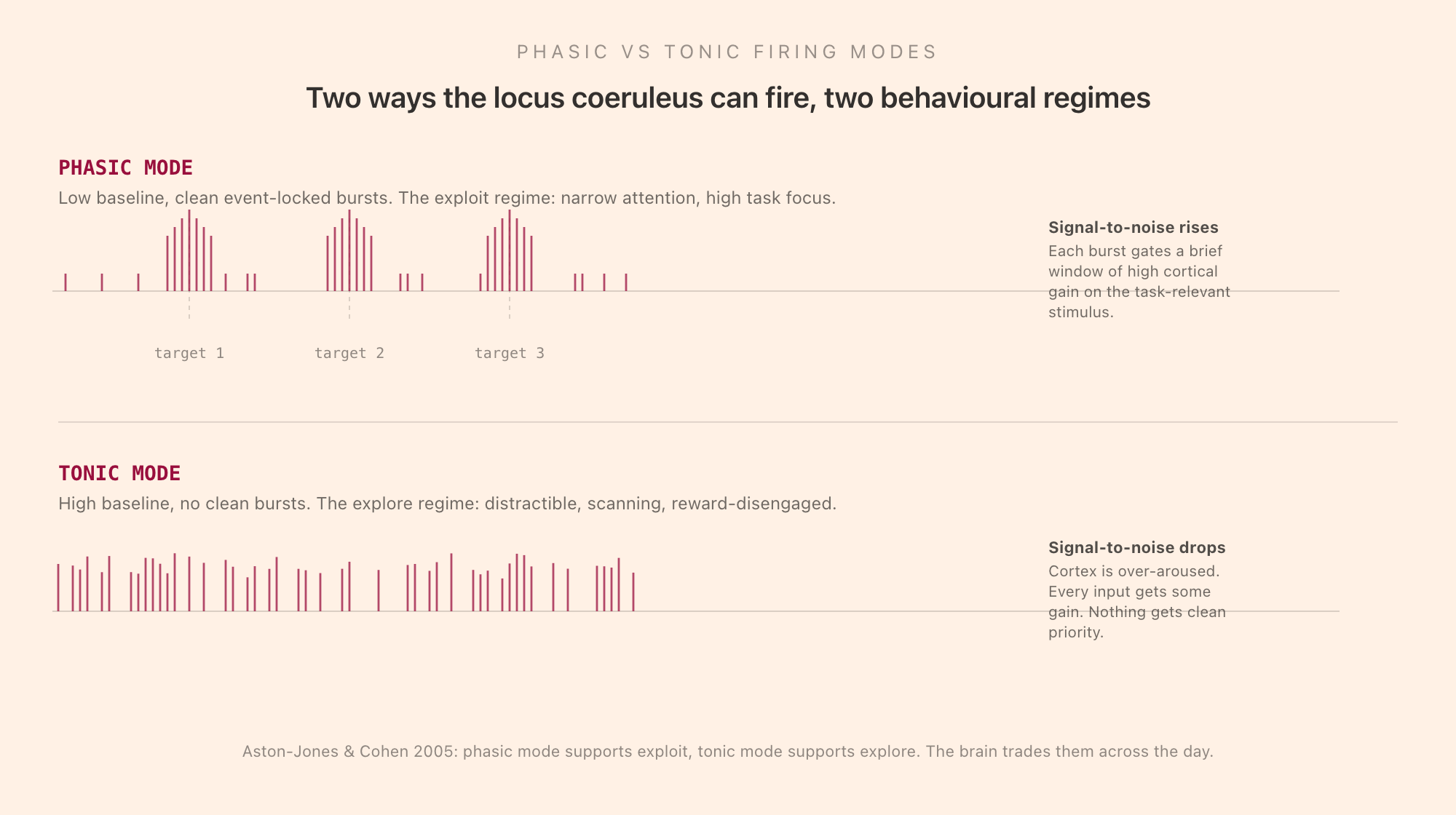
The arousal dial is not simply "more is better." The relationship between arousal and performance is an inverted U: too little and you are drowsy and inattentive, too much and you are anxious and scattered, with a sweet spot of calm, alert focus in the middle. The locus coeruleus, a key RAS nucleus, illustrates this beautifully. In its phasic mode it fires in clean, event-locked bursts that sharpen attention on the task at hand, the noradrenaline system's "exploit" setting. In its tonic mode it fires at a high, steady baseline that leaves you restless, scanning, and easily pulled off-task. The difference between focused work and distractible fidgeting is, in part, which mode your RAS has settled into. This is also why the thalamus and RAS are so often discussed together: the thalamus relays and gates the sensory traffic, and the RAS sets the arousal level that determines how sharply that gating is done.
The RAS and the Myth of "Just Focus Harder"
Put the two functions together and a familiar frustration starts to make sense. When you cannot concentrate, it is rarely because you lack willpower. It is usually because the gate is in the wrong state: either your arousal has drifted off the sweet spot, or your environment is forcing the filter to suppress too many competing inputs at once, or both. Telling yourself to focus harder does not directly change either of those things, which is why it so often fails.
There is a popular self-help version of the RAS that says it is a goal-seeking system you can "program" to notice opportunities, the reason you suddenly see a car everywhere after deciding to buy it. There is a real kernel here: the RAS does bias attention toward what you have tagged as important, which is why priming your goals genuinely helps. But the useful, evidence-based takeaways are more concrete than manifestation. The RAS preferentially lets through what is salient to you, so making your current task the salient thing, and removing competing sources of salience, tilts the gate in your favour.
Working With Your Reticular Activating System
If the RAS is the gate all focus passes through, the practical question is how to keep it in the state that lets good work through. A few principles follow directly from the biology.
Cut the number of competing inputs. Because the filter has to actively suppress every irrelevant stream, and that capacity is finite, the highest-leverage move is to reduce what it has to suppress. A clear desk, a phone in another room, notifications off: each one is a stream the gate no longer has to fight, freeing capacity for the task.
Manage your arousal toward the middle of the dial. If you are drowsy, the fix is genuine arousal: movement, daylight, a brief walk, caffeine timed well. If you are over-aroused and scattered, the fix is the opposite: slow breathing, which directly lowers the stress-driven arousal that pushes the locus coeruleus into its restless tonic mode. Focus lives in the calm-alert middle, not at either extreme.
Prime the gate with a clear goal. Because the RAS biases attention toward what you have flagged as important, starting a work block by explicitly naming the one thing you are doing gives the filter a target. A vague intention gives it nothing to prioritise; a specific one tilts the gate.
Give it a stable input to settle on. An unpredictable soundscape keeps triggering the RAS's novelty and threat detection, each unexpected sound a candidate for passing the gate. A steady, predictable background does the opposite: it gives the system a constant, non-alerting input, masks the disruptions that would otherwise grab the gate, and helps hold arousal in the workable middle.
Where Focus Music Fits
The RAS is exactly why the right sound environment does more than mask noise. Concentration depends on a gate that is neither flooded with competing inputs nor stuck in a restless, over-aroused state, and an unpredictable environment attacks it on both fronts: every sudden sound is a fresh candidate for your attention, and the resulting startle nudges arousal the wrong way. A steady, engineered soundscape gives the reticular activating system a constant, non-threatening signal to settle on, masks the interruptions that would otherwise force the gate open, and helps hold the arousal dial in the calm-alert band where deep work happens.
That is what Tomatoes is built to do. It generates focus music designed to give your RAS one stable thing to lock onto, so the gate stops fighting a dozen distractions and your attention can stay where you put it. It is a one-time $39 app, no subscriptions and no account. If you want to keep the gate in the state that lets good work through, get Tomatoes here.
The reticular activating system is the quiet doorkeeper of your entire conscious life, deciding every second what is worth your attention and how alert you should be to meet it. You cannot operate it by hand, but you can shape the conditions it responds to. Lower the competing inputs, steer your arousal toward the middle, name the task, and give the gate something steady to rest on, and the doorkeeper starts letting the right things through.