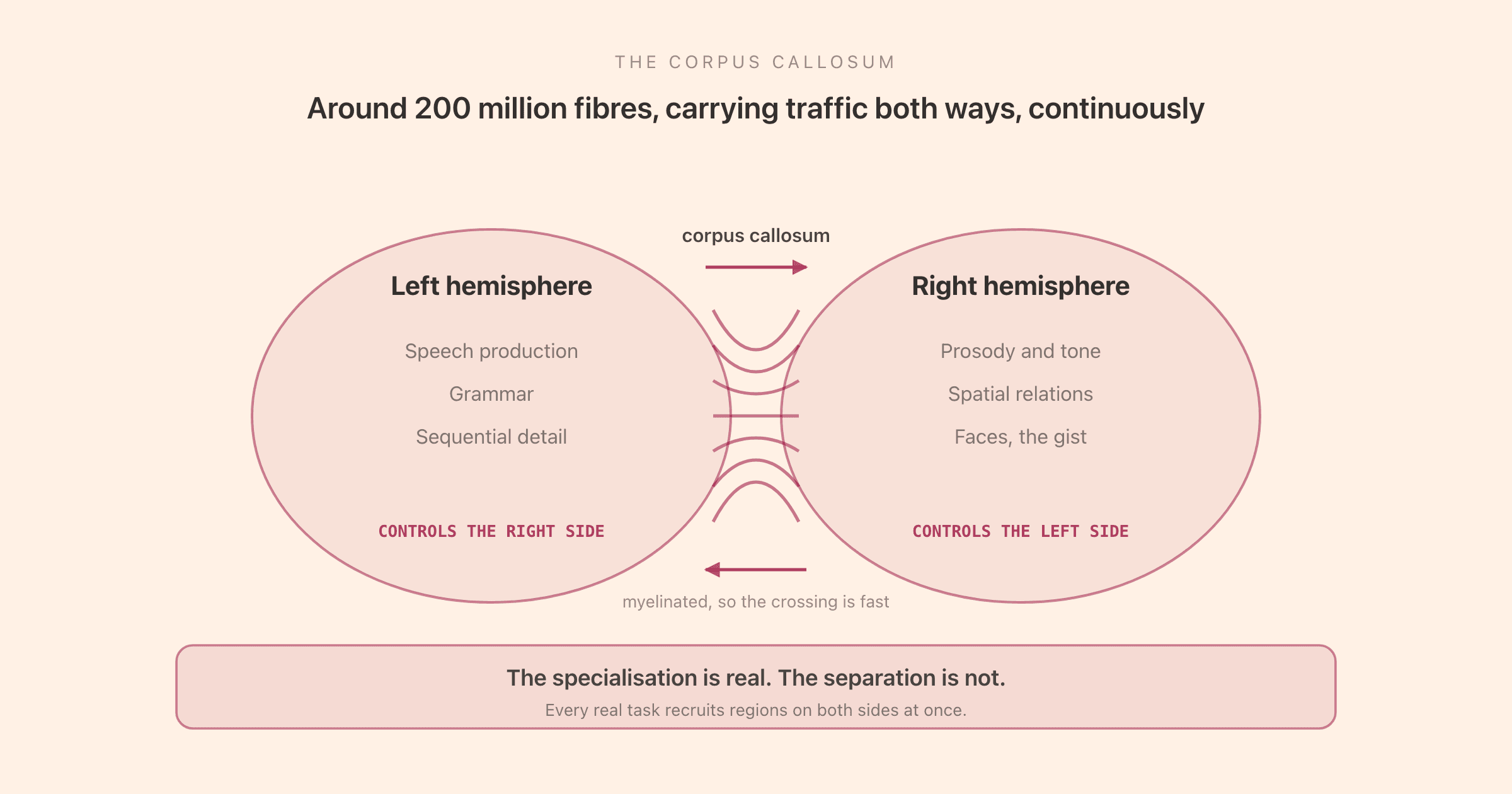
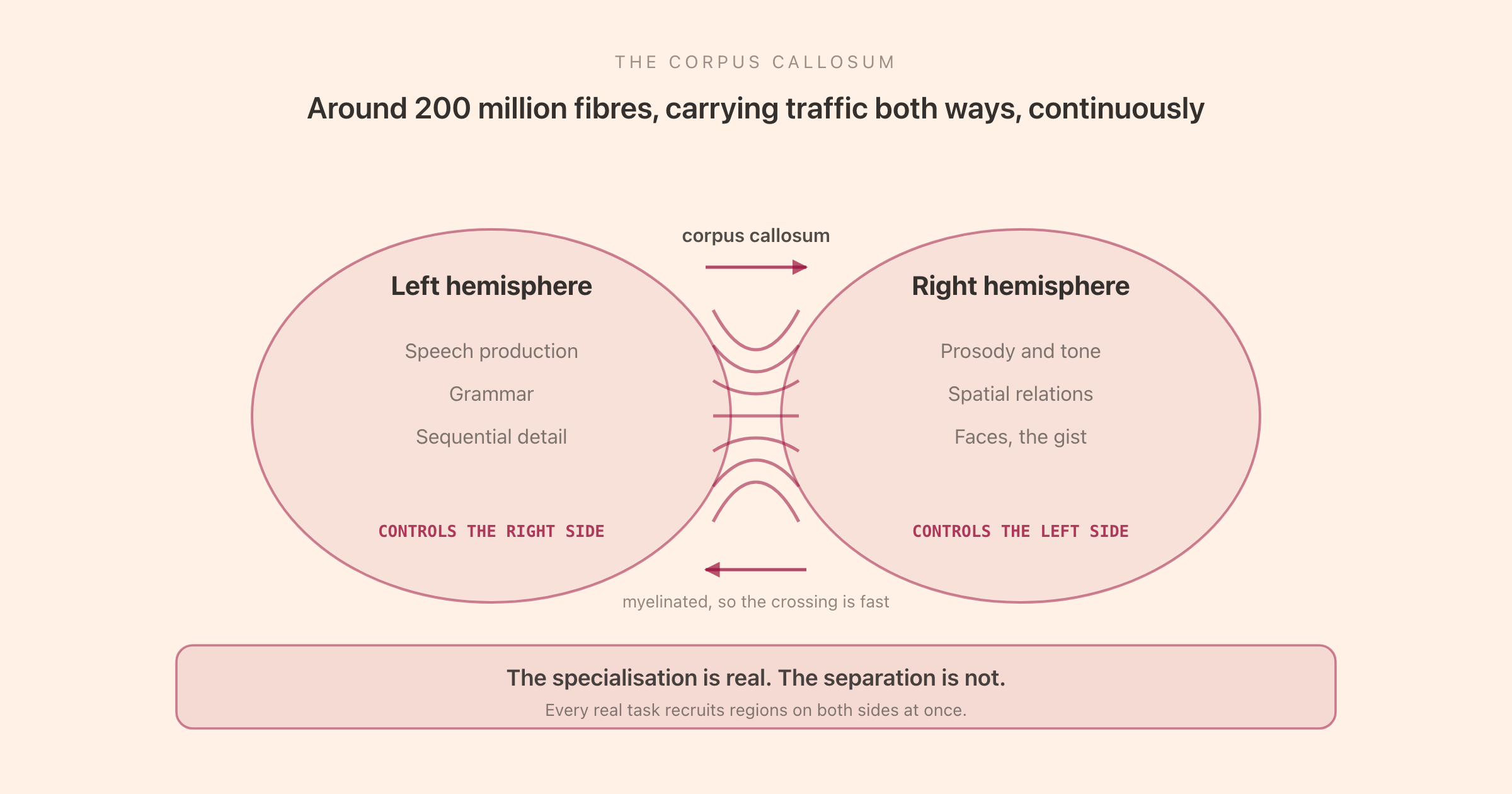
The corpus callosum is the largest bundle of nerve fibres in your brain: roughly 200 million axons running between the left and right hemispheres, carrying traffic in both directions continuously. It is the reason your brain, which is visibly built as two halves, behaves as one thing. It is also the structure behind the most famous experiments in neuroscience and the most persistent myth in popular psychology, because the discovery that the hemispheres are specialised was rapidly mangled into the idea that people are "left-brained" or "right-brained", which is not true and never was.
This article covers what the corpus callosum is, what it does, what the split-brain research actually found, why the left-brain and right-brain personality story is wrong (and what the real story is), what happens when the connection is missing, and why integration between hemispheres is relevant to concentration.
What Is the Corpus Callosum?
The corpus callosum is a broad, curved band of white matter sitting deep between the two cerebral hemispheres, connecting corresponding regions on each side. Its name is Latin for "tough body", which is what it feels like to the touch. In cross-section it has recognisable parts, from the front: the rostrum and genu (the curved front end), the body running back along the midline, and the splenium (the thicker rear end).
White matter means the fibres are wrapped in myelin, the fatty insulation that dramatically speeds up signal transmission. That matters here more than almost anywhere: the whole purpose of this structure is to move information between hemispheres fast enough that the two halves function as one system rather than two systems in conversation.
The layout is orderly rather than random. Fibres connecting the front of each hemisphere pass through the front of the corpus callosum, and fibres connecting the visual areas at the back pass through the splenium. It is less a cable and more a mapped bridge, where the crossing point corresponds to what is being crossed.
What It Actually Does
Three things.
It integrates. Each hemisphere receives sensory information mostly from the opposite side of the body, and controls the opposite side too. The corpus callosum is what allows a single unified experience of a world you are sensing on both sides at once, and coordinated movement using both hands.
It shares specialised processing. Some abilities are genuinely concentrated on one side. In most people, the main language production and grammar systems sit in the left hemisphere; certain aspects of spatial processing and face recognition lean right. Because these specialised systems are connected, the whole brain gets to use them. Language is available to you when you are thinking about a visual scene, and spatial processing is available when you are reading a map and describing it.
It coordinates and, at times, inhibits. The traffic is not only cooperative. Part of what the connection does is allow one hemisphere to suppress or moderate activity in the other, which helps produce a single decision and a single action rather than two competing ones.
What the Hemispheres Really Do Differently
Before dismantling the myth it is worth being precise about the truth underneath it, because lateralisation is real and genuinely interesting.
The clearest case is language. In the large majority of right-handed people, and most left-handed people too, the core machinery for producing speech and handling grammar sits in the left hemisphere. This was established long before the split-brain work, from patients who lost speech after left-hemisphere strokes. The right hemisphere is not silent on language, though: it contributes to prosody (the rhythm and intonation that carry tone), to understanding metaphor and humour, and to the broader gist of a story. Damage on the right can leave someone speaking fluently and correctly while missing the point of a joke.
Spatial and attentional processing leans the other way. The right hemisphere is more involved in judging spatial relationships, recognising faces, and maintaining attention across the whole of space. One of the more striking consequences is hemispatial neglect, which follows right-hemisphere damage: a patient may ignore the entire left side of their world, eating from one half of a plate and shaving one side of their face, not because they cannot see it but because it has stopped being somewhere their attention goes.
Motor control is the simplest case: each hemisphere controls the opposite side of the body, which is why a stroke on one side produces weakness on the other.
None of these specialisations are absolute, and this is the crucial point. They are tendencies in how the work is distributed, not walls, and they exist within a system whose parts are in constant communication. The specialisation is real; the separation is not.
The Split-Brain Experiments
In the 1940s onwards, some patients with severe, otherwise untreatable epilepsy were treated by cutting the corpus callosum, to stop seizures spreading from one hemisphere to the other. The operation often worked. What made these patients extraordinary scientifically was how normal they seemed afterwards: in ordinary conversation and daily life, most people would notice nothing at all.
Then Roger Sperry and Michael Gazzaniga designed experiments to present information to only one hemisphere at a time, using the fact that each half of the visual field is processed by the opposite hemisphere. The results were remarkable. Show a word to the left hemisphere and the patient could read it aloud. Show the same word only to the right hemisphere and the patient would say they had seen nothing, while their left hand, controlled by the right hemisphere, could pick out the matching object from a set of hidden items.
The most philosophically striking finding came from what Gazzaniga called the interpreter. When the right hemisphere was instructed to do something, and the left hemisphere (which does the talking) was asked why, patients did not say "I have no idea". They produced a confident, plausible explanation that was simply invented. The talking half of the brain narrates the behaviour of the whole person, and when it lacks the real reason it constructs one without any sense of doing so. Sperry received a Nobel Prize in 1981 for this work, and the interpreter finding remains one of the more unsettling things neuroscience has established about self-knowledge.
Why "Left-Brained" and "Right-Brained" Is Wrong
The split-brain work reached the public as a much simpler story: the left brain is logical and analytical, the right brain is creative and intuitive, and people are dominated by one or the other. It is memorable, it feels true, and it is wrong.
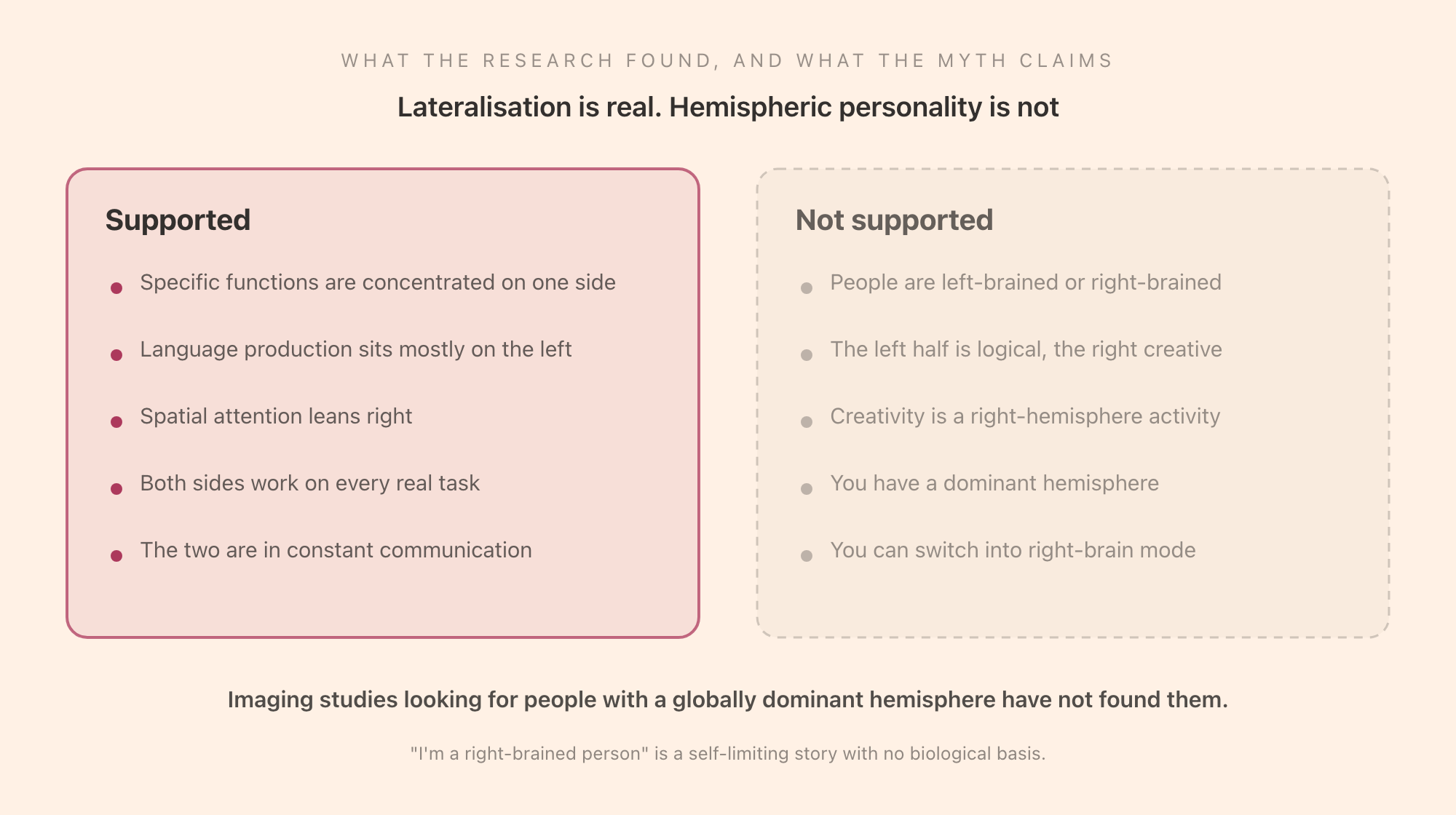
Two things are being conflated. Lateralisation is real: specific functions genuinely are concentrated more on one side, most clearly language. Hemispheric dominance as a personality type is not. Large brain-imaging studies looking for individuals with a generally stronger left or right hemisphere have not found them; people show the expected local specialisations, and no global tilt to one side.
The deeper problem with the myth is that it gets the architecture backwards. Any real task, doing arithmetic, having a conversation, drawing, playing music, recruits regions across both hemispheres working together. Creativity in particular is not a right-hemisphere activity; it draws on memory, language, evaluation, and control systems spread across the whole brain. The corpus callosum exists precisely because the brain's design is integration, not division of labour between two personalities.
There is a practical cost to the myth, too. "I'm a right-brained person, I'm not analytical" is a self-limiting story with no biological basis. There is no dominant hemisphere to be stuck with.
When the Bridge Is Missing
Some people are born without a corpus callosum, a condition called agenesis of the corpus callosum. Outcomes vary widely: some people have significant developmental difficulties, while others have near-typical intelligence and function, with subtler differences in processing complex or novel information and in some social and language nuances.
That partial resilience is a striking demonstration of neuroplasticity. When the main bridge is absent from birth, smaller connections between the hemispheres are used more heavily and the developing brain reorganises around the gap. It is a much better outcome than cutting the connection in adulthood, which tells you something general: the developing brain adapts to a missing structure far better than a mature brain adapts to losing one.
The corpus callosum also changes across a normal lifespan. It continues myelinating well into early adulthood, one of the later parts of the brain to finish maturing, and it thins gradually in later life.
Integration, Attention, and Focus
The corpus callosum is not an attention structure, and there is no technique that trains it directly. What it illustrates is a principle that runs through everything about concentration: cognitive work is a whole-brain activity, and performance depends on communication between specialised systems rather than on any one of them.
This is why the useful mental model for focus is not "activate the right part of your brain" but "let the parts communicate without interruption". Sustained attention on anything demanding requires several systems, language, spatial reasoning, memory, motor planning, executive function, to stay coordinated over time. Every interruption forces that coordination to be rebuilt, which is the real cost of task-switching and the reason multitasking performs so badly.
It also reframes the popular hacks. There is no left-brain or right-brain mode to switch into, no music that activates your creative hemisphere, no exercise that syncs your halves. What genuinely supports whole-brain integration is unglamorous and familiar: sleep, which consolidates and maintains white matter; aerobic exercise, which supports white-matter health; sustained practice, which myelinates the pathways you use; and uninterrupted time, which lets coordinated work actually happen.
Where Focus Music Fits
If the honest picture is that good cognitive work depends on many systems staying coordinated over time, then the most valuable thing you can give yourself is an uninterrupted stretch in which that coordination can hold. Interruptions are expensive not because they cost you a minute but because they break a state that took a while to assemble.
That is what Tomatoes is designed to protect: focus music that gives you a steady, non-distracting sound environment, so a working session stays a session rather than becoming a series of restarts. It is free to try for 3 days, then from $4.99 a week, $29.99 a year, or $39 for lifetime access. If you want longer stretches of coordinated work, try Tomatoes free for 3 days.
The corpus callosum is a satisfying structure to know about because it corrects a myth by explaining the very thing the myth got wrong. Yes, the hemispheres are specialised. No, that does not make you one kind of thinker or another, because 200 million fibres are carrying traffic between them continuously, and every real task you perform uses both sides at once. The brain's defining feature is not that it is divided. It is that it is connected, and connected fast.