Myelin is the reason a skill you have practised thousands of times feels effortless while the same task felt impossibly clumsy the first week you tried it. It is a fatty, insulating sheath that your brain wraps around the nerve fibres you use most, and it physically speeds up the signals travelling along them, by as much as a hundredfold. When people say practice rewires the brain, myelin is a large part of what they are describing. It is the biological record of what you have repeated, laid down in white matter, and it is one of the most concrete answers neuroscience has to the question of how skill actually forms.
This article explains what myelin is, how it makes neural signals so much faster, and the part that matters most for anyone trying to learn or focus: how myelin is built by activity, so that the circuits you fire repeatedly get insulated and the ones you neglect do not. Understanding myelination reframes practice from a vague act of willpower into a physical process you are literally constructing, one focused repetition at a time.
What Is Myelin?
Myelin is a fatty substance that forms an insulating layer around the axons of neurons, the long fibres that carry electrical signals from one nerve cell to the next. If you picture a neuron as an electrical wire, myelin is the insulation wrapped around it. It is produced by specialised support cells: in the brain and spinal cord by cells called oligodendrocytes, and in the rest of the body by Schwann cells. A single oligodendrocyte reaches out and wraps segments of many different axons, coiling layers of its own membrane around each one like tape around a cable.
Myelin is what gives the brain's "white matter" its colour and its name. The grey matter is mostly the cell bodies where computation happens; the white matter is the vast network of myelinated fibres connecting those regions together, and its pale colour comes directly from the fatty myelin. Roughly half of the human brain is white matter, which is a clue to how important this insulation is. A brain is not just its neurons; it is the speed and reliability of the connections between them, and that is largely a story about myelin.
The importance of myelin shows most starkly when it fails. In demyelinating diseases such as multiple sclerosis, the immune system attacks and strips the myelin from axons in the central nervous system. The nerves are still there, but without their insulation the signals slow, scatter, and fail, producing the wide range of neurological symptoms the disease is known for. Myelin is not a minor accessory to the neuron. It is essential to the nervous system working at all.
How Myelin Makes Signals Faster
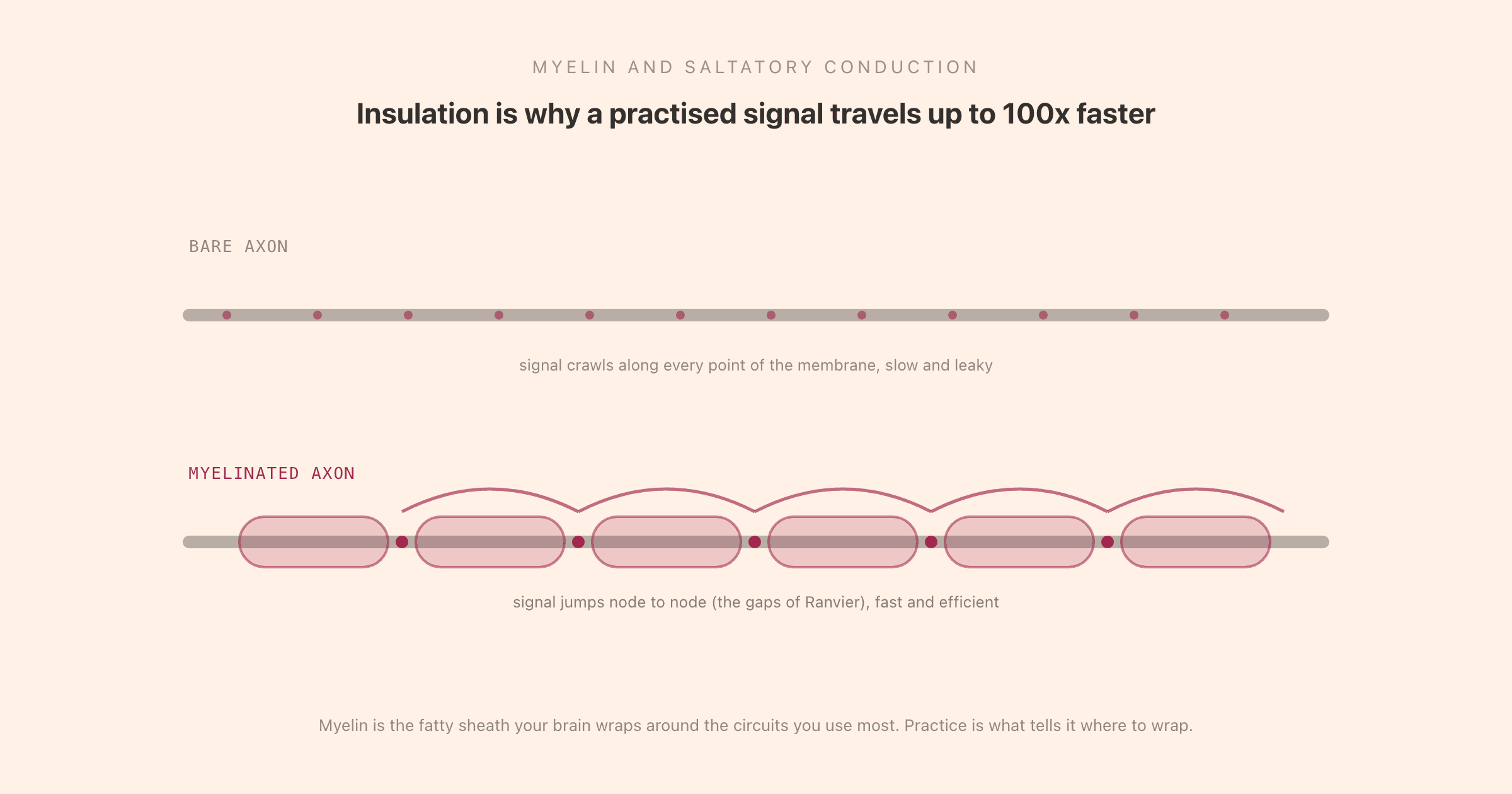
To see why myelin matters for learning, you have to understand how it speeds a signal up, because the mechanism is genuinely elegant. On a bare, unmyelinated axon, the electrical impulse has to regenerate itself continuously along the entire length of the membrane, point by point. Every stretch of membrane has to open its ion channels, pass the charge along, and reset. It works, but it is slow and it leaks energy the whole way.
A myelinated axon is different. The insulating sheath is not continuous; it comes in segments, with tiny bare gaps between them called the nodes of Ranvier. Because myelin insulates the stretches it covers, the electrical signal cannot leak out there, so instead of crawling along every point of the membrane, the impulse effectively jumps from one node to the next, regenerating only at the gaps. This mode of transmission is called saltatory conduction, from the Latin saltare, to leap. The signal leaps down the axon node by node rather than trudging along every inch of it.
The payoff is enormous. Saltatory conduction can make a signal travel up to about a hundred times faster than it would on a comparable bare axon, and it uses far less energy doing so, because only the small nodes have to do the metabolic work of regenerating the impulse. Speed and efficiency both rise at once. For a brain trying to coordinate complex actions across regions in real time, that speed is not a luxury; it is the difference between a movement that is jerky and effortful and one that is smooth and automatic.
Myelin Is Built by Use
Here is the part that turns myelin from a biology-textbook fact into something practical: myelination is not fixed at birth. It responds to activity. The circuits you use get insulated; the ones you do not, largely do not. This is called activity-dependent myelination, and it is one of the most important discoveries in the neuroscience of learning.
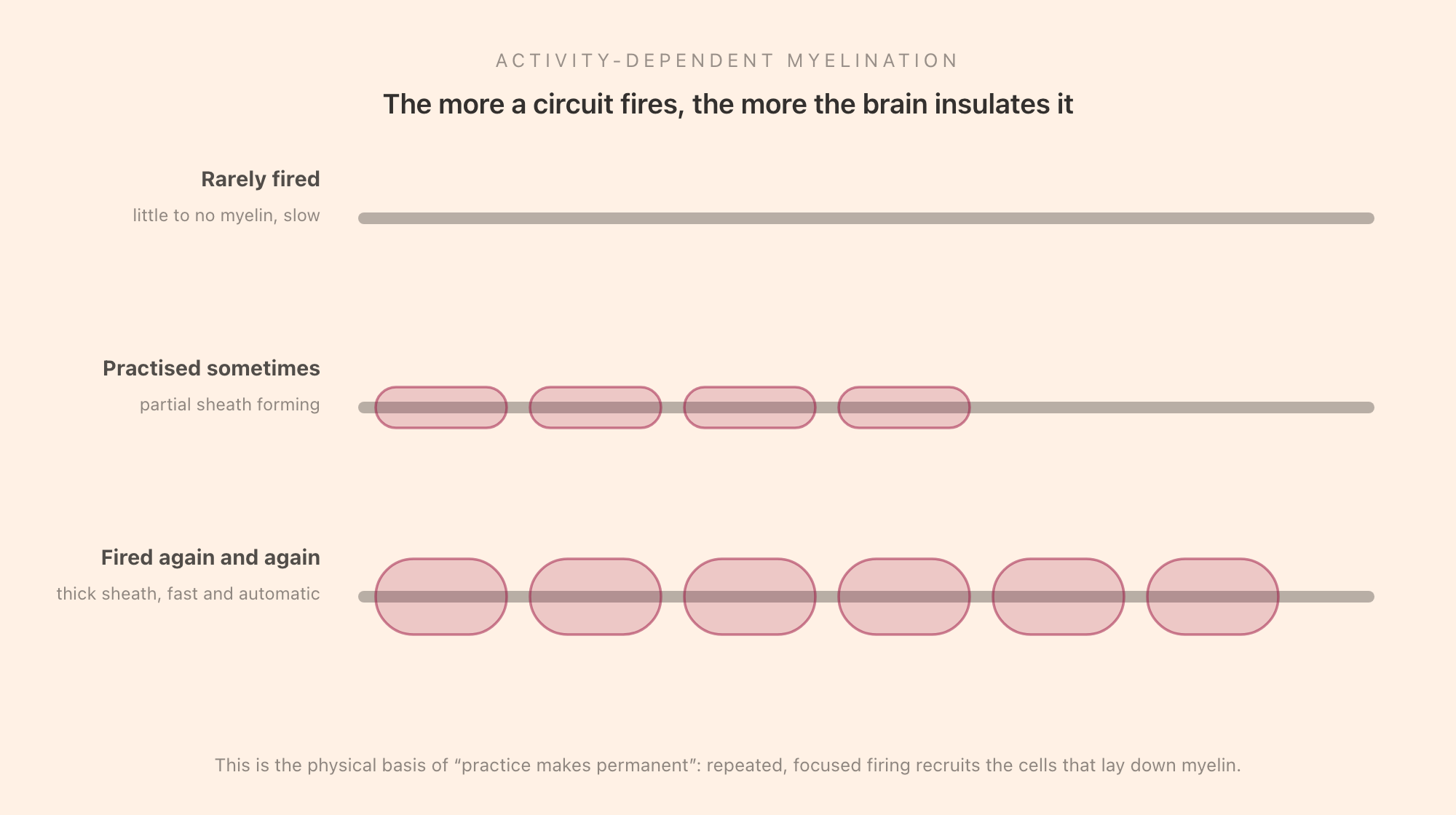
When a neural circuit fires repeatedly, it releases signals that recruit the myelin-forming cells to that active pathway, prompting oligodendrocytes to wrap more myelin around the axons that are doing the work. The more a circuit is used, the more heavily it tends to be myelinated, and the faster and more reliable it becomes. This is the physical basis of the old saying that practice makes permanent. Every time you repeat a skill, you are not just strengthening the connections between neurons, the synaptic changes described in the article on neuroplasticity; you are also, over longer timescales, insulating the pathway so that it runs faster next time.
This is why a difficult skill feels so different after months of practice. Early on, the relevant circuit is poorly myelinated, so the signals are slow and the action demands enormous conscious effort. With repetition, the pathway is progressively insulated, transmission speeds up, timing tightens, and the skill starts to feel automatic. The cerebellum, which fine-tunes so much of our motor and cognitive timing, depends heavily on well-myelinated circuitry for exactly this reason. What we experience as "getting good" at something is, in part, the slow physical construction of myelin around the circuit that does it.
Why This Matters for Focus and Learning
Activity-dependent myelination has a direct and slightly demanding implication: the quality of your practice shapes what gets myelinated. The brain insulates the circuit you actually fire, not the one you meant to fire. Practise a skill sloppily or with divided attention, and you may be myelinating a mediocre version of it. Practise it with full focus and accurate repetition, and you insulate the pathway you actually want to be fast.
A few principles follow from the biology:
Focused repetition is the input. Myelination responds to circuits being fired, clearly and repeatedly. Distracted, half-present practice fires the target circuit less cleanly and mixes in the circuits of whatever pulled your attention away. Deep, undistracted repetition is what most reliably drives insulation of the pathway you care about.
Consistency beats cramming. Building myelin is a biological construction process that unfolds over time, including during rest and sleep, not something completed in a single marathon session. This is the same reason spaced repetition and distributed practice beat cramming for durable learning: short, regular, focused sessions give the slow machinery of myelination repeated chances to lay down another layer.
Automaticity is the goal and the reward. As a circuit myelinates and speeds up, the skill demands less conscious effort, which frees your limited attention for the harder, not-yet-automatic parts of the work. Every skill you myelinate into automaticity is attention you get back.
The uncomfortable corollary is that there is no shortcut. Myelin is built by real, repeated, focused activity, which is why genuine expertise takes the time it takes. But the encouraging version of the same fact is that the process is reliable: put in accurate, focused repetitions and your brain will, physically, build the insulation that makes the skill fast. You are not just memorising; you are wiring.
Where Focus Music Fits
Because myelination responds to focused, accurate repetition, the depth of your attention during practice is not a soft variable, it is the input to the process. The circuit you fire cleanly is the one that gets insulated, so practice done while half-distracted quietly wastes reps, firing the target pathway less precisely and lacing in the circuits of every interruption. Protecting the focus of a practice session is, in a real sense, protecting what your brain chooses to myelinate.
That is where a stable sound environment earns its place. Tomatoes generates focus music designed to hold your attention steady through a block of deep, repeated practice, so the reps you put in are clean and undivided, firing the circuit you actually want to make fast. It is a one-time $39 app, no subscriptions and no account. If you want the hours you spend practising to physically upgrade the right circuit, get Tomatoes here.
Myelin is the quiet, physical bookkeeping of everything you have practised, the brain's way of turning what you repeat into what you can do without thinking. It is slow to build and it demands genuine, focused repetition, but that is also its promise: the skill you want is not a matter of talent alone but of insulation you can construct, one attentive rep at a time. Fire the circuit you want to be fast, fire it cleanly, and fire it again, and your brain will wrap it in the myelin that makes it yours.