Curiosity is the pull towards information you do not yet have. It is the itch that makes you open a tab, ask a follow-up question, or turn a page at midnight when you meant to sleep an hour ago. It is also the single most useful thing you can bring to any piece of learning, because a curious brain does not have to be forced into paying attention: it is already leaning in. And curiosity turns out to be considerably more mechanical than its reputation as a personality trait suggests, which means it can be deliberately provoked, including for material that starts out looking dull.
This article covers what curiosity actually is, the information-gap theory that explains why it comes and goes, the two distinct kinds of curiosity, what the research shows about curiosity and memory (including a genuinely strange finding), why it fades with age and expertise, and how to create it on purpose.
The Information Gap
The most useful account of curiosity comes from the economist George Loewenstein, who in 1994 proposed that curiosity is the feeling produced by a gap between what you know and what you want to know. On this view curiosity is not a pleasant state of interest but a mild aversive one, closer to an itch than a glow: a deprivation you are motivated to remove.
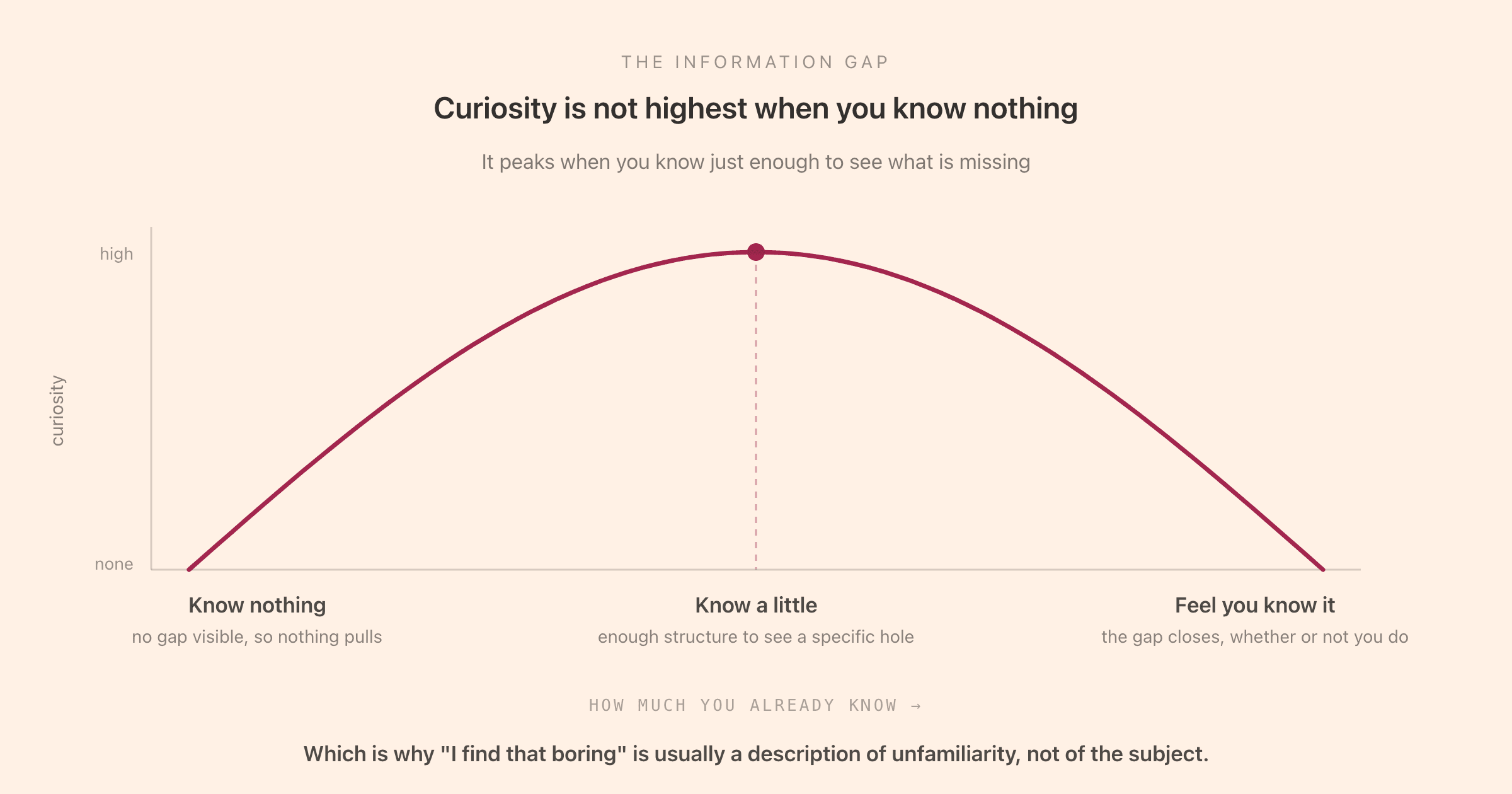
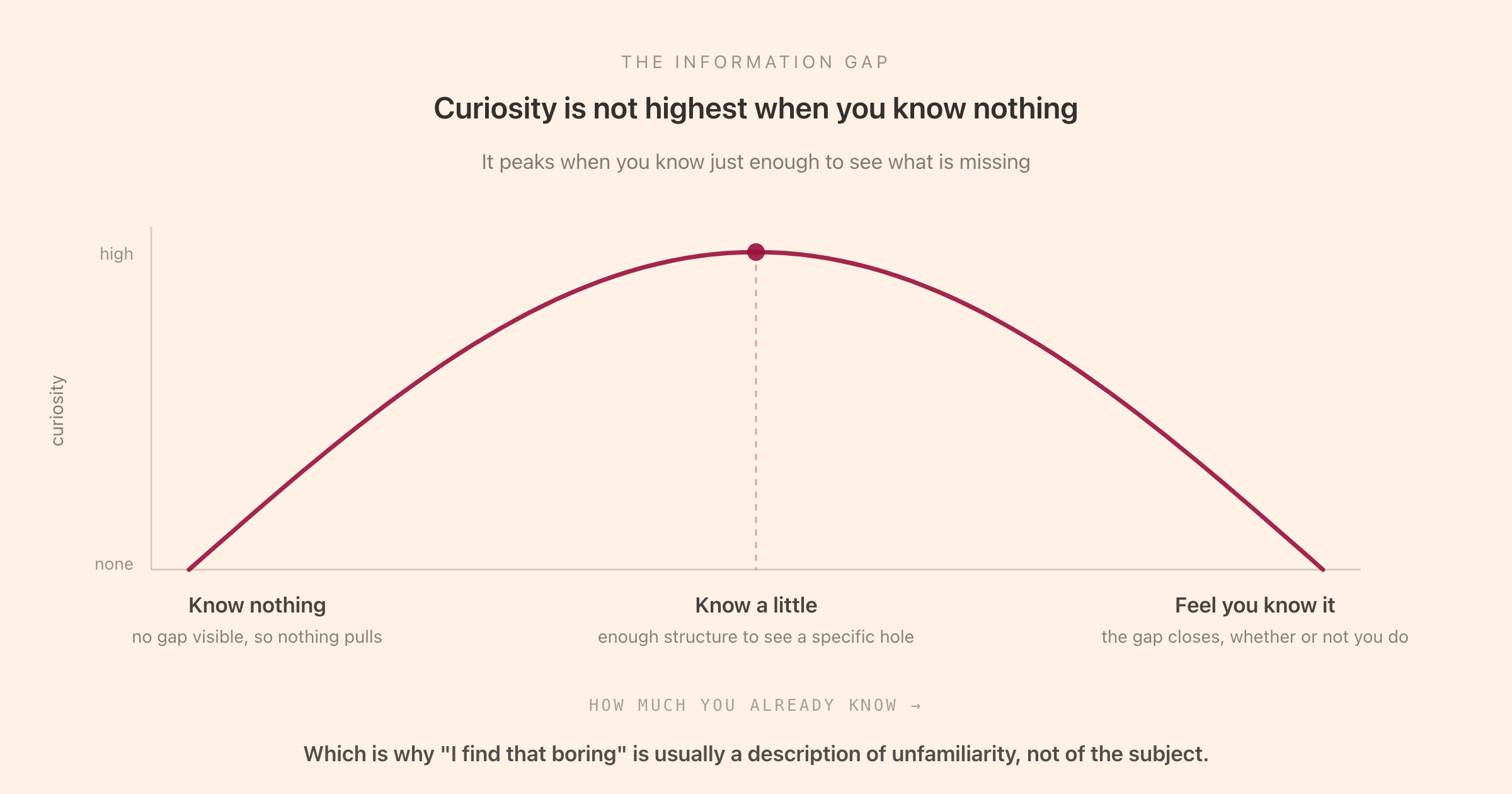
That framing explains the shape of curiosity, which is the part most people find counterintuitive. Curiosity is not highest when you know nothing. It follows an inverted U.
Know nothing about a subject and you feel no gap, because you cannot see what is missing. Nobody is curious about a field they have never heard of, which is why "I find that boring" is so often a description of unfamiliarity rather than of the subject.
Know a little, and curiosity peaks. You have enough structure to perceive a specific hole, and the hole is what pulls. This is why a good introduction to almost anything is more gripping than either a technical paper or nothing at all.
Feel you already know it, and curiosity collapses, because the gap has closed, whether or not you actually do know it.
The practical consequence is immediate. If something bores you, the fix is often not more willpower but a small amount of preliminary knowledge, just enough to see what you are missing. Curiosity is manufacturable, and the raw material is a little context.
Two Kinds of Curiosity
Researchers generally distinguish two flavours, and they behave differently.
Diversive curiosity is the restless seeking of novelty in general: the pull towards anything new. It is what makes you scroll, and it is the state most modern media is designed to exploit. It feels like curiosity and produces very little.
Epistemic curiosity is the desire to understand a specific thing: to close a particular gap, to actually know how the thing works. It is effortful, it sustains over time, and it is where learning happens.
The distinction matters because the two feel similar from the inside and lead to opposite outcomes. An evening of diversive curiosity leaves you having consumed a great deal and learned nothing. An hour of epistemic curiosity leaves you understanding one thing you did not before. This maps neatly onto the mechanism described in the guide to boredom: a phone offers infinite novelty, which satisfies diversive curiosity endlessly and therefore never resolves anything, while an actual question stays open until you answer it.
Curiosity Makes Things Stick
The link to memory is well supported, and one of its findings is genuinely odd.
The clearest work here comes from a study by Matthias Gruber and colleagues, published in Neuron in 2014. Participants rated their curiosity about a series of trivia questions, then saw the answers while being scanned. Unsurprisingly, they remembered the answers to questions they had been curious about far better than answers they had not cared about.
The strange part is what else they remembered. During the waiting period between question and answer, an unrelated photograph of a face was shown. Participants were better at remembering the faces that had appeared while they were in a high-curiosity state, even though the faces had nothing to do with the questions. Curiosity did not just improve memory for the thing they were curious about; it improved memory for whatever happened to be around at the time.
The imaging suggested why. High curiosity was associated with activity in the brain's reward circuitry, involving dopamine pathways, and with increased activity in and connectivity with the hippocampus, the structure that encodes new declarative memories. Curiosity appears to put the brain into a state that is simply better at learning, and that state does not discriminate about what it encodes.
The practical reading is encouraging: provoking curiosity at the start of a study session may improve how well you absorb the whole session, not only the interesting part.
Why It Fades
Children ask an exhausting number of questions and adults mostly do not, and it is worth being clear about why, because the usual explanation is wrong. Curiosity does not simply wear out.
The gap closes, or seems to. Expertise is the main culprit. The more you know about something, the fewer visible holes remain, and the feeling of already knowing suppresses curiosity even where real gaps exist. This is why experts can be less curious about their own field than an interested amateur.
Asking gets socially expensive. In school and at work, questions can read as not knowing something you are expected to know. A great deal of adult incuriosity is really the management of how you appear.
Answers became frictionless. When any question can be resolved in four seconds, the gap never has time to build, and a gap that never builds never generates the pull. There is something to be said for sitting with a question for an hour before looking it up.
Novelty gets consumed rather than pursued. Diversive curiosity is constantly satisfied and epistemic curiosity is rarely started, which feels like being curious all day while learning nothing.
How to Provoke It Deliberately
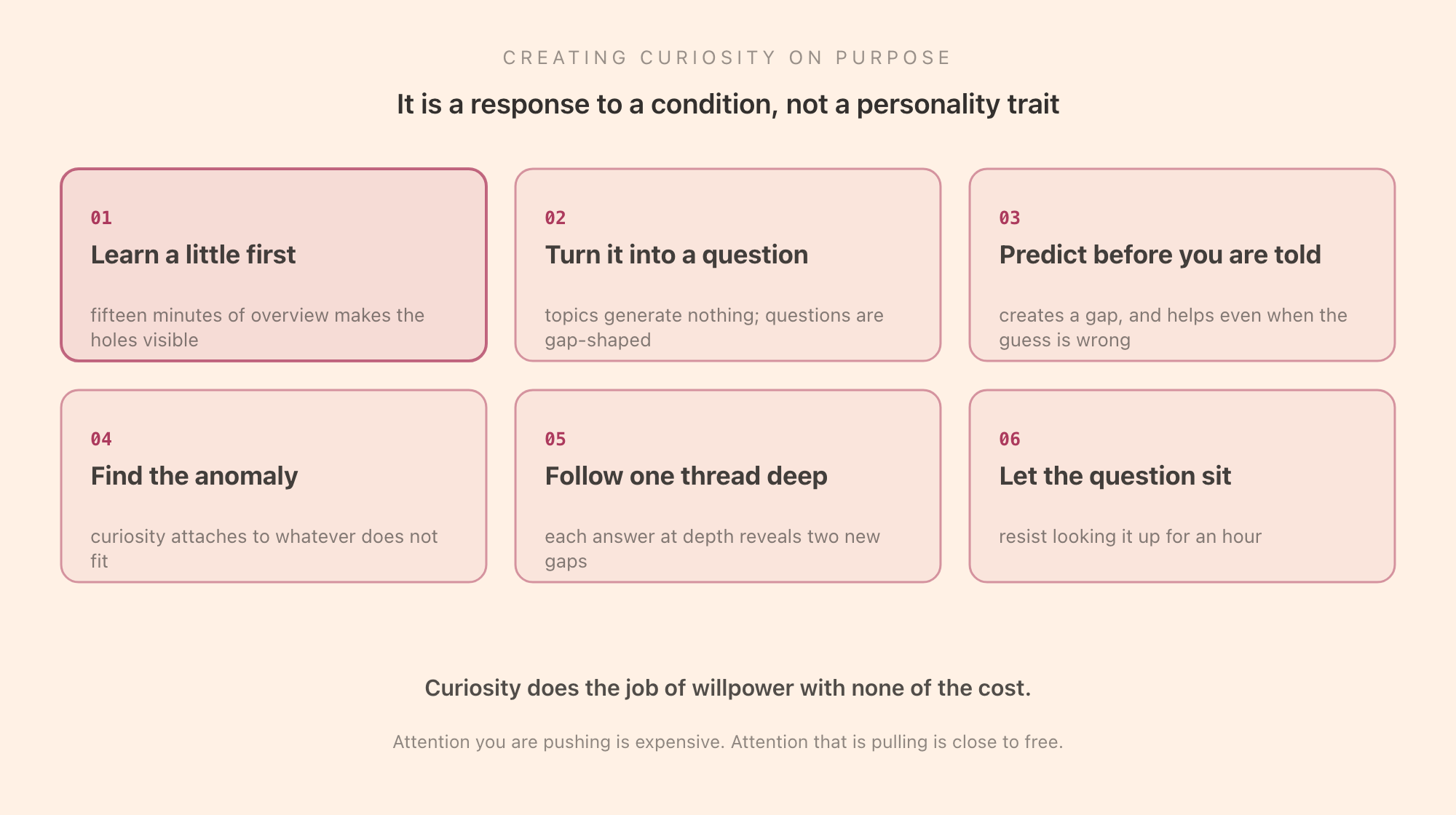
Learn a little first. The single most effective move, straight out of the information gap. Fifteen minutes of overview turns an opaque subject into one with visible holes. Most things are boring only from the outside.
Turn the topic into a question. "Read chapter four" generates nothing. "Why did this fail when the obvious approach should have worked?" creates a gap you can feel. Questions are curiosity-shaped; topics are not.
Predict before you are told. Guessing the answer before reading it creates a gap and, separately, improves retention even when the guess is wrong. It is one of the cheapest study interventions there is.
Look for the anomaly. Curiosity attaches to things that do not fit. When something surprises you or contradicts what you expected, that is the thread worth pulling, and noticing surprise is a skill.
Follow one thread properly. Depth generates more curiosity than breadth, because each answer at depth reveals two new gaps, while skimming reveals none.
Let the question sit. Resist looking it up immediately. Letting a gap stay open for a while makes both the pursuit and the eventual answer more memorable.
Ask the question out loud. In a group, the person who admits to not knowing something usually discovers that most of the room did not know it either.
Curiosity and Focus
Curiosity is the cheapest attention there is. Concentration is normally a matter of effortful top-down control, holding yourself on a task against competing pulls, and that control is limited and tiring. Curiosity replaces it: when you genuinely want to know something, attention is not being spent, it is being drawn.
That is why the same person can struggle to read four pages of an assigned text and then lose two hours to something they got interested in. It is not a discipline difference, it is the difference between attention you are pushing and attention that is pulling, and the second is close to free.
The practical implication is that finding an angle into a task is a legitimate and often faster route to focus than trying harder at it. If the material is genuinely dull, look for the smallest genuine question inside it, or for the part that surprises you. Curiosity is doing the same job as willpower with none of the cost, which makes it worth a few minutes of setup before a difficult session rather than being treated as a mood you either happen to be in or not.
Where Focus Music Fits
There is a specific failure this all points at. Curiosity is fragile at the start: the gap you have just noticed is small, and any interruption closes it, because attention snaps to whatever interrupted and the question quietly evaporates. Getting from mild interest to genuine absorption takes an uninterrupted stretch, and the first ten minutes are the vulnerable ones.
That is what Tomatoes is built to protect: focus music that gives you a steady, unchanging sound environment, so a session that starts with a question has the chance to become an hour of following it. It is free to try for 3 days, then from $4.99 a week, $29.99 a year, or $39 for lifetime access. If you want more sessions that pull rather than push, try Tomatoes free for 3 days.
Curiosity is worth understanding precisely because it is not the fixed personality trait it is usually described as. It is a response to a specific condition, a visible gap between what you know and what you want to know, and that condition can be created deliberately. Learn a little to see the hole, turn the topic into a question, guess before you are told, chase the thing that surprised you, and give the question time to sit. Do that and attention stops being something you have to spend and becomes something the material takes from you, which is both more effective and considerably more enjoyable.