The limbic system is the part of your brain that decides what matters before you have consciously decided anything at all. It is the emotional core, a set of deep structures that tag the world with feeling, drive your motivation, lay down your memories, and trigger the stress response, all of it running underneath the slower, deliberate thinking you experience as "you". Understanding the limbic system matters for focus because almost every failure to concentrate is, at bottom, the emotional brain winning a contest it was never supposed to win. The pull to check your phone, the dread that makes you avoid a hard task, the spike of anxiety that scatters your attention: that is the limbic system asserting itself over the part of the brain that was trying to work.
This article explains what the limbic system is, the main structures it contains and what each one does, and the single most important dynamic for anyone who cares about deep work: the constant tug-of-war between the limbic system and the prefrontal cortex. Get that relationship right and focus becomes far less mysterious, because you stop treating concentration as a matter of willpower and start treating it as a balance of power between two brain systems.
What Is the Limbic System?
The limbic system is not a single organ but a network of interconnected structures sitting deep in the brain, roughly between the brainstem below and the cortex above. The term was popularised in the mid-twentieth century to describe a ring of structures on the inner border of the cortex (limbus is Latin for border), and while neuroscientists now argue about exactly which structures belong to it, the functional idea has held up well: this is the brain's system for emotion, motivation, memory, and the regulation of basic drives.
It helps to think of the brain in three rough functional layers. The brainstem handles the automatic machinery of staying alive: breathing, heart rate, arousal. The cortex, especially the prefrontal cortex, handles deliberate thought: planning, reasoning, holding a goal in mind. The limbic system sits between them, and its job is to assign value. It answers questions the other layers do not: Is this good or bad? Safe or dangerous? Worth approaching or worth avoiding? Those judgments arrive fast, often before conscious awareness, and they colour everything you subsequently think and do.
That speed is the point. The limbic system evolved to keep an animal alive in a world where hesitation was fatal, so it is built to react first and rationalise later. Most of the time this is invaluable. The trouble for a modern knowledge worker is that the same fast, emotional, reactive system treats a buzzing phone or a stressful email with some of the same machinery it would use for a genuine threat.
The Parts of the Limbic System
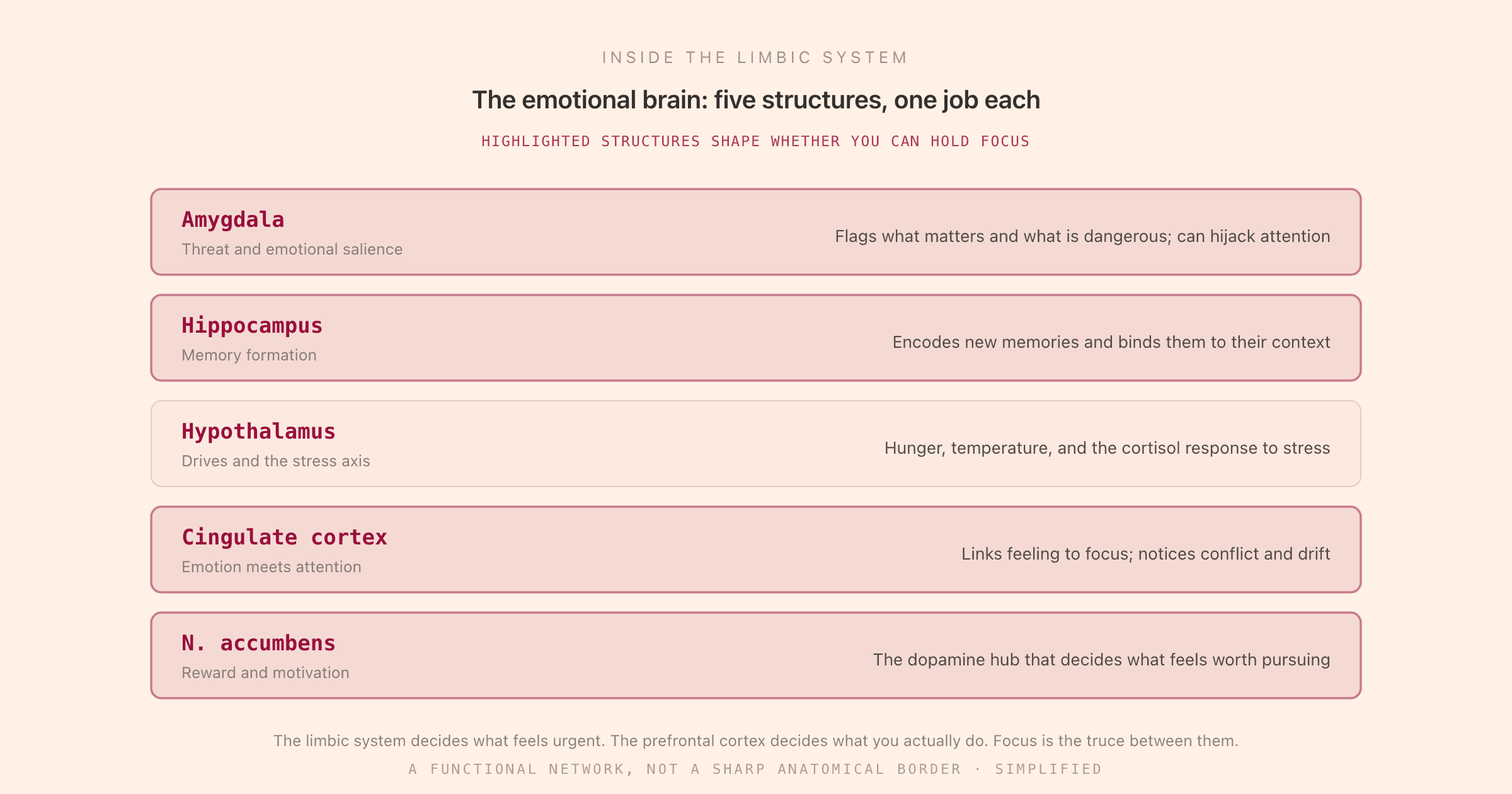
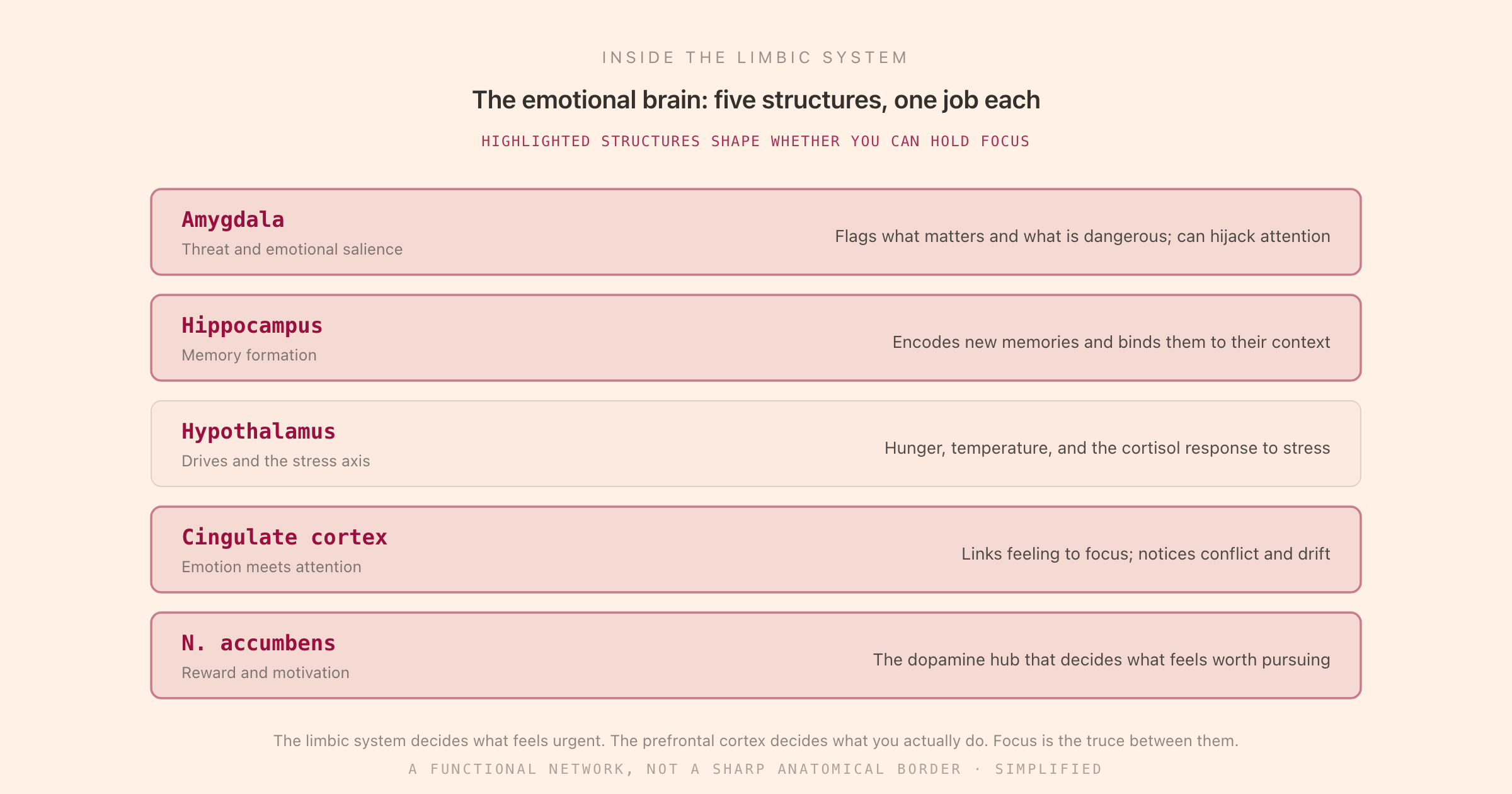
The limbic system's structures each have a distinct role, and the focus-relevant ones are worth knowing by name.
The amygdala
The amygdala is the brain's threat detector and emotional-salience tagger. It scans incoming information for anything emotionally significant, especially danger, and when it finds it, it fires fast and hard. The amygdala is what makes you flinch before you have identified the snake, and it is also what makes an anxious thought feel urgent enough to derail an hour of careful work. It is small, but it has outsized power over attention, because evolution gave threat detection a priority override.
The hippocampus
The hippocampus is the seat of new memory formation. It binds the disparate elements of an experience into a coherent memory and ties that memory to its context. Its inclusion in the limbic system reflects a deep truth about the brain: memory and emotion are intertwined. Emotionally charged events, tagged by the amygdala, are remembered more strongly, which is why you can recall the details around a stressful moment far better than an ordinary Tuesday.
The hypothalamus
The hypothalamus is the limbic system's link to the body. It regulates hunger, thirst, temperature, and the sleep-wake drives, and crucially it sits at the top of the stress response, triggering the hormonal cascade (the HPA axis) that floods the body with cortisol under pressure. When stress wrecks your concentration, the hypothalamus is a large part of the mechanism.
The cingulate cortex
The cingulate cortex, particularly its forward portion, is where emotion and attention meet. It helps detect conflict, including the conflict between what you intend to do and what you are actually doing, and it links emotional state to the allocation of attention. It is part of why a bad mood and a wandering mind so often travel together.
The nucleus accumbens
The nucleus accumbens is the reward and motivation hub, the centre of the brain's dopamine system. It is what makes a reward feel worth pursuing and what gives an anticipated payoff its motivational pull. It is also the structure that variable rewards, like the unpredictable hit of a social feed, exploit so effectively. When a distraction feels almost magnetically compelling, the accumbens is doing the pulling.
The Limbic System Versus the Prefrontal Cortex
Here is the dynamic that matters most for focus. The limbic system generates fast, emotional impulses about what to attend to and what to do. The prefrontal cortex, the deliberate executive at the front of the brain, is supposed to evaluate those impulses against your actual goals and decide which to act on. Focus is what it looks like when the prefrontal cortex is winning that negotiation: you hold your goal in mind, the limbic system suggests a dozen more appealing or more frightening things to do instead, and the prefrontal cortex calmly overrides them and keeps you on task.
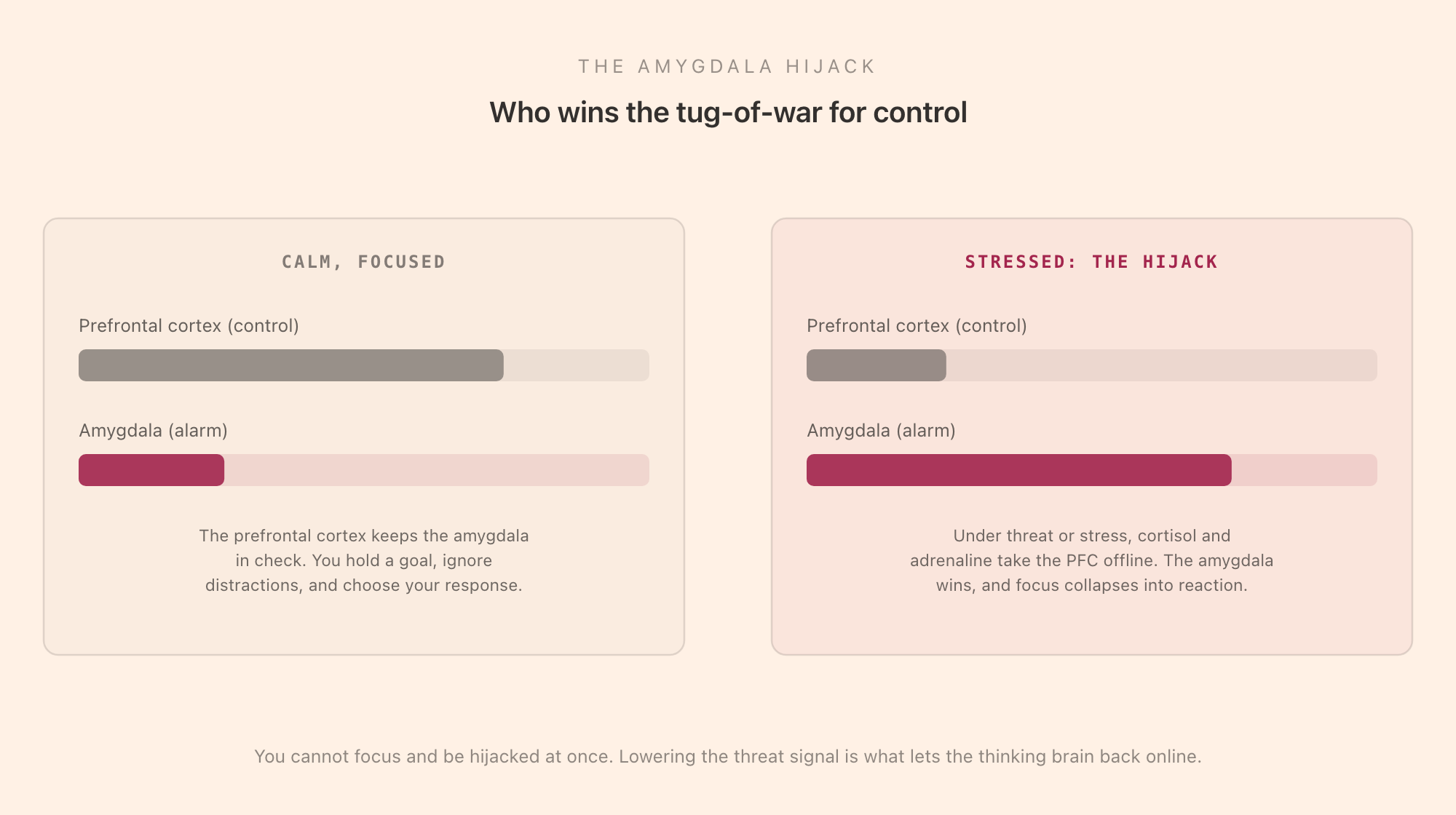
The problem is that this contest is not a fair fight when you are stressed. Under genuine threat, or the low-grade chronic stress that defines a lot of modern work, the hypothalamus drives up cortisol and adrenaline, and these hormones impair prefrontal function while sharpening the amygdala. The executive that was supposed to keep order gets quieter exactly when the emotional system gets louder. Psychologists call the extreme version an "amygdala hijack": a moment where the emotional brain seizes control and deliberate thought goes offline entirely. You have experienced milder versions every time anxiety made it impossible to concentrate on anything but the thing you were anxious about.
This reframes a huge amount of what people call distractibility or lack of discipline. You cannot be deeply focused and limbically hijacked at the same time; they are mutually exclusive brain states. So the route to better focus is not to grit your teeth harder, which engages a prefrontal cortex that stress has already weakened. It is to lower the limbic signal, to bring the emotional brain down to a level where the prefrontal cortex can do its job. Calm is not a nice-to-have for focus. It is a precondition.
Working With Your Limbic System Instead of Against It
If focus is a balance of power, then the practical question is how to tilt it toward the prefrontal cortex. A few principles follow from the biology.
Lower the threat signal before you try to focus. Because stress hormones are what hand the contest to the amygdala, anything that genuinely lowers arousal makes deep work more achievable: slow breathing, which directly damps the stress response, a few minutes of movement, or simply removing the source of low-grade alarm (the unread-count badge, the pending notification). You are not procrastinating by settling yourself first; you are putting the prefrontal cortex back in charge.
Reduce the number of limbic temptations in reach. The nucleus accumbens responds to cues. A phone in sight is a standing invitation for the reward system to pull your attention. Removing the cue is far more effective than trying to resist it in the moment, because resistance spends the very prefrontal resource you need for the work.
Protect sleep and manage chronic stress. Sustained high cortisol keeps the prefrontal cortex chronically under-powered and the amygdala chronically over-reactive. Sleep and stress management are not separate from focus; they set the baseline tone of the whole limbic-prefrontal balance for the day.
Use a stable environment to settle the system. A consistent, predictable sensory environment gives the limbic system less to react to. This is part of why a steady background soundscape helps so many people concentrate: it masks the unpredictable noises that would otherwise trip the amygdala's novelty and threat detectors, and it provides a calm, repetitive signal that keeps arousal in a workable range.
Where Focus Music Fits
The limbic system explains why the right audio environment is more than a preference. Concentration depends on keeping the emotional brain quiet enough for the prefrontal cortex to hold a goal, and an unpredictable environment, sudden voices, a slamming door, a notification chime, repeatedly pings the amygdala and nudges you toward the reactive state where focus collapses. A steady, engineered soundscape does the opposite: it gives the limbic system a constant, non-threatening input, masks the disruptions that would otherwise hijack attention, and helps hold arousal in the calm-but-alert band where deep work actually happens.
That is what Tomatoes is built to do. It generates focus music designed to settle the system and keep it settled through a work block, so the contest between your emotional brain and your thinking brain tips, and stays tipped, toward the side that gets things done. It is a one-time $39 app, no subscriptions and no account. If you want to give your prefrontal cortex a fighting chance against the limbic pull, get Tomatoes here.
The limbic system is not the enemy of focus. It is the part of you that knows what matters, and a brain without it would be a brain that could not care about anything, including its own goals. The skill is not to silence the emotional brain but to keep it calm enough that the thinking brain can steer. Once you see focus as that balance of power rather than a test of willpower, the levers that actually move it, lower the stress, remove the cues, settle the environment, become obvious.