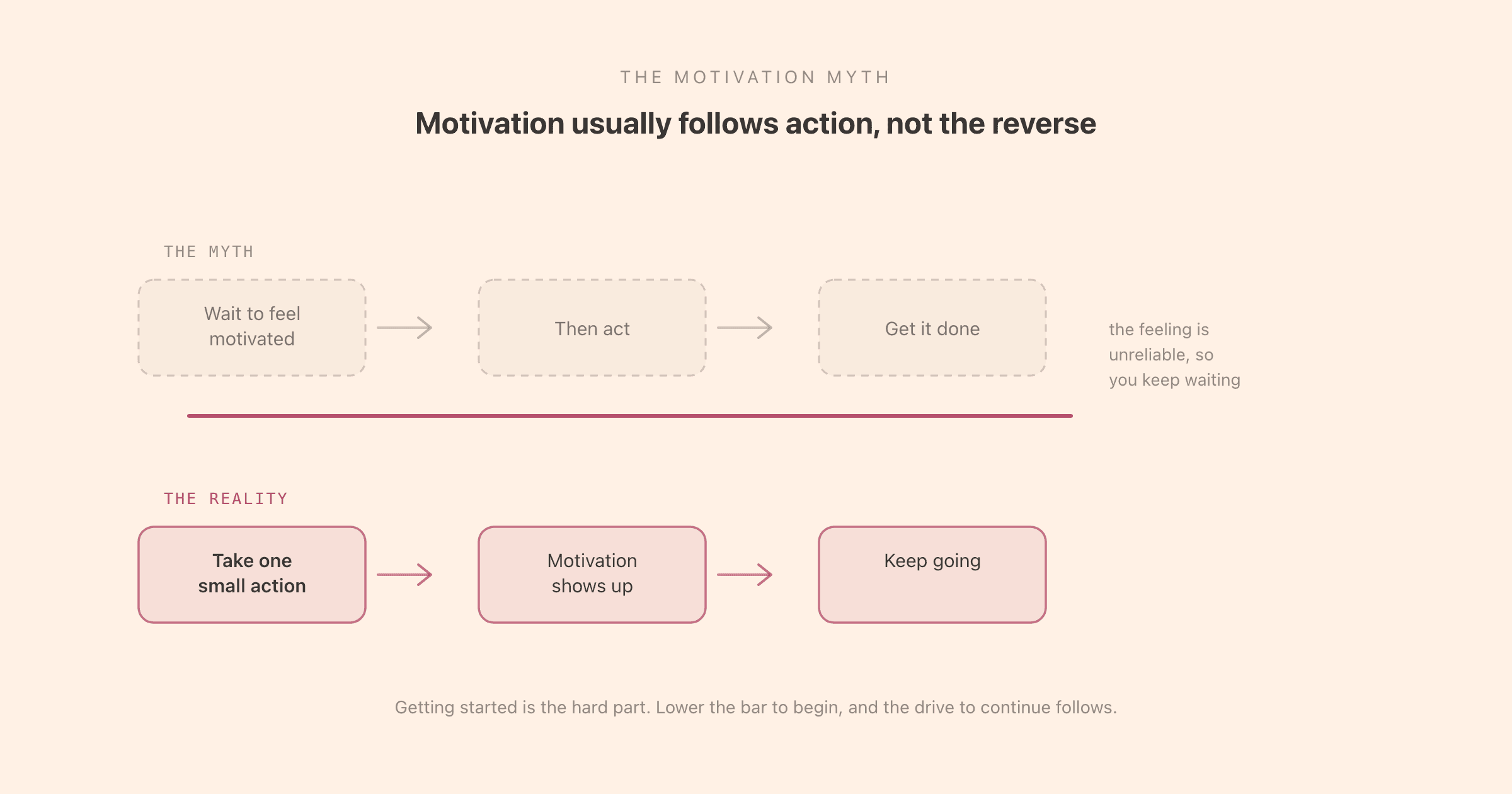
Motivation is the thing everyone wishes they had more of, and almost everyone misunderstands. The common belief is that motivation is a feeling you need to have before you can act: you wait to feel motivated, and then you start. That belief is the single biggest reason people stay stuck, because motivation, as a feeling, is unreliable, it comes and goes for reasons largely outside your control, and if you wait for it you will wait a long time. The more useful truth is that motivation is not really the fuel you need to get going; more often, it is the thing that shows up once you have already started. Understanding what motivation actually is, and how little you can depend on it, is what lets you get things done whether you feel like it or not.
This article explains what motivation really is, the crucial difference between intrinsic and extrinsic motivation, what genuinely drives it, why it fluctuates so much, and, most importantly, how to build a way of working that does not depend on feeling motivated at all. The goal is not to become permanently motivated, which is impossible, but to need it less.
What Is Motivation?
Motivation is the internal drive that moves you to act, the force that initiates, directs, and sustains behaviour toward a goal. It is what gets you to start a task, keep going when it is hard, and choose one action over another. Psychologists study it as the "why" behind behaviour: why you do anything at all rather than nothing.
Neurologically, motivation is closely tied to dopamine, which is often misunderstood as the "pleasure chemical" but is really more about pursuit and wanting than enjoyment itself. Dopamine drives the seeking of rewards, it is what makes a goal feel worth pursuing and pulls you toward it. This is a useful clue to how motivation actually works: it is bound up with the anticipation of a reward, which is why goals that feel meaningful and achievable are motivating, and ones that feel pointless or hopeless are not.
But here is the crucial thing to understand: motivation is a feeling, and feelings are not under your direct command. You cannot simply decide to feel motivated any more than you can decide to feel happy. This is exactly why building your life around waiting for motivation is a losing strategy, and why the people who get the most done are usually not the most motivated, but the least dependent on it.
Intrinsic vs Extrinsic Motivation
The most important distinction in understanding motivation is between its two sources, because they behave very differently.
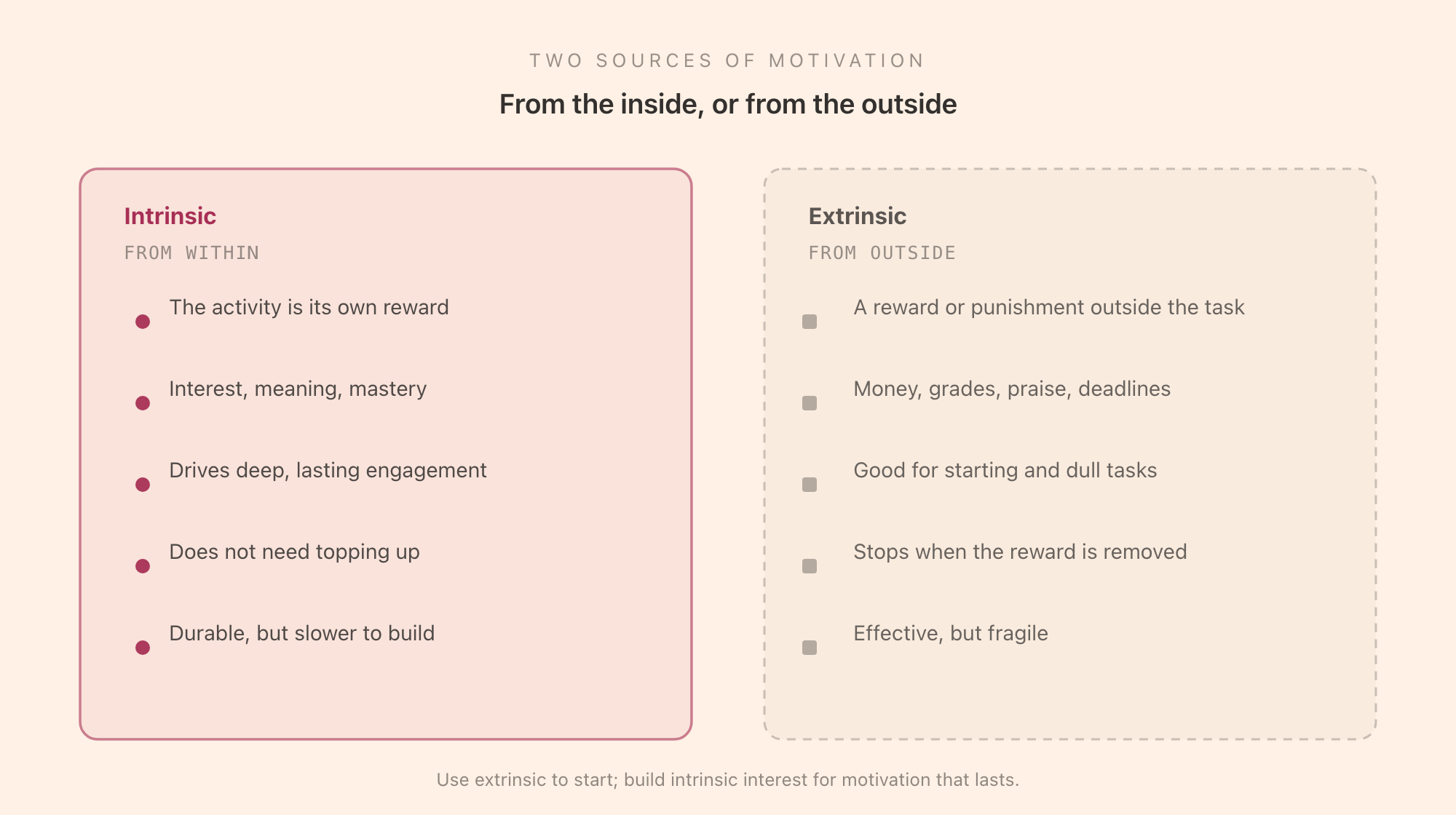
Intrinsic motivation comes from within. You do the activity because it is inherently interesting, satisfying, or meaningful to you, the work itself is the reward. A person who codes for the joy of solving the problem, or runs because they love the feeling, is intrinsically motivated. This kind of motivation is powerful and durable: it sustains effort over the long term, drives deeper engagement, and does not need to be topped up from outside.
Extrinsic motivation comes from outside. You do the activity to gain a reward or avoid a punishment, money, grades, praise, a deadline, or the fear of consequences. Extrinsic motivation is genuinely effective, especially for getting started or for tasks that are not intrinsically enjoyable, but it is more fragile: remove the reward and the behaviour often stops, and relying on it heavily can even undermine intrinsic interest over time.
The practical lesson is not that one is good and the other bad. Extrinsic motivators are useful tools, especially for unpleasant-but-necessary tasks. But the most sustainable motivation comes from finding or building intrinsic interest, connecting a task to something you genuinely care about, so that the drive to do it comes from inside rather than needing to be constantly supplied.
What Actually Drives Motivation
If motivation is not something you can summon at will, what conditions make it more likely? The most influential answer comes from Self-Determination Theory, which identifies three basic psychological needs that fuel intrinsic motivation.
Autonomy: the sense that you have some control and choice over what you are doing. People are far more motivated by things they have chosen than things imposed on them, which is why even small amounts of ownership over how you do a task increase the drive to do it.
Competence: the feeling that you are capable and making progress. Motivation thrives on a sense of getting better, which is why tasks pitched at the right level of challenge, hard enough to engage, achievable enough to succeed, are motivating, and why visible progress is such a powerful fuel.
Relatedness: a sense of connection to others and to a larger purpose. Work that feels connected to people you care about or a goal that matters is far more motivating than work that feels isolated and pointless.
The practical upshot: when motivation is missing, it is often because one of these is missing. You can frequently rebuild motivation by restoring a sense of choice, breaking a task down so progress becomes visible, or reconnecting it to why it matters.
Why Motivation Comes and Goes
Motivation fluctuates because it is a feeling, and feelings are shaped by things you do not fully control: your energy and sleep, your mood, stress, how you feel about the specific task, and simple biological rhythms. Some days the drive is there; some days it is not, and often for no reason you can identify. This is completely normal, and expecting to feel consistently motivated is setting yourself up to feel like a failure whenever you inevitably do not.
The trap is the "I will do it when I feel motivated" mindset. Because the feeling is unreliable, waiting for it means constantly postponing, and the postponing itself, especially with an unpleasant task, tends to build the avoidance that hardens into procrastination. The motivation you are waiting for often only arrives after you begin, not before, which flips the usual logic on its head: action is frequently the cause of motivation, not its result.
How to Stop Depending on Motivation
The real skill is not maximising motivation but reducing your dependence on it, so that what you do is driven by systems and habits rather than by how you happen to feel. This is the single most valuable shift you can make.
Rely on habits, not feelings. A habit runs automatically, on a cue, without needing motivation to fire it. The more of your important behaviours you turn into habits, the less you need to feel like doing them. This is why building a consistent routine beats relying on daily willpower.
Act first, wait for motivation second. Since motivation often follows action, lower the bar to starting. Commit to just two minutes, or the first tiny step, and let beginning generate the drive to continue. Getting started is the hard part; motivation usually shows up once you are moving.
Reduce friction. Make the thing you want to do as easy to start as possible, and the things you want to avoid harder. When starting is effortless, you need far less motivation to do it.
Build in autonomy, competence, and progress. Give yourself some choice in how you work, break big tasks into achievable steps so you feel progress, and reconnect the work to why it matters. These restore the conditions that generate motivation naturally.
Do not moralise the off days. Motivation will dip, and treating those dips as personal failings just adds guilt to the mix. Systems are what carry you through the low-motivation days, which is the entire point of having them.
Where Focus Music Fits
The most reliable way to work without depending on motivation is to make starting automatic, and a consistent ritual is one of the best ways to do that. A cue that reliably signals "we are working now" lets you begin without first having to feel like it, and once you have begun, the motivation to continue tends to follow.
Tomatoes is built to be exactly that starting ritual: press play on the focus music, and the act itself becomes the cue that gets you into a work session, no motivation required to begin, just a button that starts the routine. It is free to try for 3 days, then from $4.99 a week, $29.99 a year, or $39 for lifetime access. If you are tired of waiting to feel motivated, building a reliable way to just start is the answer, and a focus ritual is a good place to begin: try Tomatoes free for 3 days.
Motivation is real and it matters, but it makes a terrible foundation, because it is a feeling you cannot command and it comes and goes on its own schedule. The people who consistently get things done have not found a way to feel permanently motivated; they have built a way of working that does not require it, habits that run without it, rituals that let them start without it, and systems that carry them through the days it is absent. Stop waiting to feel motivated, start before you feel ready, and let the motivation catch up. It usually does.