Acetylcholine is the neurotransmitter that decides what your brain pays attention to and whether it is in a state to learn. If dopamine is about wanting and norepinephrine is about how alert you are, acetylcholine is about where the spotlight points and how sharp its edges are. It is the chemical that raises the brain's signal-to-noise ratio, turning up the volume on the sensory information that is actually in front of you while turning down the internal chatter of expectation and memory. It is also the switch that puts the hippocampus into "record new information" mode. When acetylcholine is doing its job, you notice the right things and you encode them; when the cholinergic system fails, as it does first and worst in Alzheimer's disease, attention and the laying down of new memories are the first abilities to go.
This is the focus-science version of acetylcholine: what it is, the small set of source neurons that broadcast it across the whole brain, how it sharpens attention mechanically, the difference between nicotinic and muscarinic receptors, and why high acetylcholine means "encode" while low acetylcholine means "consolidate." Tomatoes is a focus tool built around protected, low-distraction work blocks, the kind of practice that gives this system clean signal to lock onto. The app is free for 3 days, then $4.99/week, $29.99/year, or $39 lifetime.
What Acetylcholine Actually Is
Acetylcholine, abbreviated ACh, was the first neurotransmitter ever discovered, identified by Otto Loewi in 1921. Chemically it is simple: the body builds it by joining choline, an essential nutrient you get largely from food, to an acetyl group, using an enzyme called choline acetyltransferase. Once it has done its job in the synapse, a second enzyme, acetylcholinesterase, breaks it down again almost immediately. That fast breakdown matters, because it is the exact target of the Alzheimer's drugs discussed later in this article.
Acetylcholine wears two very different hats. In the body, at the neuromuscular junction, it is the signal that makes your muscles contract, a fast and specific point-to-point command. In the brain, it plays a completely different role: it is a neuromodulator, a slow background signal that biases how entire networks behave rather than carrying a single specific instruction. This article is about the brain version, the cholinergic system that underwrites attention and learning. The two systems use the same molecule but do unrelated jobs, which is why "acetylcholine" can describe both a muscle twitch and your ability to concentrate.
The Cholinergic System: A Small Source for a Brain-Wide Signal
The brain's acetylcholine comes from a surprisingly small number of neurons clustered in two regions, and understanding where they sit explains what acetylcholine does.
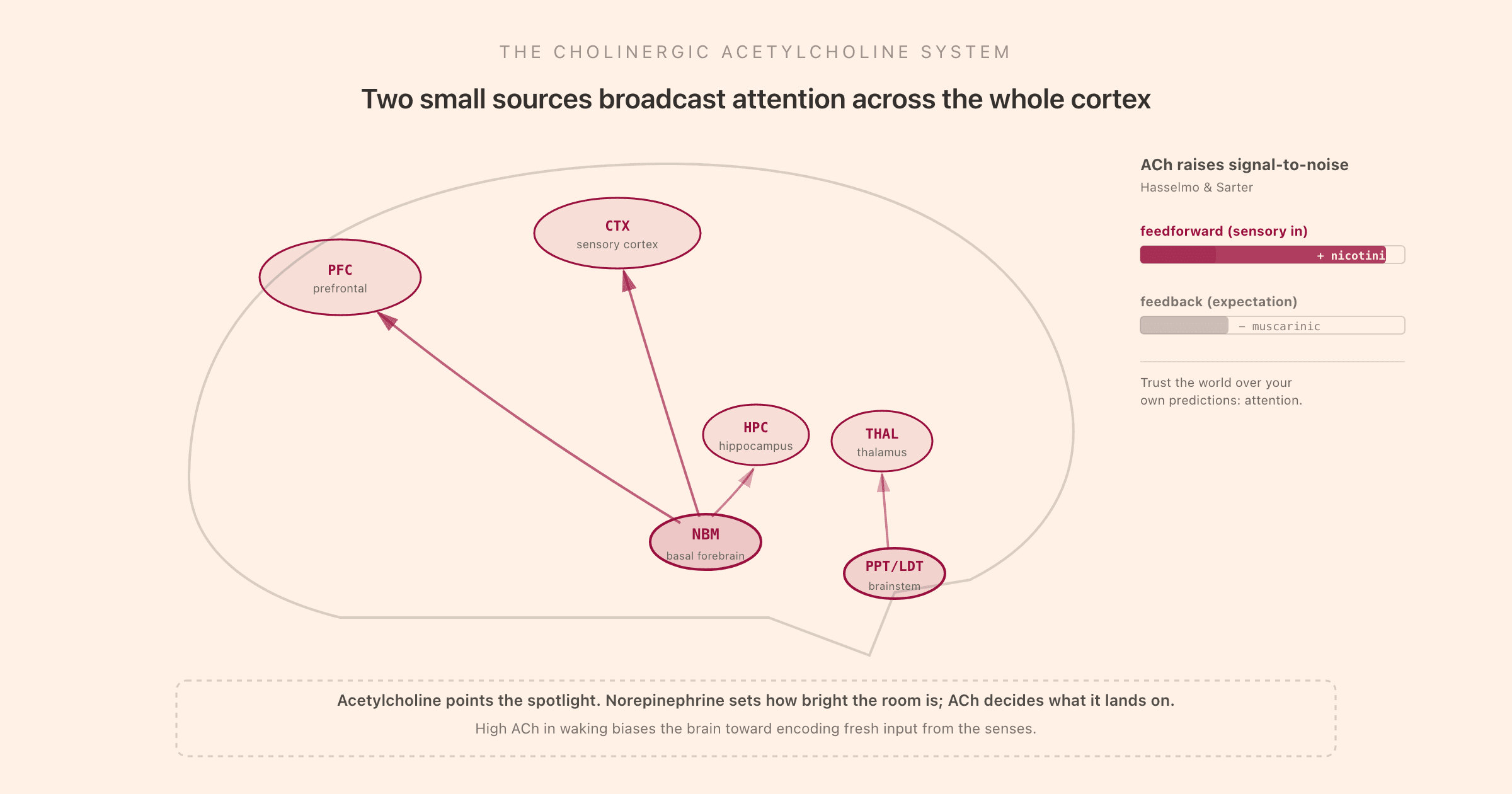
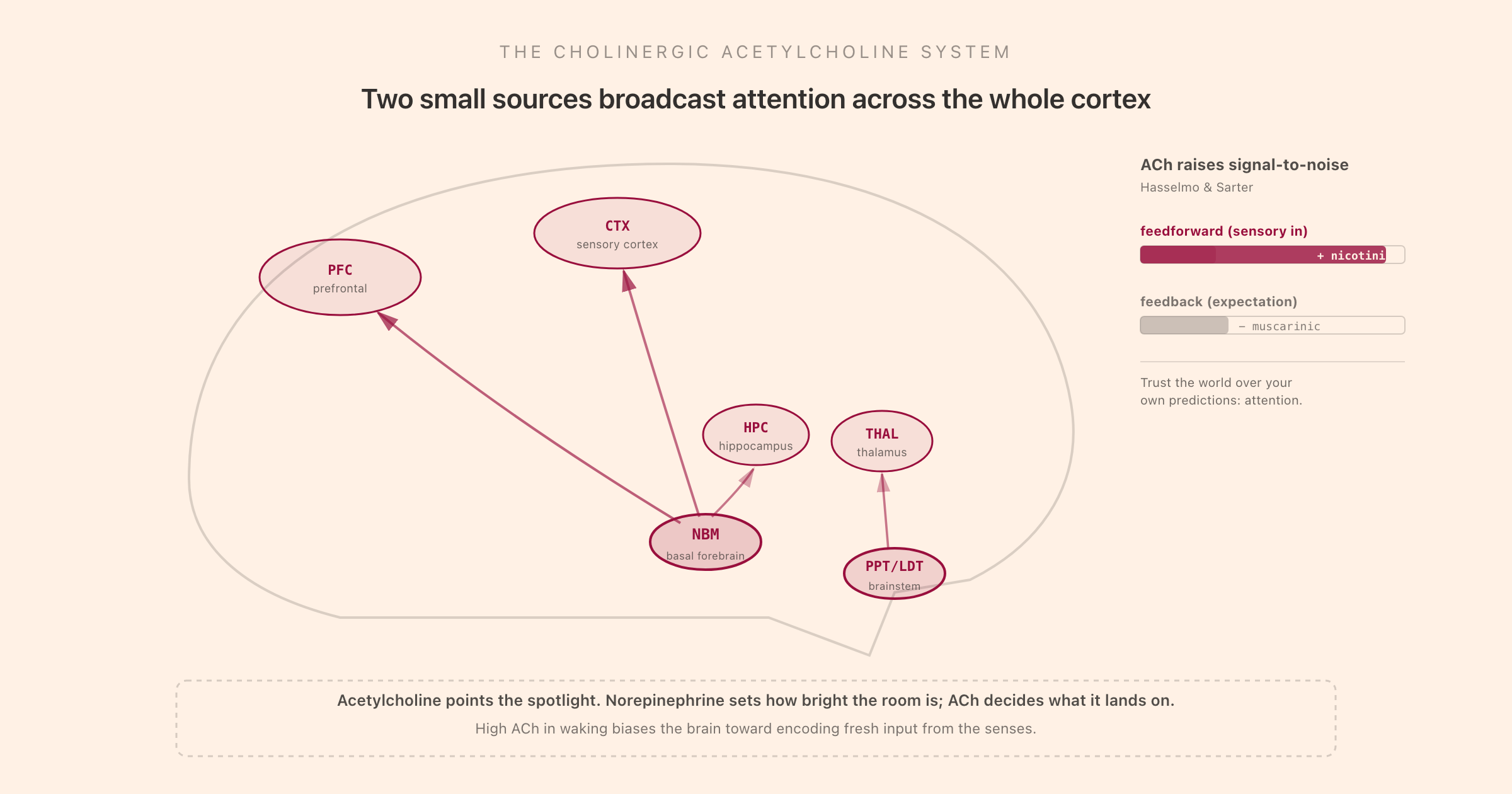
The first source is the basal forebrain. Within it, the nucleus basalis of Meynert sends cholinergic axons fanning out across almost the entire neocortex, and a neighbouring group, the medial septum and diagonal band, projects to the hippocampus. This is the system that powers cortical attention and hippocampal learning. The second source is the brainstem, where the pedunculopontine and laterodorsal tegmental nuclei (the PPT and LDT) project mainly to the thalamus and help control arousal, wakefulness, and REM sleep.
The design principle here is the same one behind the locus coeruleus norepinephrine system and the raphe serotonin system: a tiny number of source neurons set a slow, brain-wide tone that tunes how the rest of the brain processes information. Acetylcholine is not delivering the content of your thoughts. It is setting the conditions under which the cortex handles whatever content arrives. That is why a structure smaller than a fingernail can shape something as broad as your capacity to pay attention.
Signal-to-Noise: How Acetylcholine Sharpens Attention
The most important thing acetylcholine does for focus is raise the brain's signal-to-noise ratio, and the mechanism is elegant. Work by researchers including Michael Hasselmo and Martin Sarter describes acetylcholine as biasing the cortex toward the outside world.
In practical terms, when cholinergic tone is high, acetylcholine amplifies feedforward, bottom-up sensory input, the signals arriving from the thalamus carrying fresh information about what is actually out there. At the same time, it suppresses intracortical, top-down feedback, the internal signals that carry expectation, prior assumptions, and stored associations. The net effect is that the brain trusts the incoming evidence over its own predictions. It attends to what is genuinely present rather than what it expected to find.
This is exactly the state you want for focused work. Concentration is not about thinking harder; it is about letting the relevant input dominate and keeping internal noise from drowning it out. Acetylcholine is the chemistry of that selectivity. It is closely related to what norepinephrine does, but the division of labour is clean: norepinephrine sets your global level of alertness, the overall gain, while acetylcholine determines what within that aroused state actually gets processed. Norepinephrine answers "how awake am I," and acetylcholine answers "what am I locking onto." The two together do for attention what a good microphone and a noise gate do for a recording.
Nicotinic vs Muscarinic Receptors
Acetylcholine produces these effects through two completely different families of receptor, and the split explains a lot, including why nicotine is a stimulant.
Nicotinic receptors (nAChRs) are ionotropic, meaning they are ligand-gated ion channels that open directly and almost instantly when acetylcholine binds, letting positive ions rush in. They are fast and excitatory. These are the receptors that mediate the rapid enhancement of feedforward sensory signals, and they are the ones nicotine activates, which is why nicotine acutely sharpens attention and reaction time even though it is a deeply problematic way to get there.
Muscarinic receptors (mAChRs) are metabotropic, meaning they are G-protein-coupled receptors that work through slower internal signalling cascades rather than opening a channel directly. They are slower and more modulatory, and they handle much of the suppression of intracortical feedback and the longer-lasting changes in cortical state. Different muscarinic subtypes do different jobs across the cortex and hippocampus.
The practical upshot is that acetylcholine is not a single lever. The fast nicotinic arm turns up the sensory signal and the slower muscarinic arm reshapes how the cortex weighs that signal against its own assumptions. Both arms point the same way: toward processing the world as it is right now.
High ACh Means Encode, Low ACh Means Consolidate
Acetylcholine does not only govern attention in the moment. It also acts as a switch that decides whether the hippocampus is in a mode to take in new information or to file away what it already has. This is one of the most useful ideas in memory neuroscience for anyone who studies, and it comes largely from Hasselmo's work.
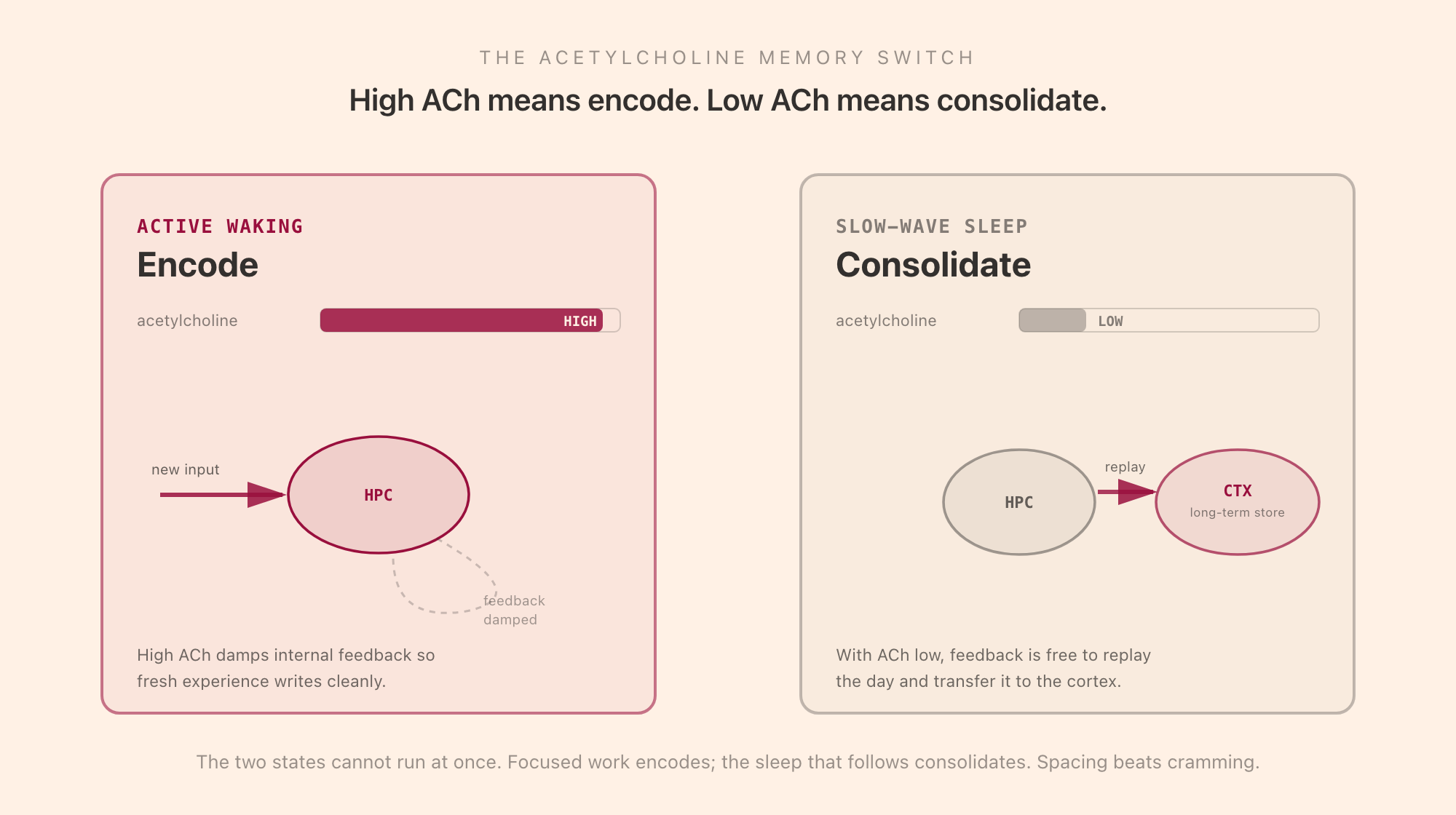
During active waking, acetylcholine is high, and high ACh biases the hippocampus toward encoding. It does this by suppressing the internal excitatory feedback within the hippocampus that would otherwise let already-stored memories interfere with the new input. With that feedback turned down, fresh experience can be written cleanly without being overwritten by or confused with old patterns. This is the "record" setting.
During slow-wave sleep, acetylcholine falls to its lowest levels, and that drop flips the system into consolidation mode. With cholinergic suppression lifted, the internal feedback connections are free to drive replay, the process by which the hippocampus reactivates the day's experiences and gradually transfers them into long-term neocortical storage. This is the "save to disk" setting, and it is one of the reasons the deep stages of sleep matter so much for learning.
The implication for how you work is direct. Encoding and consolidation are different states that the brain cannot fully be in at once, and acetylcholine is part of what separates them. Cramming fights this; spacing works with it. It is the same logic that underlies spaced repetition: you encode in focused waking blocks when ACh is high, then let low-ACh sleep do the consolidation you cannot force while awake. Protecting both halves of that cycle, the focused encoding session and the sleep that follows it, is how you actually convert attention into durable memory.
When the Cholinergic System Fails: Alzheimer's and Donepezil
The clearest evidence that acetylcholine underwrites attention and memory comes from what happens when the system breaks down. In Alzheimer's disease, the cholinergic neurons of the basal forebrain, including the nucleus basalis of Meynert, are among the earliest and most severely damaged. The loss of cortical and hippocampal acetylcholine tracks closely with the decline in attention and the inability to form new memories that define the disease. This observation became known as the cholinergic hypothesis of Alzheimer's.
It is also why the most common Alzheimer's medications work the way they do. Drugs such as donepezil, rivastigmine, and galantamine are cholinesterase inhibitors: they block acetylcholinesterase, the enzyme that breaks acetylcholine down, so that whatever acetylcholine the remaining neurons release lingers longer in the synapse. They do not cure the disease or rebuild the lost neurons, but by raising effective acetylcholine levels they can modestly improve attention and memory for a time. The fact that propping up acetylcholine helps at all is strong confirmation of what the molecule normally does.
How to Support Your Acetylcholine System
There is no clean way to "boost acetylcholine" on demand in a healthy brain, and you should be sceptical of anything that promises otherwise. But the system rests on real inputs, and a few of them are worth getting right.
Get enough choline. Acetylcholine is built from choline, an essential nutrient, and the richest dietary sources are eggs (especially the yolks), liver, and soybeans, with smaller amounts in meat, fish, and cruciferous vegetables. Most people who eat a varied diet get adequate choline, but very low intake genuinely limits the raw material the system has to work with.
Protect the encode-and-consolidate cycle. Because high-ACh waking encodes and low-ACh sleep consolidates, the single most reliable thing you can do for this system is to pair focused work with good sleep. A sharp study session is wasted if the slow-wave sleep that consolidates it never happens. Treat sleep as part of the learning, not as time off from it.
Exercise and manage attention load. Regular aerobic exercise supports the cholinergic system along with the rest of brain health, and giving your attention clean, single-task conditions lets the signal-to-noise mechanism actually work rather than fighting a flood of competing inputs.
Be honest about supplements. The "nootropic" world is full of choline and racetam stacks that claim to raise acetylcholine for sharper focus. The evidence in healthy people is weak and inconsistent, and the acute attention boost most associated with nicotinic activation comes from nicotine, which carries addiction and health costs that make it a bad trade. Cholinesterase inhibitors are powerful but are medications for disease, not focus aids for healthy brains.
Working With Your Attention Chemistry
Acetylcholine is the part of your neurochemistry most specifically about focus. It points the spotlight, sharpens its edges by favouring real input over internal noise, and sets your hippocampus to record. You cannot will it higher, but you can give it the conditions it needs: clean single-task input to lock onto, and protected sleep to consolidate what you took in. The rest of the attention chemistry, from dopamine's drive to norepinephrine's alertness, sets the stage, and acetylcholine decides what actually gets attended to and learned.
That is the principle Tomatoes is built on. A focus block is not about forcing concentration; it is about removing the competing signals so the cholinergic spotlight has something single and clear to land on, then ending the day in a way that lets sleep do the filing. If you want a focus tool designed around protected, low-distraction work blocks, Tomatoes is free for 3 days, then $4.99/week, $29.99/year, or $39 lifetime.