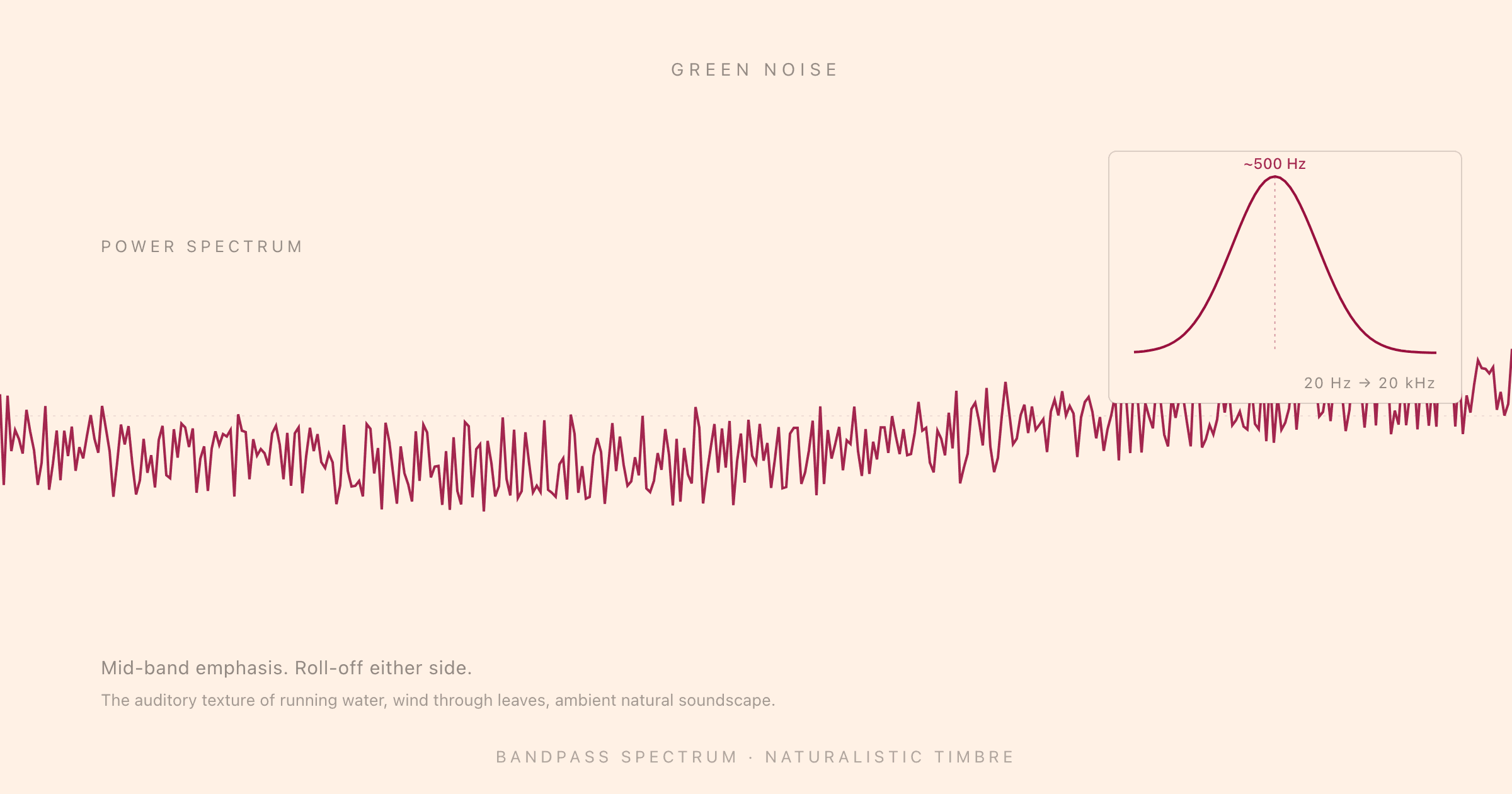
Green noise is the broadband sound whose power is concentrated in the middle of the audible band, peaking around 500 Hz and falling off below 250 Hz and above 2 kHz. The result is a sound somewhere between rushing water and distant wind, with the bright hiss of white noise sanded down and the heavy rumble of brown noise lifted out. That mid-band emphasis is the whole point, and it is the reason green noise has cropped up in sleep apps, focus playlists, and TikTok productivity videos as a third option after the better-known white and brown. This article is the deeper dive on green noise: what defines it acoustically, what the research actually shows about its effect on focus and sleep, when it beats the other colours, and when it does not.
If you already know the theory and want a focus-music app that uses real DSP for shaped noise textures rather than YouTube loops, Tomatoes is a one-time $39 with no subscription. The rest of this piece is the science.
What Green Noise Actually Is
Green noise does not have the clean mathematical definition that white, pink, and brown have. White, pink, and brown sit on a single continuum defined by spectral slope: 0, −3, and −6 decibels per octave respectively. Green noise is a different kind of beast. It is a bandpass sound, not a continuous decay, and the precise centre frequency varies depending on which definition you read.
Three properties define green noise consistently across audio-engineering and acoustics references:
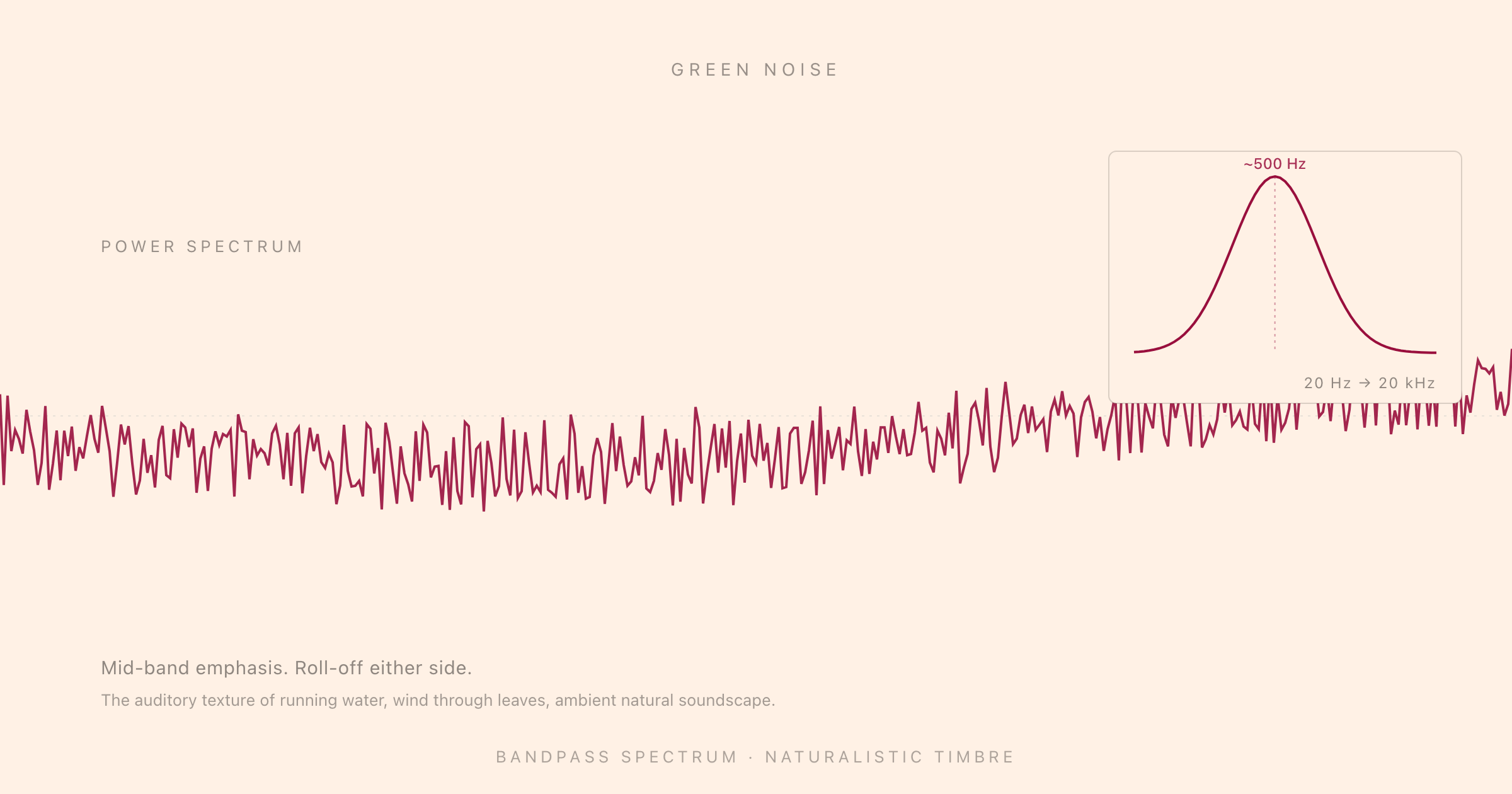
- Mid-band emphasis. Power is concentrated in the centre of the audible spectrum, with most definitions placing the peak between roughly 300 Hz and 1 kHz, centred on 500 Hz. Both lower and higher frequencies are attenuated.
- Bandpass shape. Unlike white, pink, or brown, the power spectrum is not monotonic. It rises into the mid-band and falls off either side. The roll-off rate is not standardised the way it is for pink or brown.
- Auditory impression. Green noise sounds like rushing water, wind through leaves, or a steady waterfall heard from middle distance. The bass rumble of brown is gone, the bright hiss of white is gone, what remains is a mid-band wash that feels natural and broadly unobtrusive.
The naturalistic impression is not coincidental. The frequency band where green noise sits, roughly 300 Hz to 2 kHz, is also where the bulk of natural ambient sounds (running water, light wind, leaves) put most of their acoustic energy. Some audio-engineering references in fact define green noise as the median spectral curve of natural ambient soundscapes. That is the thread that ties together every legitimate use case for green noise: it is acoustic camouflage that mimics the soundscape your auditory system evolved to ignore.
Why It Lacks a Single Spectral Equation
White, pink, and brown all map to a clean equation: power proportional to f^0, 1/f, or 1/f² respectively. Green noise does not. Different audio software vendors and acoustic researchers use slightly different bandpass shapes, and there is no IEC or AES standard defining the exact spectrum. In practice, "green noise" in a sleep or focus app is a bandpass-filtered noise source with most of its energy between 250 Hz and 2 kHz, peaking around 500 Hz. The exact slope and centre depend on the implementation.
This matters more than it sounds. If you compare two "green noise" tracks from different apps, you can be listening to two genuinely different sounds. Always sample-listen rather than assuming the label is doing the work.
The Spectral Shape in One Picture
The four colours commonly cited in focus and sleep contexts sit on different spectral curves. Each shape has different consequences for what gets masked, what fatigues your ear, and where the acoustic energy lands.
- White noise: flat. 0 dB/oct slope. Equal energy at every frequency.
- Pink noise: falls 3 dB/oct. Equal energy per octave. The default for room calibration and mastering.
- Brown noise: falls 6 dB/oct. Bass-heavy. Brownian motion mathematics applied to audio.
- Green noise: bandpass around 500 Hz. Mid-band emphasis, roll-off either side.
The first three exist on a spectrum of monotonic decay rates. Green is the odd one out: a band, not a slope. That single fact drives most of the practical differences.
For the deeper comparison of white, pink, and brown specifically (the three monotonic colours), see the white versus pink noise breakdown and the brown noise deep-dive for the 1/f² family. Green sits adjacent to that family rather than inside it.
How Green Noise Sounds Different to White, Pink, and Brown
The same broadband noise reaching your ear does different things depending on its spectral shape. Three perceptual differences matter for picking the right colour.
Less treble fatigue than white. The high-frequency hiss of white noise, the part above 4 kHz, is the part that drives auditory-fatigue reports during long listening. Green noise simply has less energy up there, so a four-hour focus session feels less acoustically taxing.
Less bass mush than brown. Brown noise excels at long-session masking but its emphasis below 250 Hz overlaps with HVAC, traffic, and your own bone-conduction sounds, sometimes producing a "muffled" quality that obscures rather than masks. Green noise sits above that range, so the masking happens in the band where most office distractions live.
More natural to most listeners than pink. Pink noise, despite being the engineer's favourite (equal energy per octave matches the way human hearing perceives loudness), often reads as an electronic artefact at sustained exposure. Green noise reads as ambient nature, and the listener typically tunes it out faster. In a focus context that is exactly what you want.
What green noise is not better at: short-burst impulse masking. A keyboard click, a phone notification, a colleague laughing, all of those have most of their energy in the same 500 Hz to 2 kHz band as green noise. Green noise occupies that band but does not necessarily mask it well at moderate volumes. White noise, with energy spread evenly across all frequencies, masks short impulses more reliably.
What the Research Actually Says (and What It Does Not)
The honest answer about green noise research is that there is very little direct evidence. Almost every controlled study of "broadband noise for focus or sleep" uses white, pink, or brown as the experimental sound, because those have unambiguous spectral definitions. Green noise has been the subject of marketing claims, app descriptions, and TikTok videos, but only a handful of acoustics papers and one or two informal sleep studies have evaluated it specifically.
Here is what the adjacent literature does support, and where the bridge to green noise is reasonable:
Mid-band masking is well studied. Industrial-noise research has decades of evidence on the masking efficacy of bandpass-filtered noise centred in the speech-intelligibility band (roughly 500 Hz to 4 kHz). Conversation, the most common workplace distraction, lives there. Filling that band with steady mid-band noise reduces speech intelligibility to neighbouring listeners, which is the principle behind office sound-masking systems. Green noise is, in effect, a consumer-grade version of those systems.
Pink and white noise have shown sleep effects in small studies. A 2017 study in Frontiers in Human Neuroscience found pink noise played in synchrony with slow-wave EEG activity enhanced declarative memory consolidation in older adults. White noise has shown faster sleep onset in NICU and preterm-infant settings. These are the cleanest sleep-and-noise findings to date. Green noise specifically has not been tested in a comparable randomised design.
The rushing-water analogy has biological grounding. Naturalistic-soundscape research, including the well-known Berto 2014 study on attention restoration, suggests that ambient natural sounds (water, wind, leaves) reduce stress markers and improve attention compared with traffic noise. Green noise's spectral resemblance to those sounds is the strongest indirect argument for its plausible focus benefit. It is not the same as direct evidence.
What the literature does not show, despite consumer claims:
- A specific frequency that "deactivates the default mode network." This is content-marketing language, not neuroscience.
- A unique sleep-onset advantage over white or pink at matched loudness.
- Any compelling difference in sustained attention between green noise and a comparable bandpass-filtered alternative.
The honest framing is: green noise is plausible as ambient masking with a naturalistic timbre, and the population studies on adjacent broadband noises support that. The strong claims you will see on app store pages outrun the evidence by a wide margin.
When Green Noise Beats the Other Colours (and When It Does Not)
Picking a noise colour is a task-specific decision. The right colour depends on what you are trying to mask, how long you are listening, and what acoustic environment you are in.
Green noise wins when:
- The dominant distraction is conversation in the next room. Speech intelligibility lives in the mid-band; green noise sits on top of it.
- The listening session is long (90 minutes or more) and you do not want treble fatigue.
- You want acoustic masking that reads as natural rather than electronic. Coffee shops, libraries, shared offices.
- You are sleeping in a moderately noisy environment with neighbours' conversation, doors, or muffled TV. Green noise covers that band better than brown.
Brown noise wins when:
- The session is even longer (3-4 hours plus) and you want minimal high-frequency exposure.
- The dominant distraction is your own bone-conduction sound (chewing, breathing, swallowing during quiet work) rather than external speech.
- You want the deepest masking floor for a meditation or sleep-onset session.
White noise wins when:
- The dominant distractions are short-burst impulse sounds (keyboards, doors closing, alerts).
- The masking volume needs to be low (white noise's full-band coverage compensates for limited loudness).
- A mathematically reproducible reference is needed (lab work, calibration).
Pink noise wins when:
- A clean equal-energy-per-octave reference is needed for testing or mastering.
- You want a balanced spectrum that does not bias toward any band, and you accept the slightly electronic timbre.
- You are pairing the noise with a sleep-EEG entrainment protocol; pink is the noise colour with the best evidence in that specific use.
For a fuller breakdown of which colour fits which task, the noise-color taxonomy in the focus-music guide lays out the same decision tree alongside binaural beats, isochronic tones, and natural soundscapes.
The TikTok Story and Why Green Noise Suddenly Matters
Brown noise had its TikTok moment in 2022-2023, driven by the ADHD community sharing how the deep rumble felt like it slowed their racing thoughts. White noise had its turn earlier, mostly in baby-sleep contexts. Green noise is the third wave, surfacing in 2024-2025 alongside an interest in "natural" or "ambient" soundscapes. The pattern is the same in each case: a small acoustic concept gets reframed in personal-development language, gets repackaged as a Spotify playlist or app feature, and the marketing claims drift well ahead of the science.
The honest take on green noise specifically: it is a real and reasonable sound to use, the bandpass shape is genuinely useful for office and shared-living masking, and the naturalistic timbre is preferable to white or pink for many listeners. None of that requires the "tuned to a specific brain frequency" claim to be true. It is just a well-shaped masking signal.
If you are evaluating a green-noise track or app, two things matter more than the marketing copy:
- Listen to it. Different implementations vary widely. The "green noise" in one app may be brighter or duller than another, with the centre frequency and roll-off varying without disclosure.
- Check the loudness. Acoustic masking only works when the masking sound is at or above the level of the distraction you are masking. A green-noise track played quietly will not cover speech in the next room. The right level is barely audible above the distraction, not aggressive.
How Green Noise Is Generated
Two practical methods produce green noise. Knowing which method an app uses helps explain why some "green noise" sounds richer than others.
Bandpass-filtered white noise. Take a white-noise source, run it through a bandpass filter centred at 500 Hz with a wide skirt (typically Q around 0.5 to 1). The filter shape determines the green-noise character. Steeper skirts produce a more focused mid-band wash; shallower skirts approximate the pink-to-mid-band transition more naturally. This is how most software DSP green-noise generators work.
Recorded natural soundscape. Field recordings of running water, leaves, or wind already have a spectrum that approximates green noise without any filtering. Many "green noise" tracks on streaming platforms are simply recorded waterfalls or streams, not synthesised noise. They sound closer to "real green noise" than the filtered alternative because they include the small temporal variations and reflections that pure DSP misses.
A focus-music app like Tomatoes that builds shaped noise via real DSP rather than looped recordings has the advantage of being deterministic: it does not loop, which avoids the perceptual habituation that long YouTube green-noise tracks fall into after the second pass. It also has the disadvantage of being a synthesised approximation rather than a real ambient recording. Both approaches work; the choice is preference and listening duration.
Sleep, Focus, and the Specific Claims to Be Sceptical Of
The two largest claims you will see attached to green noise are:
- "Green noise helps you sleep through ambient disturbances." This one is likely true at the level of acoustic masking, broadly equivalent to pink or white, with the small bonus of a more natural timbre. Sample-listen and pick the colour you actually find unintrusive.
- "Green noise tunes the brain to a specific frequency for relaxation." This one is misleading. Green noise has no specific frequency; it has a band. The "tuning" claim is the same one made for brown noise, white noise, and binaural beats, and it consistently fails to hold up in controlled trials.
If you want a specific, evidence-based protocol for using broadband noise alongside sleep architecture, the pink-noise-and-slow-wave entrainment work is closer to where the science actually is. Pink-noise pulses timed to slow-wave activity have published results. Green noise does not.
What to Use Green Noise For Today
A reasonable practical protocol for using green noise as a focus or sleep tool, given the current evidence:
- Daytime focus in a moderately noisy office or coffee shop. Loop green noise at a level just above the conversation around you. Twenty to ninety minutes per session. If the session is longer than 90 minutes, switch to brown noise to reduce mid-band exposure.
- Sleep through neighbour or shared-living noise. Green noise at low to moderate level for the sleep-onset window (the first 20-30 minutes). Switch to a quieter brown-noise floor through the rest of the night, or stop the noise entirely once you have fallen asleep.
- Light masking during shallow work (email, admin, light reading). White or pink may serve better here because they handle short-burst sounds more reliably. Green noise is overkill for tasks where you do not need to maintain deep focus.
Tomatoes ships shaped noise textures at 24-bit depth, computed in real-time DSP rather than looped recordings, with the four classical colours and several mid-band variations. It runs alongside the Pomodoro timer so the noise floor matches the work block. One-time $39, no subscriptions. Buy Tomatoes for $39 and the app handles the colour-picking automatically based on the time of day and work block length. Or, if the colour decision is the part you want to keep manual, the focus music taxonomy lays out which sound type fits which task across the whole noise, binaural beats, and natural soundscape space.
The simplest summary, if you skipped the sections above: green noise is a real, acoustically distinct mid-band signal that genuinely helps mask conversation and produces a natural-sounding wash. It is not a magic frequency. It is a well-shaped masking sound, and treating it as that one thing is enough to use it well.