
If you search for a binaural beats app, the App Store hands you back a pile of products that look interchangeable and are not. Some genuinely generate binaural beats, a real auditory illusion created by playing two slightly different frequencies into each ear. Some play generative music that has nothing to do with binaural beats but markets itself in the same aisle. Some are just looping rain and white noise. And some are not sound apps at all, they are pomodoro timers that happen to show up in the same search. Picking the "best focus app" without first sorting them by what they actually play is how people end up paying for the wrong tool and concluding that focus audio does not work for them.
This is a 2026 comparison of the best binaural beats and focus apps, sorted by the only thing that matters first: the sound mechanism. We will look at Brain.fm, Endel, Noisli, myNoise, and Tomatoes, compare them on platform, personalization, evidence, and price, and be honest about which kind of focus app suits which kind of person. If you already know you want real-time binaural focus music and you work on a Mac, Tomatoes is built for exactly that, but the rest of this guide explains the whole landscape so you can choose deliberately.
The Four Kinds of "Focus App"
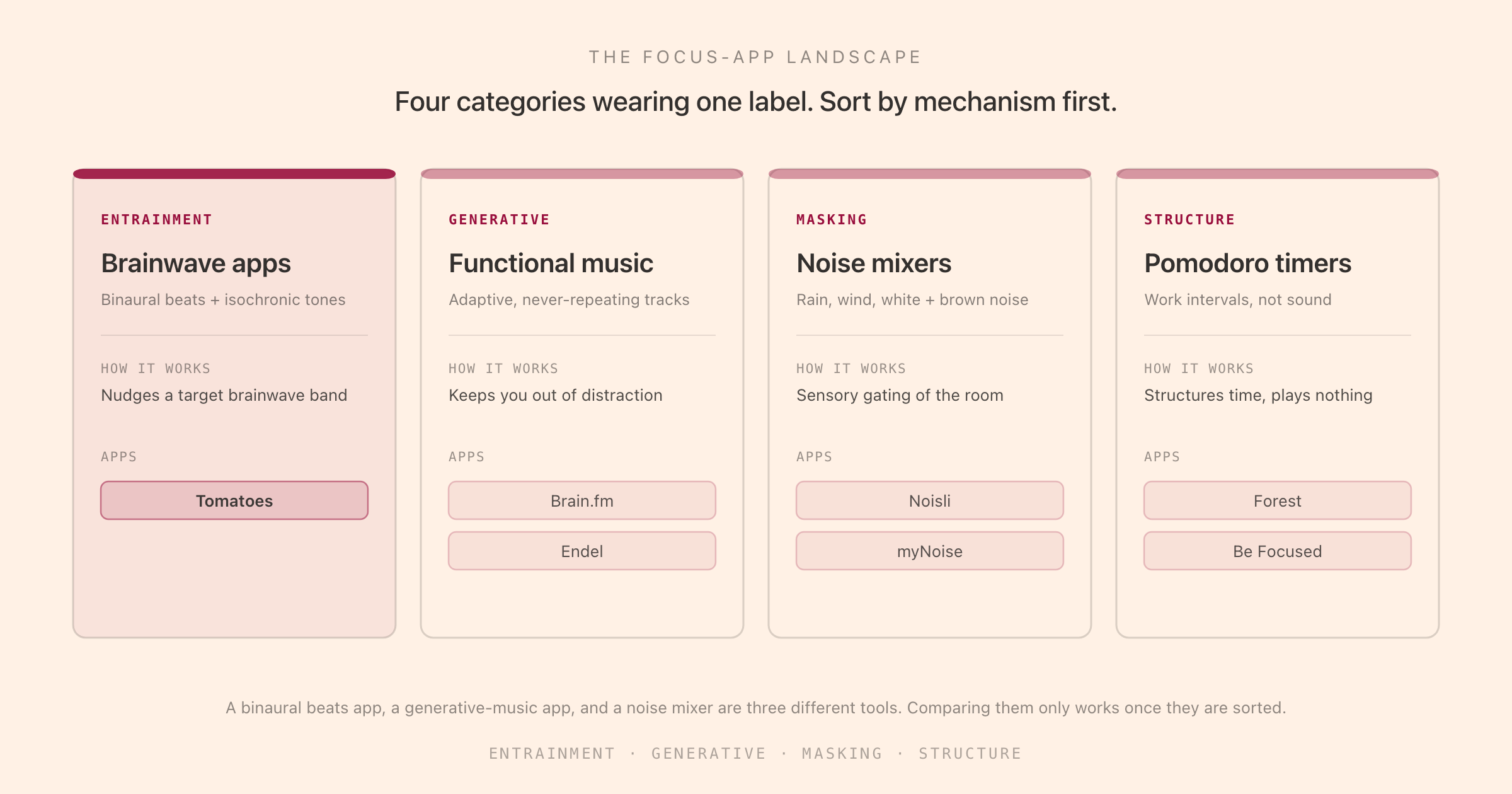
The single most useful thing you can do before reading any "best focus app" list is to realize that the category is really four categories wearing one label. Each works on attention through a different route, and the research on focus music only makes sense once you separate them.
Brainwave-entrainment apps play binaural beats or isochronic tones, rhythmic audio designed to nudge your dominant brainwave frequency toward a target band (beta or gamma for focus, alpha for relaxed alertness, theta for flow). The mechanism is rhythmic entrainment, and the better apps in this group build the modulation into actual music rather than leaving you with a bare sine tone.
Generative functional-music apps compose continuous, never-repeating instrumental music tuned for a mental state. They are not built around binaural beats as such; their claim is that the texture, tempo, and lack of structure keep you out of distraction. Brain.fm and Endel live here.
Ambient-noise mixers layer environmental sounds: rain, wind, cafe chatter, and the noise colors like white, pink, and brown. The mechanism is sensory gating, using broadband sound to mask distracting noise and even out your auditory environment. Noisli and myNoise live here.
Pomodoro timer apps structure your time rather than your sound. Forest, Be Focused, and Pomofocus break work into intervals; they are a genuinely useful tool, but they belong to a different category, and the best setup is usually a timer paired with a sound app, not one app trying to be both.
What to Look For in a Binaural Beats App
If a true binaural beats app is what you are after, not every product that uses the phrase delivers one. A few things separate a serious tool from a frequency-table novelty.
- Real audio, not bare tones. A pure 40 Hz sine wave is unlistenable for more than a few minutes. The apps worth paying for weave the beat into music or textured sound you can keep on for hours.
- The right target band for the task. Focus wants beta or gamma; relaxed creative work wants alpha; you should not be pushed toward theta or delta when you are trying to concentrate. A good app is explicit about what state each session targets.
- Headphones handled correctly. Binaural beats only work over stereo headphones, because the illusion depends on each ear getting a different frequency. An app that claims binaural benefits through a single speaker does not understand its own mechanism.
- Session length and seamlessness. Focus audio fails the moment a track ends, an ad plays, or a loop seam jolts you. Continuous, non-looping output matters more than a big library.
- A pricing model that fits how you work. Subscriptions suit people who want a constantly updated library; a one-time unlock suits people who just want a tool that works and then gets out of the way.
The Apps, Compared
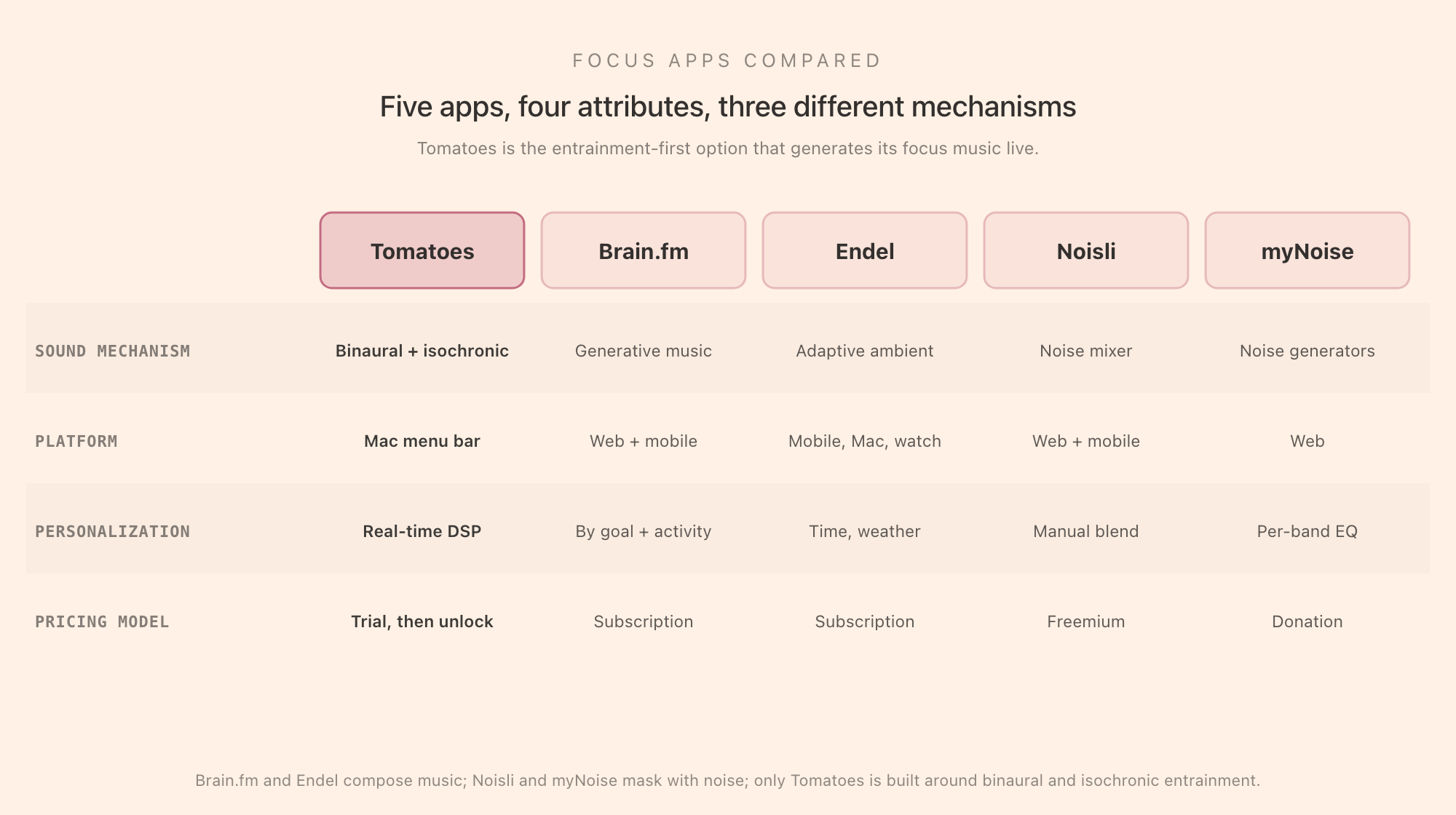
Here is how the main contenders actually differ. The honest summary is that there is no single best focus app, because they are not all trying to do the same job.
Brain.fm
Brain.fm is a generative functional-music app, and the most-cited name when people search for a brain.fm alternative. It composes continuous instrumental tracks and layers in rhythmic amplitude modulation that it describes as supporting neural phase locking. It has an in-house science team and has run pilot studies, which puts it ahead of most of the category on evidence, though the literature is still early. It runs on the web and on mobile, and it works on a subscription. If you want a polished, research-flavored music service and you do not care whether the mechanism is technically "binaural," it is a strong pick.
Endel
Endel makes adaptive soundscapes that personalize to inputs like time of day, weather, and in some versions heart rate, producing gentle ambient textures rather than structured music or binaural beats. It is genuinely cross-platform, including a Mac app and a watch app, and it leans more toward calm, sleep, and relaxation than hard cognitive focus. It is subscription based. As an endel alternative seeker usually discovers, the trade-off is that the soundscapes are soothing but light on the rhythmic drive that focus-band entrainment provides.
Noisli
Noisli is an ambient-noise mixer. You blend rain, wind, a crackling fire, and noise colors into a background bed, and it does that one job cleanly on web and mobile with a freemium model. It is not a binaural beats app and does not claim to be. If your problem is a noisy room rather than a wandering mind, a sensory-gating mixer like this may be all you need.
myNoise
myNoise is the connoisseur's noise generator: a deep, web-based collection of meticulously calibrated soundscapes and noise generators with per-band equalizers, run on a donation model. It is the most flexible noise tool here and the least app-like, with no native desktop menu-bar presence. Like Noisli, it is about masking and texture, not entrainment.
Tomatoes
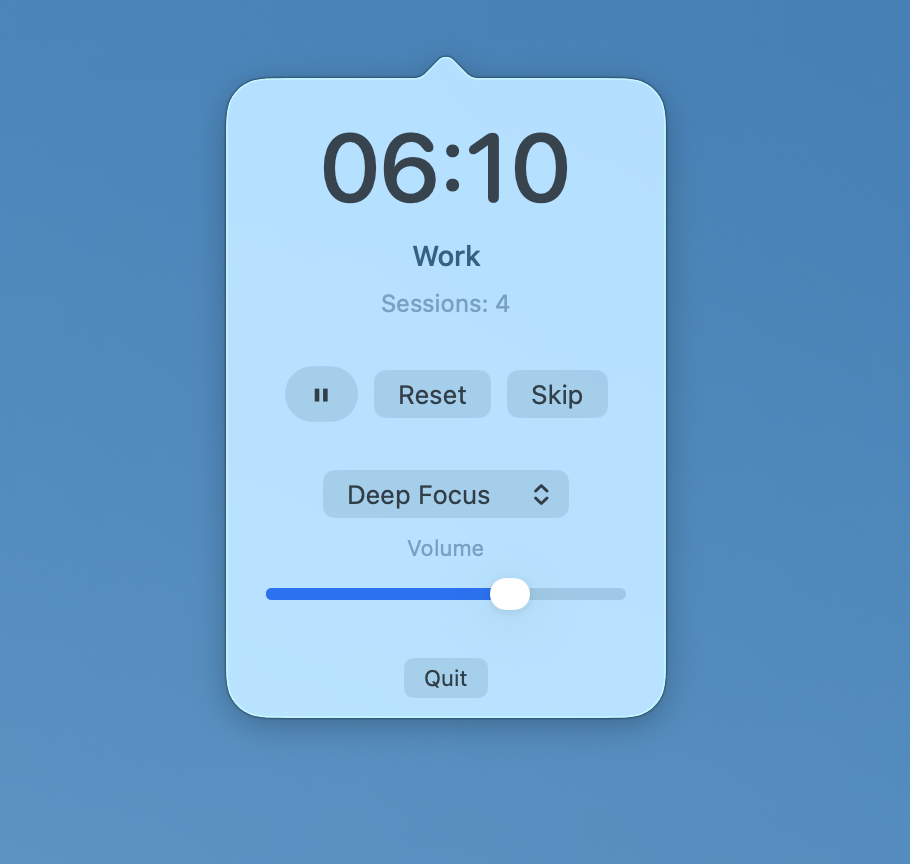
Tomatoes is a brainwave-entrainment app built specifically for focus, and it is the one in this list that generates its sound in real time rather than streaming a fixed library. A DSP engine weaves binaural and isochronic modulation patterns into evolving music using techniques like Freeverb reverb, Karplus-Strong synthesis, and granular textures, so the entrainment is carried by something you can actually listen to for a three-hour work block. It lives in the macOS menu bar, so it starts and stops without pulling you into a browser tab or a separate window. Pricing is trial-first: a free trial, then a low weekly or annual subscription, or a one-time lifetime unlock for people who would rather pay once. If you want real-time binaural focus music on a Mac without a tab open, it is purpose-built for that.
Binaural Beats vs Generative Music vs Noise: Which Should You Pick
Once the apps are sorted by mechanism, the choice gets simple, because it comes down to which route to attention works for your brain and your task.
Pick a binaural beats or entrainment app if you respond to rhythm and you want audio actively aimed at a focus brainwave band. This is the route with the most specific theory behind it, it depends on headphones, and it is best for sustained deep work where you want to be pulled up into beta or gamma. Tomatoes is the entrainment-first option here.
Pick a generative-music app like Brain.fm if you want pleasant, structured, never-repeating music and you care more about staying out of distraction than about hitting a specific frequency. It is a gentler experience than raw entrainment and does not strictly require headphones.
Pick a noise mixer like Noisli or myNoise if your real problem is environmental: an open-plan office, a chatty cafe, a partner on a call in the next room. Broadband noise masks the interruptions, and you do not need headphones or a frequency theory to benefit.
Many people end up using two of these: a noise bed for masking on bad days, and an entrainment or generative app for genuine deep work. They are complementary, not competing.
Pomodoro Timer Apps Are a Different Category
A lot of "best focus app" and best pomodoro app searches are really looking for a timer, and it is worth being clear that a timer and a sound app solve different halves of the same problem. Forest gamifies focus by growing a virtual tree that dies if you leave; Be Focused and Pomofocus run clean interval timers. None of them produce focus audio, and none of the sound apps above run a structured pomodoro cycle.
The most effective desk setup is usually a pairing: a pomodoro timer to structure the work into intervals, and a focus-audio app to fill those intervals with the right sound. Reaching for one app to do both is how you end up with a mediocre timer bolted to a mediocre sound library. Pick the best of each.
The Bottom Line
There is no single best focus app, only the best app for the mechanism that works for you. If you want masking, use a noise mixer. If you want pleasant structured music, use a generative app like Brain.fm. If you want time structure, use a pomodoro timer. And if you want real-time binaural and isochronic focus music aimed at a concentration brainwave band, built into a Mac menu-bar app so it stays out of your way, that is exactly what Tomatoes is for.
Try Tomatoes free, then keep it for a one-time unlock or a low monthly plan. It is the entrainment-first option in this roundup, it generates its focus music live rather than looping a library, and it is designed to be the sound half of your deep-work setup without ever asking for your attention.