Concentration is the skill almost everyone wishes they had more of, and almost nobody was ever taught. It is the ability to hold your attention on one thing, deliberately, for as long as the task needs, while shutting out everything else competing for it. When your concentration is good, hard work feels smooth and time disappears; when it is poor, you read the same paragraph three times, drift to your phone without deciding to, and end the day busy but with nothing to show for it. The good news, and the theme of this article, is that concentration is not a fixed trait you either have or lack. It is a skill, shaped by your habits and your environment, and it can be improved.
This article explains what concentration actually is, why it breaks down (the internal and external forces that scatter it), the foundations that make good concentration possible, and the specific techniques and exercises that genuinely strengthen it. None of it is complicated, but it does run against the grain of how most of us now live, which is exactly why concentration feels harder than it used to.
What Is Concentration?
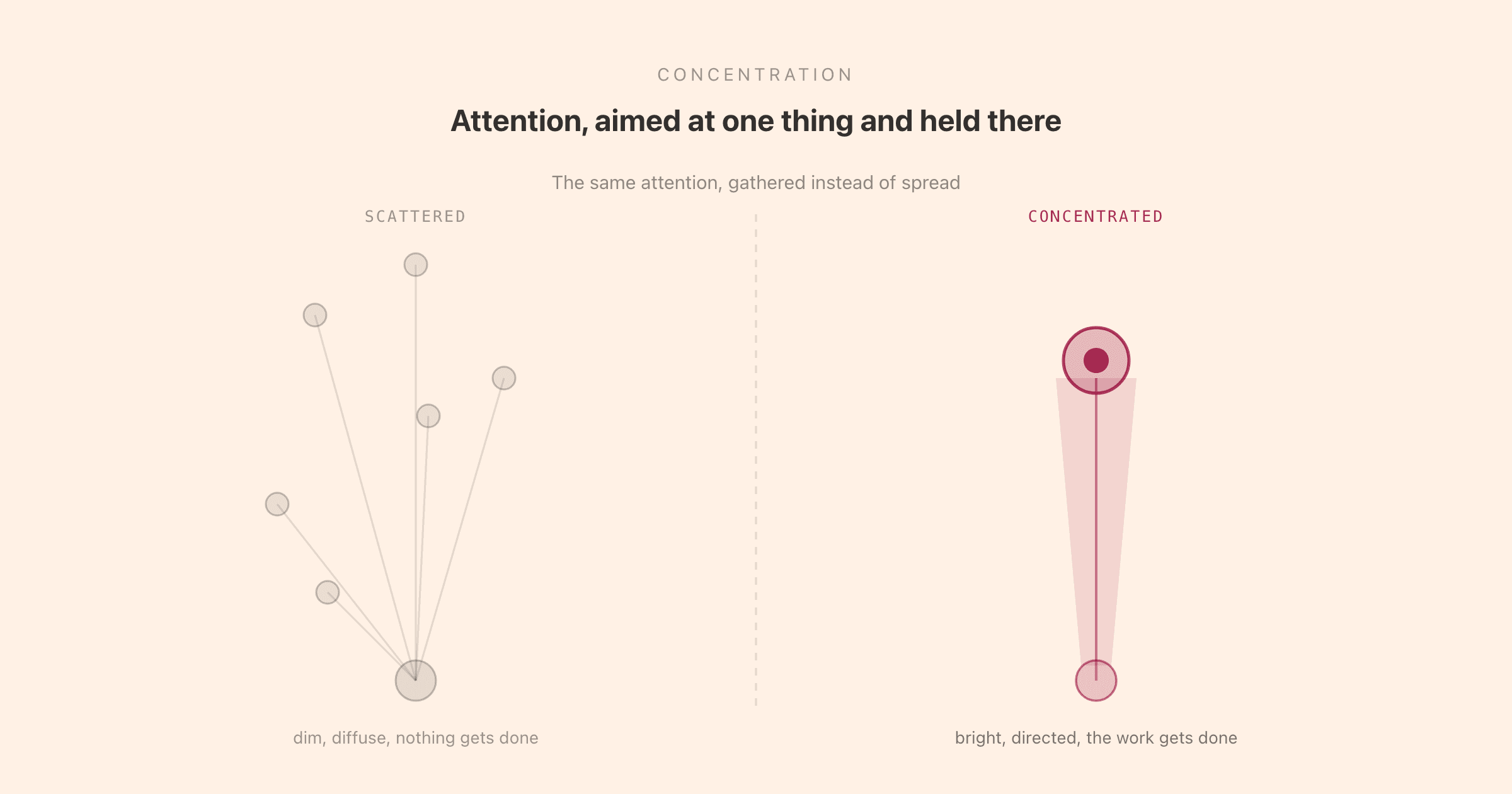
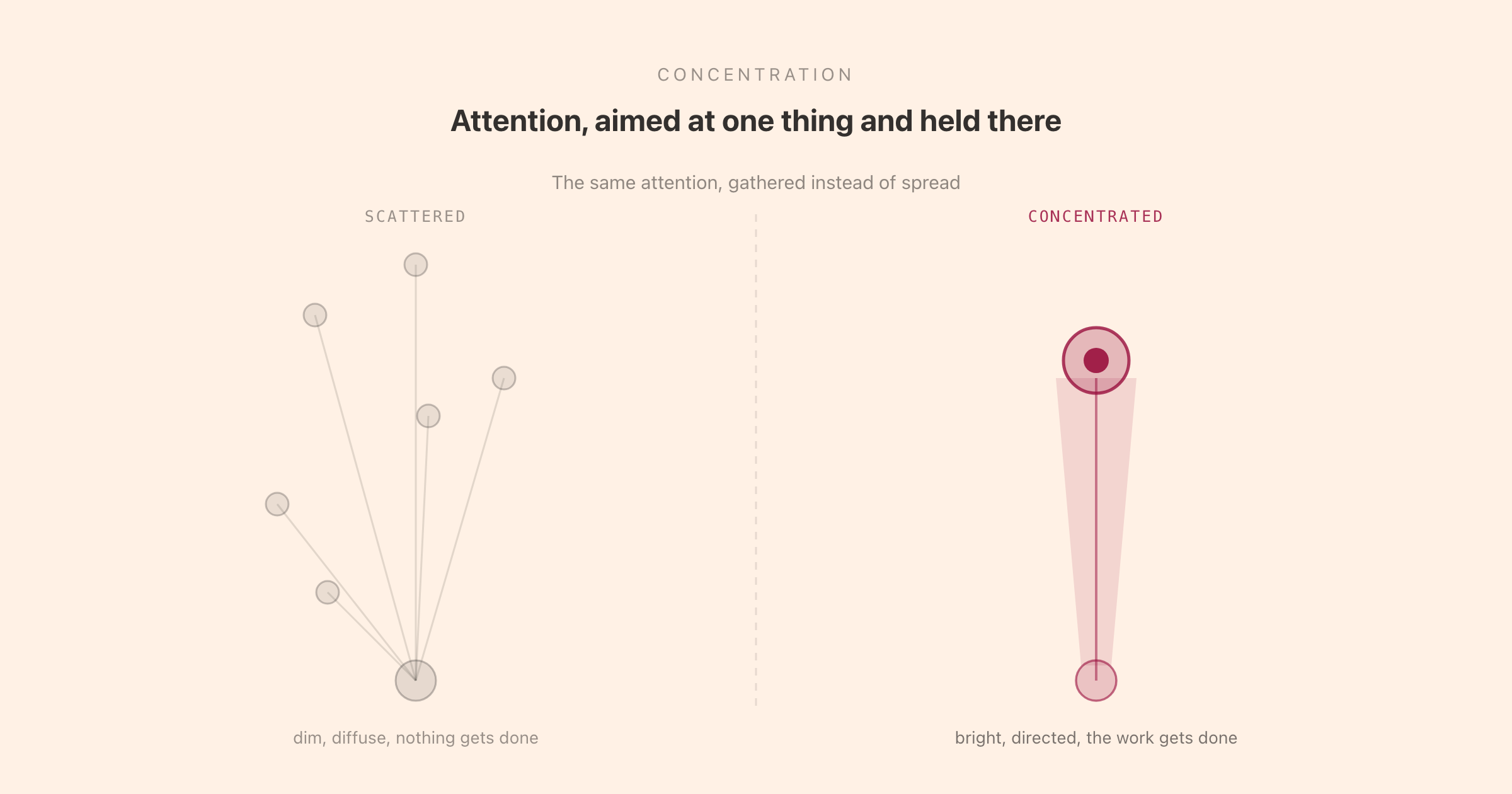
Concentration is the act of directing your mental effort onto a single task or object and sustaining it there while ignoring distractions. If attention is the spotlight of the mind, concentration is your ability to aim that spotlight deliberately and keep it steady, rather than letting it swing toward whatever is loudest in the moment.
It has two components that are worth separating. The first is selective attention: choosing what to focus on and filtering out competing inputs, the conversation you are following in a noisy room, the paragraph you are reading past the pinging phone. The second is sustained attention: keeping that focus going over time without it decaying. Most concentration problems are really a failure of one or both, either you cannot block out the distraction, or you cannot maintain focus once you have it. Understanding which is failing points you to the fix.
Concentration is closely tied to your broader attention span, but it is more active. Attention span describes how long focus tends to last; concentration is the deliberate effort of directing and holding it. And like any effortful skill, it draws on limited mental resources, which is why it fails predictably when those resources are depleted.
It is also worth saying plainly that concentration is normal to find hard, and getting harder for almost everyone. We now spend our days in environments engineered to fragment attention, training our brains to expect a new stimulus every few seconds, so the struggle to concentrate is far less a personal failing than a predictable response to how modern life is built. That reframe matters, because it points the solution not at trying to force more willpower, but at changing the habits and surroundings that are quietly working against you.
Why Concentration Fails
Concentration breaks down for reasons that fall into two groups, and knowing which is at work tells you what to change.
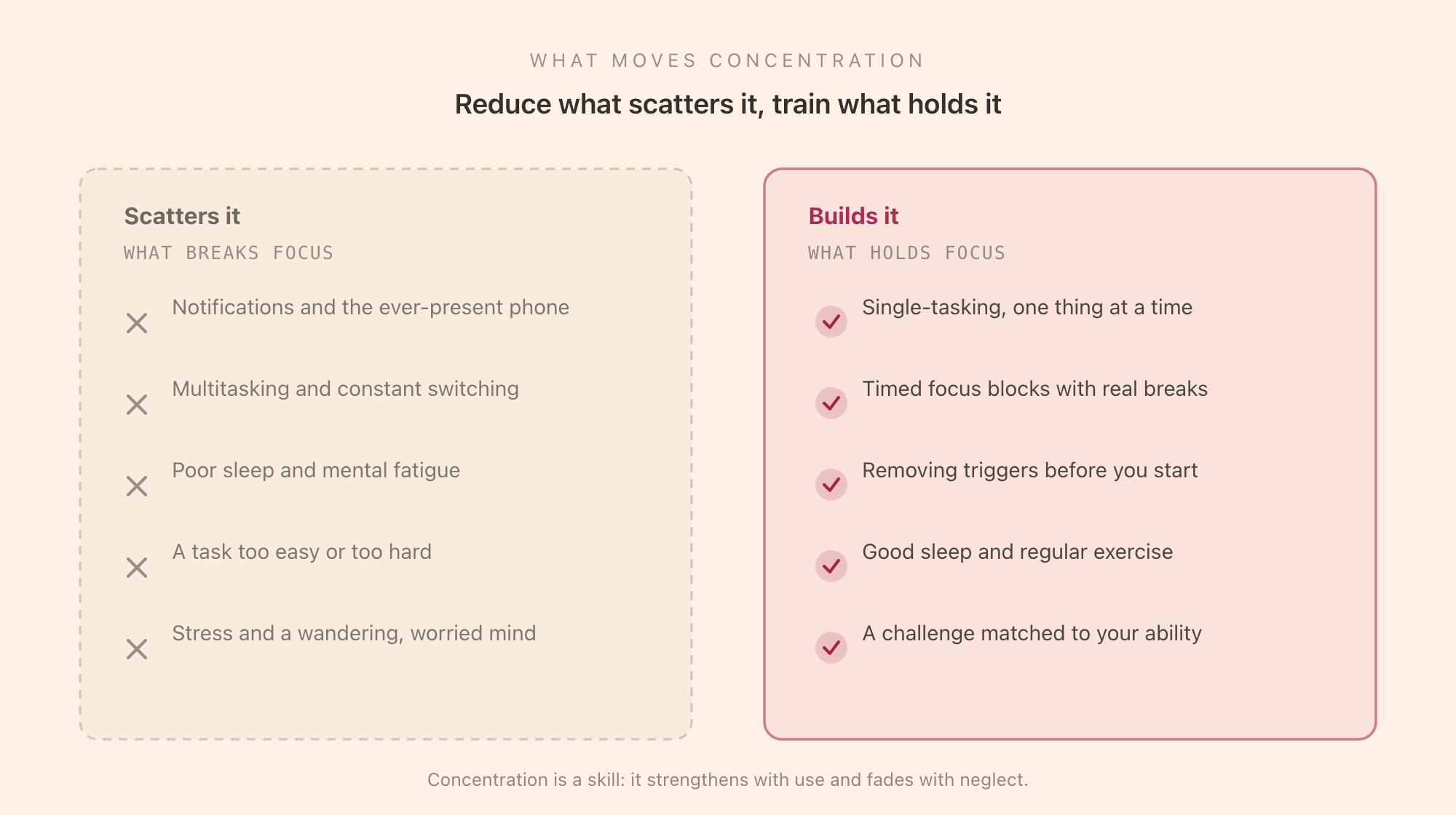
External distractions are the obvious culprits: notifications, noise, people, and the ever-present phone. What makes them so powerful is not just that they interrupt, but that they are engineered to. Every ping offers a small hit of novelty, and novelty triggers dopamine, which makes the interruption feel rewarding. Your brain learns that checking pays off and starts seeking the distraction on its own, pulling your focus away before any external prompt even arrives.
Internal distractions are subtler and often harder to manage: a wandering mind, worry, boredom, and mental fatigue. A task that is too easy lets the mind drift; one that is too hard triggers avoidance. And when your working memory is already overloaded, or you are simply tired, the cognitive load of holding focus becomes too much and concentration collapses. A great deal of what feels like weak willpower is really an overloaded or under-rested brain.
The Foundations of Good Concentration
Before any technique, concentration rests on a few foundations. Skip these and no method will save you; get them right and focus becomes far easier.
Sleep is the biggest one. A tired brain cannot concentrate, full stop. The prefrontal machinery that directs and sustains focus depends on rest, and a single poor night measurably degrades your ability to hold attention. No concentration technique survives chronic sleep deprivation.
One task at a time. Concentration is, by definition, singular. Every attempt at multitasking fractures it, because switching between tasks forces your brain to repeatedly reload context and leaves attention residue behind. Single-tasking is not a productivity nicety; it is the precondition for concentrating at all.
The right level of challenge. Focus holds most naturally when a task is difficult enough to be engaging but not so hard it overwhelms. Matching the challenge to your ability, by breaking big vague tasks into concrete ones, removes a major source of drift.
A body that is looked after. Hydration, movement, and steady energy all feed concentration. Exercise in particular has a well-established positive effect on attention and focus. The brain is physical, and it concentrates best when the body supporting it is in good order.
How to Improve Concentration
On top of the foundations, specific techniques reliably strengthen concentration. The theme running through all of them is the same: reduce what scatters focus, and train the ability to hold it.
Work in timed focus blocks. Concentration is far easier to sustain when it has a defined finish line. Committing to one task for a set stretch, then taking a real break, is the core of the Pomodoro technique, and it works because a bounded effort is much less daunting than an open-ended one. Start with a length you can actually hold and extend it as your capacity grows.
Remove the triggers, do not fight them. You will lose a moment-to-moment battle against a phone built to capture you. Put it in another room, silence notifications, and close the tabs before you begin. Making distraction require effort beats resisting it in the instant, every time.
Train it gradually. Concentration behaves like a muscle: it strengthens with use and fades with neglect. If your focus is shot, do not expect three-hour sessions immediately. Build up from short, fully-focused stretches, and the capacity grows.
Give the mind somewhere to put stray thoughts. When a worry or a to-do surfaces mid-task, write it down and return to the work. Externalising the thought stops it from circling and pulling your focus, and clears working memory for the task at hand.
Take real breaks. Concentration is a resource that depletes and recovers. Short breaks, ideally away from a screen, let it replenish, which is why sustained focus across a day depends on resting between bouts, not powering through.
Concentration Exercises That Actually Help
A few simple practices, done regularly, build the underlying capacity to concentrate. Mindfulness meditation is the best-evidenced: the basic exercise of focusing on your breath and gently returning your attention each time it wanders is, quite literally, concentration training, and it strengthens the same mental muscle you use at work. Single-tasking deliberately, doing one everyday activity with full attention, has a similar effect. Even reading a physical book for a sustained stretch, without reaching for a screen, rebuilds a tolerance for staying with one thing that constant digital switching erodes. The common thread is practising the act of holding attention and returning it when it drifts, which is the whole game.
Where Focus Music Fits
One of the most controllable levers for concentration is your sound environment, and this is where focus music earns its place. A stable, non-distracting audio backdrop does two things at once: it masks the unpredictable noises that break selective attention, and it gives your mind a steady, low-demand input that makes it easier to settle into and sustain focus rather than reaching for stimulation.
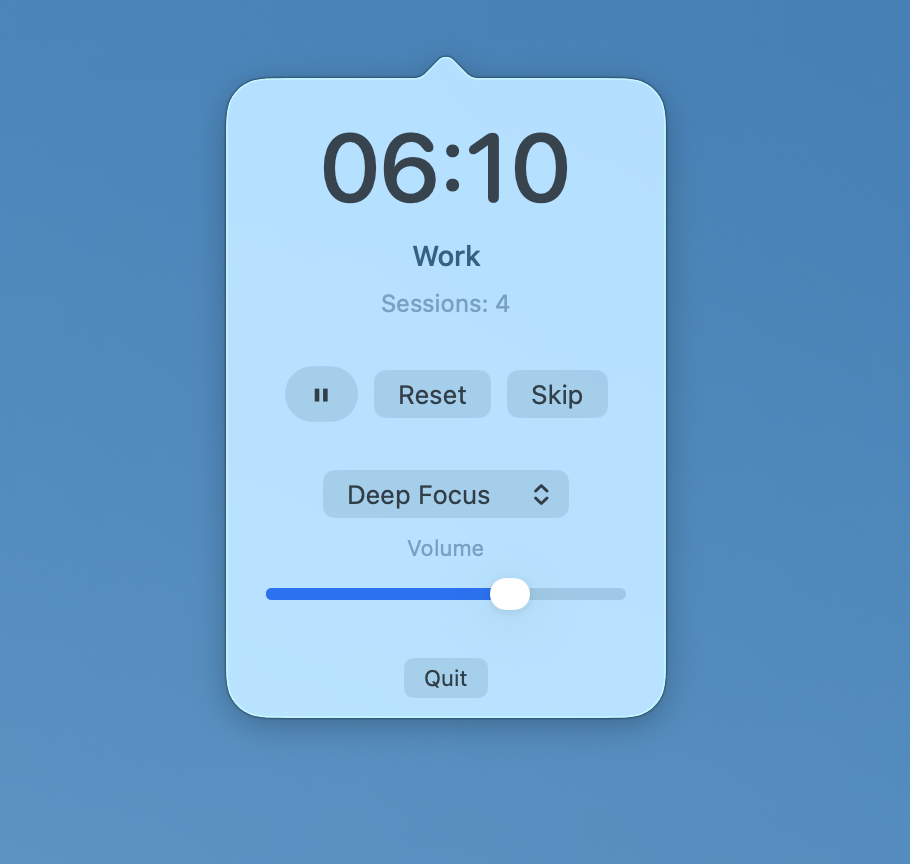
Tomatoes generates focus music designed for exactly this, holding a consistent sonic environment so your concentration has one less reason to scatter and can stay on the task long enough to build the habit of deep focus. It is free to try for 3 days, then from $4.99 a week, $29.99 a year, or $39 for lifetime access. If concentrating is a daily struggle, a calmer, more consistent focus environment is one of the simplest places to start: try Tomatoes free for 3 days.
Concentration is not a gift some people are born with and others are denied. It is a trainable skill sitting on top of a few unglamorous foundations, sleep, single-tasking, a cared-for body, and a distraction-free environment, and strengthened by deliberate practice. The modern world has quietly made it harder by filling every moment with novelty, but the levers to rebuild it are entirely in your hands. Protect the foundations, remove the triggers, train the muscle, and the concentration you thought you had lost turns out to have been there all along, waiting for a quieter place to work.