Most people can tell you their learning style. They are a visual learner, or they learn by doing, or they need to hear something explained. Surveys of teachers routinely find that a large majority believe matching instruction to a pupil's learning style improves results, and the idea is so widely taught that questioning it feels like questioning something obvious. It is worth being direct: the specific claim that people learn better when material is presented in their preferred style is not supported by the evidence, and it has been tested properly for decades.
That is not the same as saying everyone learns identically, or that preferences are imaginary. This article covers what the theory actually claims, the specific test that matters and what it found, why the belief is so persistent even among people who have looked at the evidence, what the honest version of individual differences looks like, and what genuinely improves learning instead.
What the Theory Actually Claims
There are dozens of learning-styles frameworks, but the popular one is VAK, or VARK: learners are sorted into visual, auditory, reading/writing, and kinaesthetic types, usually by a short self-report questionnaire.
The important thing is to be precise about the claim being tested, because there are three distinct statements bundled together and only one of them is contested.
People have preferences about how material is presented. True, and uninteresting. Plenty of people prefer diagrams to lectures.
People differ in ability and prior knowledge. Obviously true, and it matters enormously.
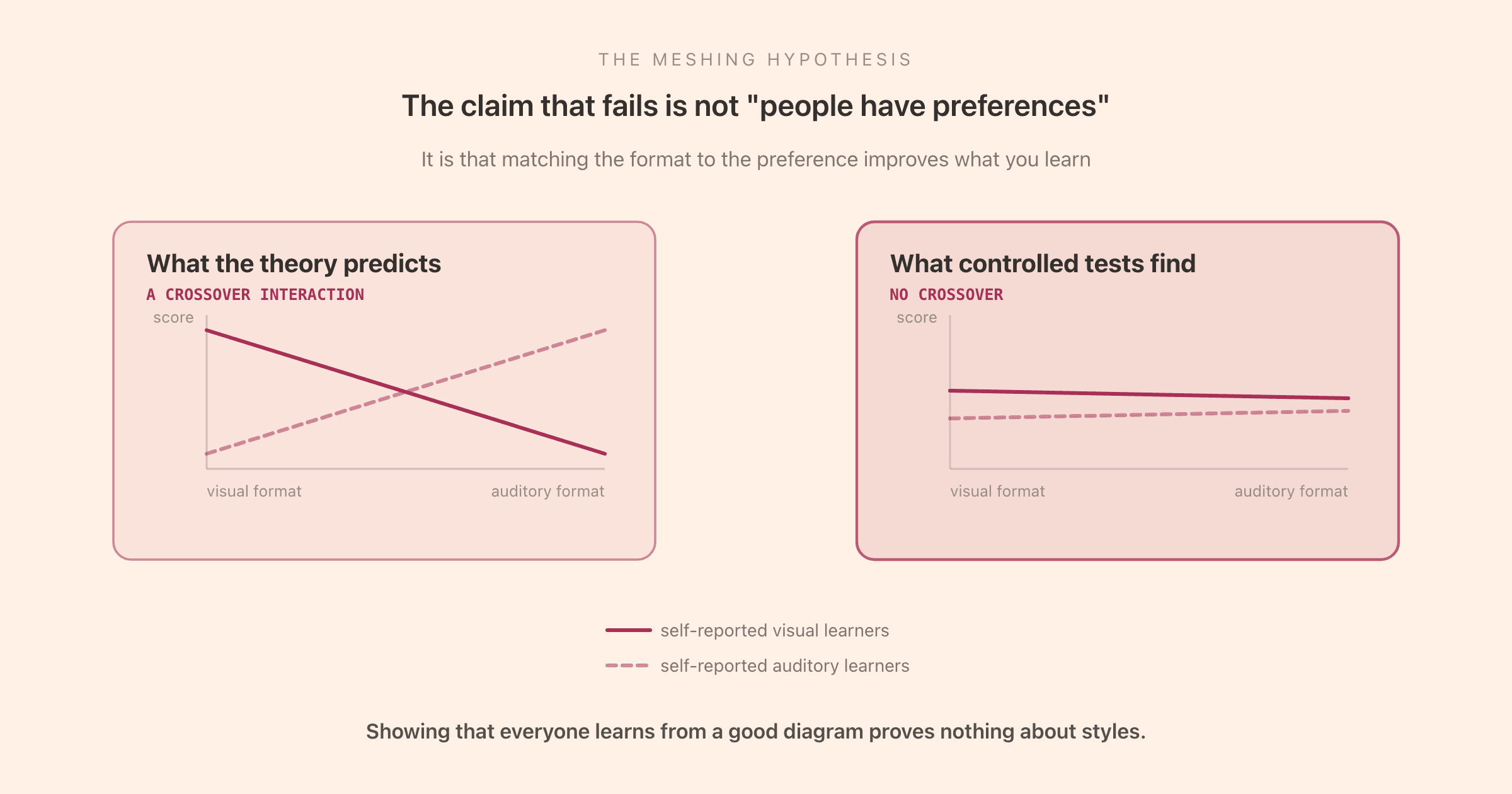
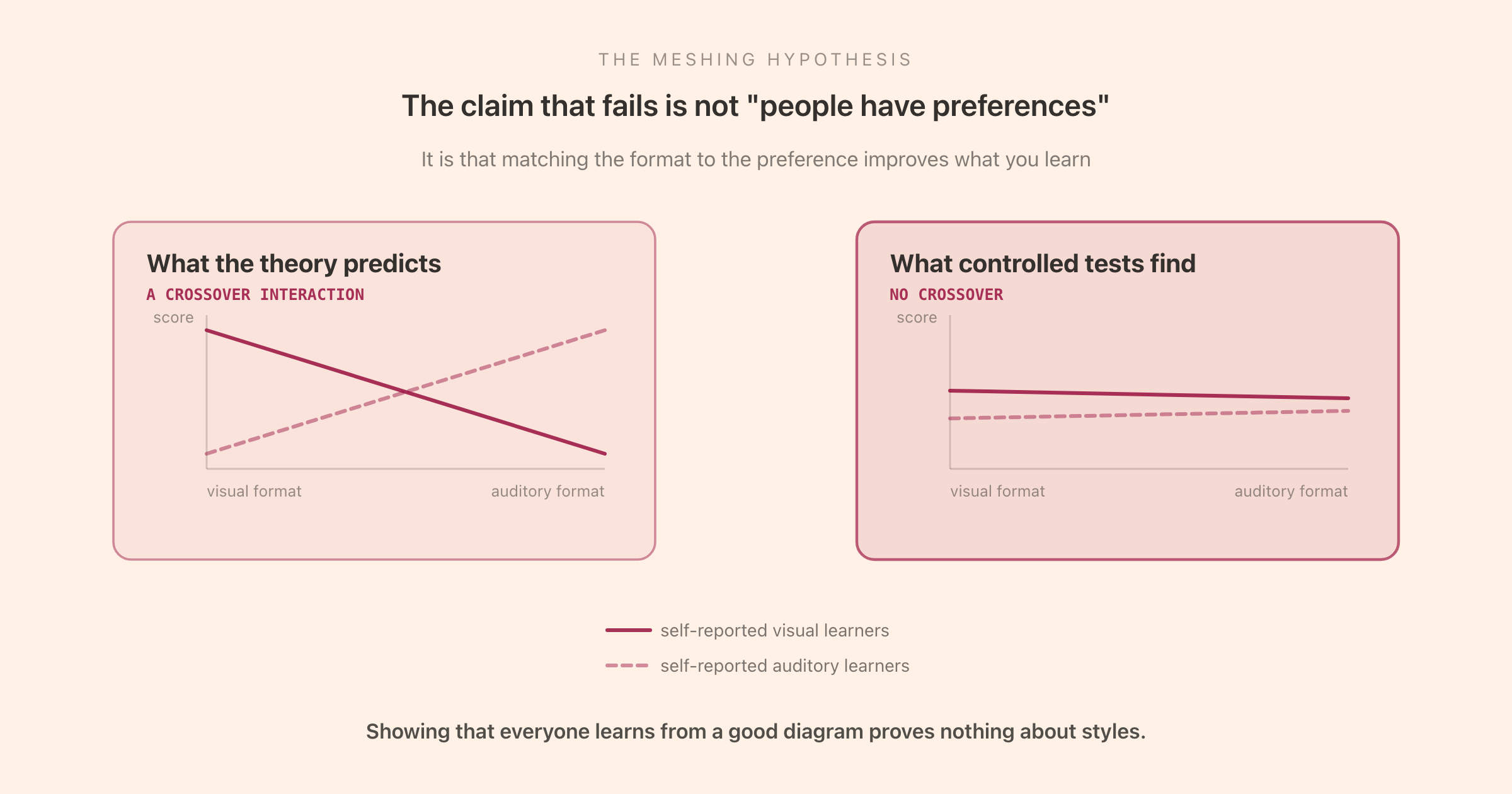
Matching the format of instruction to a learner's preferred style improves how much they learn. This is the actual learning-styles hypothesis. Researchers call it the meshing hypothesis, and it is the one that fails.
Conflating the first with the third is what keeps the idea alive. Preferring diagrams is real. Learning more from diagrams because you prefer them is what the evidence does not show.
Where the Idea Came From
The theory did not emerge from a single discredited study. It accumulated, which is part of why it is so hard to dislodge.
The idea of matching teaching to individual difference has roots going back to mid-century educational psychology, but the versions people recognise are more recent. Rita and Kenneth Dunn built a widely sold model from the 1970s. David Kolb published an influential account of experiential learning styles in 1984, based on how people prefer to move through concrete experience, reflection, abstraction, and experimentation. And in 1987 Neil Fleming introduced VARK, the visual, auditory, reading/writing, kinaesthetic scheme that became the popular version, originally as a tool to prompt teachers and students to think about how material was presented.
Then it multiplied. A 2004 review by Frank Coffield and colleagues for the UK's Learning and Skills Research Centre set out to survey the field and identified 71 distinct learning-styles models in circulation. Their assessment was blunt: most had weak theoretical foundations, and many of the instruments used to measure style had poor reliability and validity, meaning the same person could be sorted into different categories depending on which questionnaire they filled in, or even on when they filled it in.
That proliferation is itself informative. A field with 71 competing taxonomies and no agreement on what the categories are is not a mature science converging on an answer; it is a marketable idea generating products. A great deal of the learning-styles industry has always been commercial, sold as training, questionnaires, and certification, which is one reason the evidence base and the popularity have moved in opposite directions.
The Test That Matters
Testing meshing properly requires a specific design, and it is worth understanding, because most of what gets offered as evidence does not meet it.
You need to classify learners by style, then randomly assign them to different instructional formats, so that some learners get their preferred format and others do not, and then test everyone on the same material. If the theory is right, you should see a crossover interaction: visual learners doing best with visual instruction, auditory learners doing best with auditory instruction. What you must not do is simply show that everyone learns from a nice diagram, which shows nothing about styles at all.
In 2008, a review commissioned for Psychological Science in the Public Interest, by Harold Pashler, Mark McDaniel, Doug Rohrer, and Robert Bjork, went looking for studies meeting this standard. They found that although the learning-styles literature was enormous, very few studies used the required design. Of those that did, the great majority found no crossover interaction, and the handful reporting positive results had methodological problems. Their conclusion was that there was no adequate evidence base to justify incorporating learning styles into education, and that given the cost of doing so, the practice was not warranted.
Subsequent work has largely reinforced this. Studies giving students material in their preferred format have generally found no reliable improvement in test performance, including studies where students who correctly identified their style and studied accordingly did no better than those who did not. One consistent finding is that students' self-reported styles frequently fail to predict which format actually works best for them.
Why the Belief Persists
The evidence has been clear for a long time, so the interesting question is why the idea is not merely surviving but thriving.
It contains something true. Preferences are real, and people can accurately report them. The leap from "I prefer this" to "I learn better this way" feels tiny and is where the whole thing goes wrong.
Fluency feels like learning. Material presented in a format you enjoy feels easier to process, and that ease is routinely mistaken for having learned it. This is the same illusion that makes re-reading feel more productive than self-testing, described in the guide to memory.
It is a kind explanation. "You are a kinaesthetic learner in a system built for readers" is a much more generous account of struggling than most alternatives, and it protects self-esteem. That is not nothing, and it partly explains the resistance to giving it up.
It sounds scientific. A questionnaire, a category, a label. The apparatus of measurement is present even where the validity is not.
Nobody wants to be told they wasted the effort. Teachers who have redesigned lessons around styles, and students who have organised years of study around a label, have a genuine investment in it being true.
There is also a real cost, which is why this matters rather than being a harmless simplification. Time and money spent on style questionnaires and style-matched materials are not spent on methods that do work. Labelling a child a non-visual learner can narrow what they are offered. And a student who believes they cannot learn from text has been handed a reason to avoid the format most of their education will arrive in.
What Is Actually True About Individual Differences
Rejecting learning styles does not mean everyone is the same. Several individual differences are real and well supported.
Prior knowledge is the single biggest predictor of how easily someone learns new material in a subject, and it dwarfs anything style-related.
Interest and motivation genuinely change outcomes, which is part of why curiosity is worth cultivating deliberately.
Working memory capacity varies between people and affects how much can be handled at once, which is what the guide to cognitive load is about.
Background, language, and confidence all matter, sometimes a great deal.
And crucially: the best format depends on the material, not the learner. Teaching geography needs maps. Teaching pronunciation needs sound. Teaching surgery needs hands. Nobody learns the shape of Italy from a description or a bicycle from a diagram, and that is a fact about the content rather than about who is being taught. This is the sensible core that learning styles distorted: format matters, but it is dictated by what is being learned.
What Works Instead
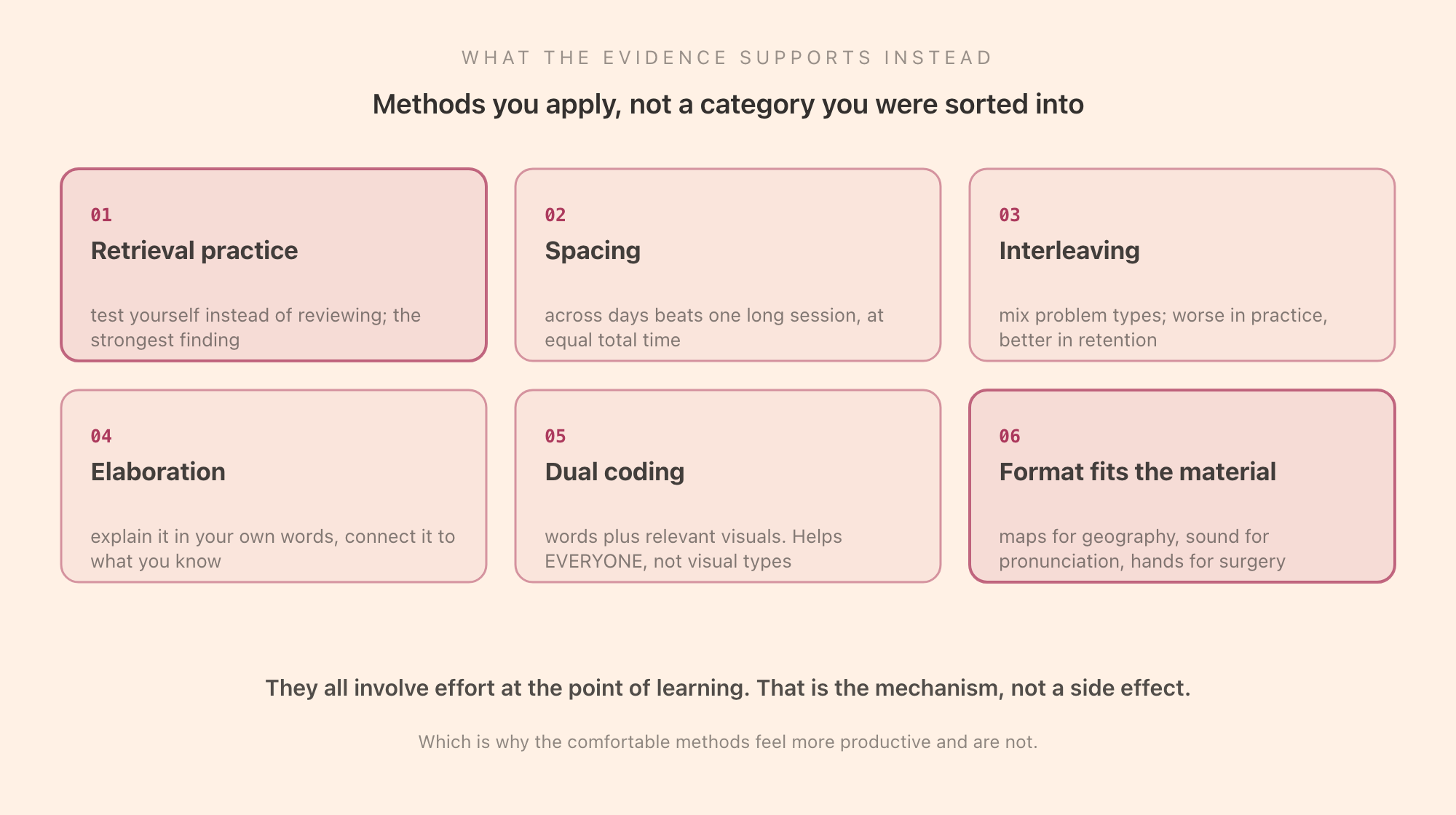
Retrieval practice. Testing yourself rather than reviewing. The best-supported finding in the whole field, and covered in the guide to active recall.
Spacing. Distributing study across days beats massing it, even at equal total time. See spaced repetition.
Interleaving. Mixing related problem types rather than blocking them. Feels worse during practice, produces better retention.
Elaboration. Explaining material in your own words and connecting it to what you already know.
Dual coding. Combining words with relevant visuals. Note carefully what this is: it helps everyone, not visual learners specifically, and it is close to the grain of truth that learning styles misread. The benefit comes from two complementary representations of the same idea, not from matching a personality type.
Concrete examples, especially several of them, so the underlying principle can be abstracted.
These share a family resemblance: they all involve effort at the point of learning, and they all feel harder than the comfortable methods. That is the mechanism, not a side effect.
The Honest Summary
If you take one thing from this: use the format the material demands, use the methods the evidence supports, and stop sorting yourself into a category. Your preference for diagrams is real and you can keep it. What you should not do is avoid a lecture, a textbook, or a practical because you have decided they are not your type.
The most useful reframe is that learning is not a fixed trait you have to work around, it is a set of methods you can apply. That is a considerably more optimistic position than the learning-styles one, which quietly tells people that their capacity is determined by a category they were sorted into by a ten-question quiz.
Where Focus Music Fits
There is one thing every method above depends on, whatever format the material is in: an uninterrupted stretch of attention. Retrieval practice, spacing, interleaving, and elaboration all require real cognitive effort, and effortful work is exactly what fragments first when the environment is noisy or interruptible.
That is the job Tomatoes is built for: focus music that gives you a steady, non-distracting sound environment, so a study session holds together long enough for the difficult, effective methods to be worth using. It is free to try for 3 days, then from $4.99 a week, $29.99 a year, or $39 for lifetime access. If you want your study time to earn its keep, try Tomatoes free for 3 days.
Learning styles is a rare case of a belief that is nearly universal, intuitively appealing, and not supported by the evidence, which makes it worth knowing about even beyond studying. The reason it survives is instructive: it takes something true, that people have preferences, and attaches to it something untested, that preferences determine how we learn best. Drop the second half and the first is still yours. Then spend the effort you were putting into finding your style on testing yourself instead of re-reading, which is boring, unglamorous, and works.