528 Hz is a tone. It is a single sustained pitch at 528 cycles per second, slightly above the C above middle C in the modern 440 Hz tuning system. That is the entire technical content of the claim. Everything else stacked on top, that 528 Hz is the "miracle tone", the "love frequency", that it repairs DNA, that it heals, that it raises consciousness, that it was hidden by the Catholic Church in the Middle Ages, that it is encoded in the Book of Genesis, comes from a chain of weakly-sourced books and YouTube videos written between roughly 1998 and the present, descending from a single self-published volume by Joseph Puleo and Leonard Horowitz called Healing Codes for the Biological Apocalypse (1999). None of those claims survives a few hours with the peer-reviewed literature.
This article works through what 528 Hz actually is, where the solfeggio-frequency idea comes from (and why it is not actually medieval), what the most-cited 2010 study about 528 Hz and DNA actually measured (it is not what is claimed), what the broader picture of frequency-dependent biological effects looks like, and what the brain genuinely does respond to in audio. It continues the same arc as our deep dives on the Mozart effect in classical music for studying, 432 Hz tuning, the Schumann resonance, and brown noise. The pattern is consistent: a small kernel of real science gets wrapped in a much larger marketing layer, and the marketing is what people remember. If you want focus music built on frequencies the brain actually phase-locks to, that is what Tomatoes does. The rest of this article explains why we do not build on 528 Hz.
What 528 Hz Actually Is
A musical frequency is a number of cycles per second of an oscillating air-pressure wave. 528 Hz is 528 such cycles per second. In modern musical notation with A tuned to 440 Hz, 528 Hz is the C above middle C, sharpened slightly. The exact pitch of "C5" varies by tuning system:
- In equal temperament with A4 = 440 Hz, C5 sits at 523.25 Hz.
- In just intonation tuned to A4 = 440 Hz, C5 can land at 528 Hz exactly (a 6:5 minor third above the A below it, depending on the reference note picked).
- In equal temperament with A4 = 444 Hz (a tuning sometimes used in the 528 Hz literature), C5 sits at 528 Hz exactly.
So "528 Hz" is approximately C5 in some tuning systems. It is not a special frequency. It is not a frequency that is hidden, suppressed, or absent from the modern Western musical scale. Any piano tuned slightly sharp will already include 528 Hz as one of its notes. Any saxophone sustaining a high C in some intonations will be playing close to 528 Hz. The note is not new and was not hidden; it has always been part of the audible frequency space that any pitched instrument produces.
The claim that 528 Hz is special is therefore not a claim about acoustics. It is a claim about a specific psychological, physiological, or biological effect that follows from a tone at this particular frequency, distinct from the effect of any neighbouring frequency. The strongest version of the claim is that 528 Hz repairs DNA. Weaker versions claim it reduces stress, induces a meditative state, boosts immunity, promotes "self-love", or "raises vibration". All of these are testable, in principle. The strong version (DNA repair) has been tested and the result is not what the marketing claims. The weaker versions have either not been tested rigorously or have been tested and showed nothing distinct from the response to any sustained tonal music.
Where the Solfeggio Frequencies Actually Come From
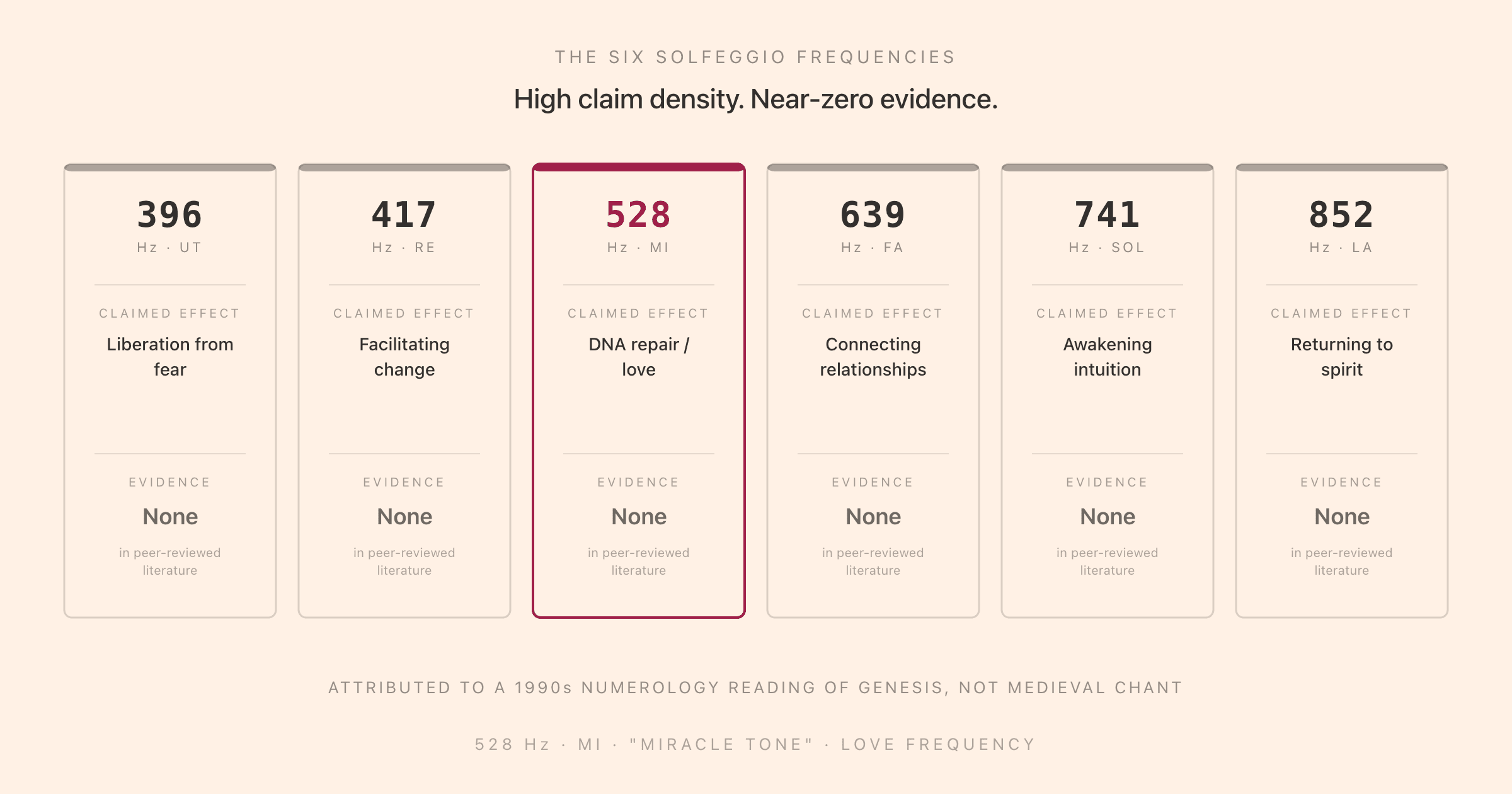
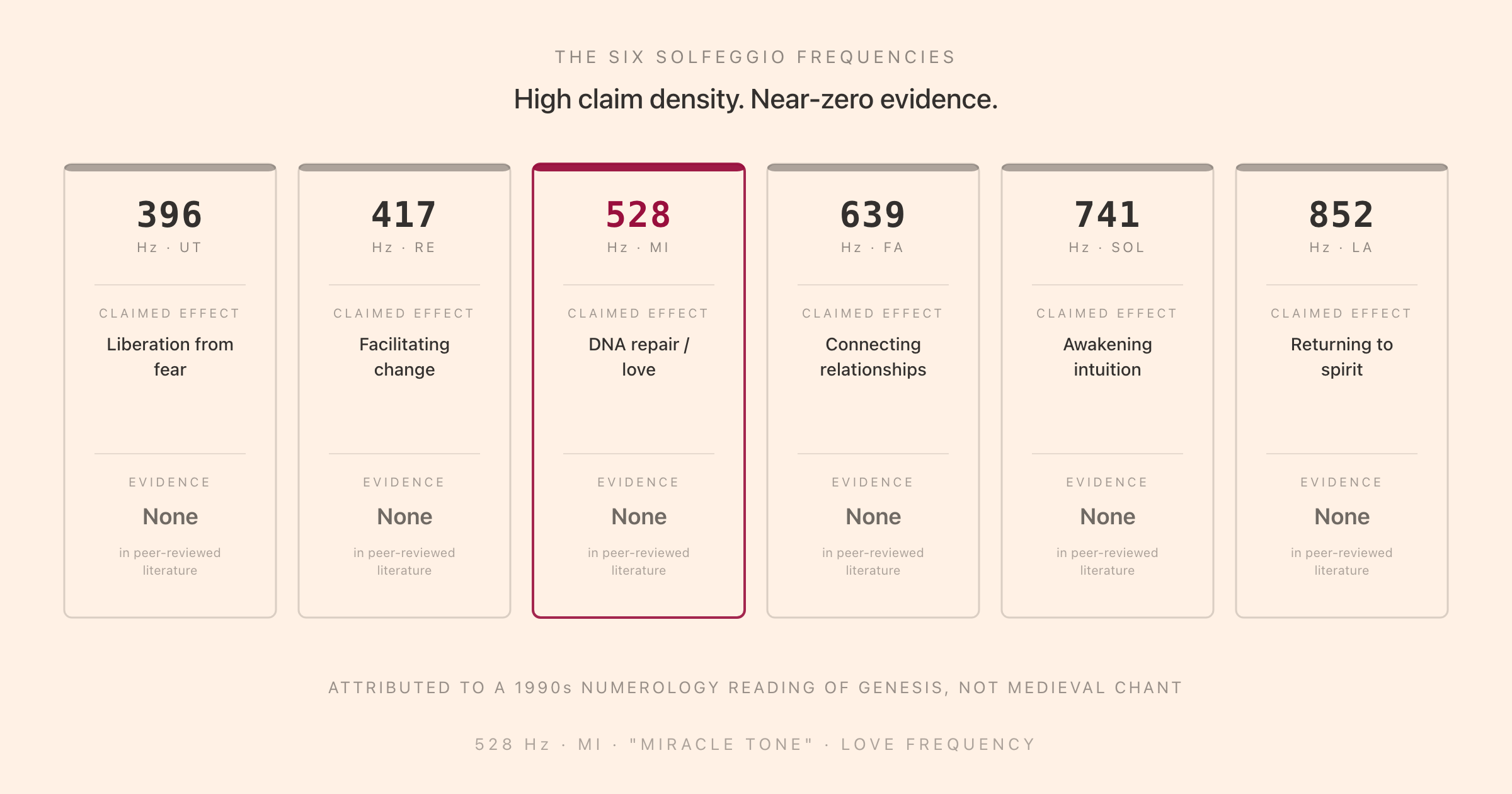
The "ancient solfeggio frequencies" (396, 417, 528, 639, 741, 852 Hz) are routinely described as a six-tone scale used in Gregorian chants and lost in the 13th or 14th century. This is not historically true.
The medieval Ut queant laxis hymn, attributed to Guido of Arezzo (c. 991-1033), gave its first six syllables (Ut, Re, Mi, Fa, Sol, La) to the names of six successive notes of a hexachord, the basis of medieval solfege. Those names are real. The frequencies attached to them are not. Medieval music had no concept of absolute pitch in hertz, because the hertz was not defined as a unit until 1930 (named after Heinrich Hertz, who died in 1894). Medieval and Renaissance pitch was relative, varied wildly between regions and eras (see the documented range from 380 Hz to 480 Hz for "A" before standardisation), and was not tracked in a way that could produce a fixed numerical scale of "true" frequencies.
The specific number 528 Hz, as a "miracle tone" tied to "Mi" and the third syllable of Ut queant laxis, originates not in any medieval source but in Healing Codes for the Biological Apocalypse (1999) by Joseph Puleo and Leonard Horowitz. Puleo, a self-described herbalist and alternative healer, wrote that he received the six frequencies in a numerological reading of the Book of Numbers in the Old Testament, specifically chapter 7, verses 12-83. He claimed to have used "Pythagorean reduction" (repeatedly summing the digits of a number until a single digit results) to extract "missing" frequency codes from the Hebrew text. The six frequencies are constructed by taking certain verse numbers and adjusting them upward into the audible range.
This is not an objection from a position of skepticism toward Hebrew biblical numerology in general. It is a more specific objection: the procedure that produces the numbers 396, 417, 528, 639, 741, and 852 is a 1990s numerological exercise on a Christian-translated Old Testament passage, not a medieval music tradition, not an ancient acoustic system, and not anything that can be derived independently from Greek, Latin, or Hebrew sources before 1999. The claim that these are "ancient solfeggio frequencies" is a marketing rebrand of a 1990s self-publication.
This matters because if the historical claim is wrong, then the implicit appeal-to-tradition argument falls. The 528 Hz claim must rest on the empirical evidence for the frequency producing distinct biological effects, not on its provenance.
The Babayi-Pour Paper That Started the DNA Claim
The most-cited piece of "evidence" for 528 Hz repairing DNA is a 2018 paper by Babayi and Riazi published in the Journal of Addiction Research and Therapy titled "The Effects of 528 Hz Sound Wave to Reduce Cell Death in Human Astrocyte Primary Cell Culture Treated with Ethanol". This is the paper that is linked in nearly every blog post and YouTube video that asserts a peer-reviewed basis for the DNA-repair claim. The paper's actual content does not match the way it is cited.
What the paper measured: human astrocyte cells (a brain-cell type) in primary culture were exposed to ethanol at concentrations from 100 mM to 200 mM, conditions that kill astrocytes through a known oxidative-stress pathway. Some cultures were simultaneously exposed to a 528 Hz sound wave at moderate volume; control cultures received either no sound or a different frequency. The authors measured cell viability and reported a small reduction in ethanol-induced cell death in the 528 Hz condition compared to controls.
What the paper did not measure: any direct effect on DNA. The paper does not contain a single measurement of DNA damage, DNA repair, or any DNA-related endpoint. The mechanism the authors discussed in the discussion was a possible reduction in oxidative stress, not "DNA repair", and was speculative; it was not supported by any oxidative-stress assay in the paper itself. The cell-viability finding has not been independently replicated in a higher-profile journal, the sample sizes were small (n in the low tens of replicates per condition), the journal ranks low in citation indices and uses an open-access pay-to-publish model with light peer review, and the authors disclose no DNA assays in the methods.
A reasonable summary of the paper: in a small, low-impact journal, a single laboratory reported that ethanol-exposed astrocyte cultures showed slightly higher viability when also exposed to 528 Hz sound. The result has not been replicated. The paper does not show DNA repair. The paper is consistent with a small acoustic-vibration-on-cell-membrane effect of the kind documented at much higher intensities for ultrasound, but it does not demonstrate any specific or unique effect of the frequency 528 Hz over neighbouring frequencies (the control conditions were "no sound" or a single comparison frequency, not a frequency-response curve).
The single-paper-with-an-overstated-headline pattern is common in this literature. The 432 Hz claims trace back to a similarly small RCT (Calamassi and Pomponi 2019) that has been similarly over-cited; see our 432 Hz article for the full breakdown. The Mozart effect traces back to Rauscher et al. 1993, also a small study, also subsequently failed to replicate; see classical music for studying. The pattern is not "no evidence exists"; it is "one underpowered, unreplicated study supports a much weaker claim than the marketing layer extracts from it".
What 528 Hz Cannot Mechanistically Do
Beyond the empirical question, there are mechanistic reasons to expect 528 Hz to produce no distinctive effect on DNA, on cell biology, or on cognition.
Acoustic energy at 528 Hz does not interact with DNA. DNA is a molecule about 2 nanometres wide. The wavelength of a 528 Hz sound wave in air is about 65 centimetres. The wavelength in water (closer to the relevant medium for cells) is about 2.8 metres. There are roughly seven orders of magnitude between the wavelength of audible sound and the size of a DNA molecule. Sound waves at audible frequencies cannot resolve, address, or selectively interact with structures at the nanometre scale. The acoustic-resonance argument that is occasionally made (DNA "vibrating in sympathy" with 528 Hz) is not a real physical mechanism at audible frequencies and audible intensities.
The brain does not phase-lock to carrier pitch. The auditory steady-state response (ASSR), the EEG signal that reflects the brain's phase-locking to a periodic auditory stimulus, peaks near 40 Hz modulation and falls off at higher and lower modulation rates. The carrier frequency of the tone (whether the underlying pitch is 528, 440, or 1000 Hz) does not change the ASSR pattern. The brain phase-locks to amplitude modulation, not to carrier pitch. We covered this in detail in our pieces on 40 Hz gamma and on neural phase locking. 528 Hz as a carrier produces no different ASSR than 524 Hz or 532 Hz at the same modulation depth.
Biomechanical resonance is not where 528 Hz lands. The mechanical resonant frequencies of the human body are well-characterised (chest cavity 4-6 Hz, eyeballs around 30-80 Hz, head 20-30 Hz, abdomen 4-8 Hz), and they all sit in the low-hertz range relevant to whole-body vibration exposure standards. None of them is anywhere near 528 Hz. The infrasonic and ultrasonic literatures contain real bioeffect findings, but they bracket the audible band; they do not single out audible-range frequencies in the few-hundred-hertz region.
The placebo effect on subjective relaxation is real but not 528-specific. Listening to any sustained, low-arousal tonal music induces parasympathetic activation, slower breathing, and self-reported relaxation. Studies that report "528 Hz reduces stress" with self-report endpoints typically have no acoustic control (a different sustained tone of comparable timbre and intensity) and no listener blinding. The reduction-in-stress finding generalises to almost any sustained tone in this register; it does not isolate 528 Hz as the active ingredient.
The combined picture: the acoustic mechanism for a unique 528 Hz effect on DNA does not exist; the brain's phase-locking response is not carrier-pitch dependent; the body's biomechanical resonances are in a different frequency range; and the subjective-relaxation reports do not separate 528 Hz from any other tonal stimulus. The predicted size of any specifically-528 effect on cognition or biology is small or zero, before any experiment is run.
What Tonal Stimulation Actually Does Do
The 528 Hz claim is interesting partly because it gets the right idea (the brain responds to specific patterns in audio) and applies it to the wrong feature of the signal (the carrier pitch instead of modulation, rhythm, and harmonic structure).
The cleaner version of the question is: what acoustic parameters does the auditory cortex actually respond to in a measurable, replicable way. A short list:
Modulation rate, especially near 40 Hz. Amplitude modulation at gamma-band rates (35-45 Hz) produces the strongest ASSR of any tested rate. This is the single most replicated finding in auditory entrainment. See the Tsai-Han-Tsai 2019 line of work and the GENUS protocol from MIT (Adaikkan et al. 2019, Martorell et al. 2019) for the clinical application of 40 Hz gamma sensory stimulation in cognitive disorders.
Tempo, in the breathing-rate range. Music with a tempo near 60 beats per minute (one beat per second) tends to slow breathing toward the same rate, which produces parasympathetic activation. Bernardi and colleagues (2006, 2009) demonstrated this with classical music and meditation traditions across multiple papers in Heart and the Journal of the American College of Cardiology. The mechanism is respiratory entrainment, not pitch.
Spectral pink-noise-like structure. Music with a 1/f spectrum (energy decreasing with frequency at roughly 3 dB per octave) is processed more efficiently by the auditory cortex and rated as more pleasant. Voss and Clarke (1975, 1978) characterised this in Nature; subsequent work (Levitin and colleagues 2012) connected it to musical preference. Most coherent tonal music (Bach, Debussy) sits near a 1/f spectrum.
Predictable harmonic motion. Music with predictable but not boring chord progressions activates dopaminergic reward systems (Salimpoor et al. 2011, Nature Neuroscience) and produces pleasure-correlated EEG signatures. This is about harmonic prediction, not frequency.
The Tomatoes app builds on the first of these (40 Hz amplitude modulation, occasionally combined with isochronic and binaural support tones in supported brainwave bands), with attention to spectral shape and harmonic motion in the layered ambient texture. It does not use 528 Hz as a special frequency, because there is no replicated mechanism by which 528 Hz would do anything different than 524 or 532 Hz at the same modulation depth.
Why the 528 Hz Claim Is So Sticky
A reasonable question is why the 528 Hz claim spreads as well as it does, given the absence of mechanistic or empirical support. A few factors converge.
The claim packages a specific number with a specific outcome. "DNA repair at 528 Hz" is more memorable than "tonal music in the 100-1000 Hz range produces relaxation". Specificity is a memetic advantage even when the specificity is fictional.
The claim provides a low-cost intervention. Listening to 528 Hz on YouTube is free, requires no device, no doctor, no commitment. The cost-to-claimed-benefit ratio is favourable, which lowers the threshold for trying it. Trying it produces (typically) some subjective relaxation, which is then attributed to the frequency rather than to the act of listening.
The biblical numerology is a feature, not a bug, for a specific audience. For listeners who already believe that the Bible contains hidden numerical truths, Puleo's derivation reads as evidence rather than as ad-hoc post-hoc construction. The historical claim that the frequencies were "lost" by the Catholic Church adds a conspiracy element that pre-mobilises the same audience.
The marketing is decoupled from the evidence chain. YouTube channels with hundreds of millions of cumulative views on "528 Hz miracle tone" content rarely cite Babayi and Riazi 2018 explicitly, because that level of citation friction does not match the medium. The viewer hears "scientists have shown" and does not click through; the citation chain frays at the first link.
The pseudoscience-debunk arc is not as visible. Long-form takedowns sit on lower-traffic surfaces (a Wikipedia talk page, a blog post like this one, an academic comment) than the original claim. Both Wikipedia's article on "solfeggio frequencies" and several skeptic-community pieces document the Puleo origin, but they do not match the marketing layer in distribution.
This is not a moral judgement on listeners. It is an explanation for why a claim with no replicated empirical support can sustain a multi-million-view subgenre on YouTube. The same dynamic powers the brown noise TikTok wave (see our brown noise piece), the Schumann-resonance market (see the Schumann piece), and the 432 Hz market.
So Should You Listen to 528 Hz?
If the answer is "I find it relaxing", then: yes, listen to it. Listening to a sustained, gentle tonal piece of music for twenty minutes has small but real effects on heart rate, breathing, and self-reported stress, regardless of the specific carrier frequency. The placebo effect is also real, and there is no harm in receiving a placebo effect from a free YouTube track. None of this article should be read as "do not listen to 528 Hz audio".
What this article argues against is much narrower: the specific claim that 528 Hz, as opposed to neighbouring frequencies, produces a distinctive biological or cognitive effect, including DNA repair, immune activation, cellular healing, or any other strong claim. That claim does not survive the historical evidence (the frequencies are not ancient), the empirical evidence (the Babayi paper does not measure DNA and has not been replicated), or the mechanistic evidence (audible-frequency sound does not interact with nanometre-scale molecules and the brain phase-locks to modulation, not carrier pitch).
The cleaner version of "I want to use audio for focus or relaxation" is: pick an acoustic parameter the literature actually supports, and use that. For relaxation, slow tempo (60 bpm) and 1/f spectral shape. For focus, gamma-band amplitude modulation (40 Hz) layered into broadband content. For sleep onset, slow rolling pink-noise textures. None of these requires a special carrier frequency. None of these is a miracle tone.
If you want a focus-music app that is built on the parameters the literature supports rather than on a 1990s numerological reading of the Book of Numbers, that is what we are doing at Tomatoes. One-time $39, no subscriptions, runs offline. We picked 40 Hz gamma modulation (and the other replicated parameters) over 528 Hz for the same reason this article exists: the science is on a different layer of the signal than the marketing keeps pointing to.