Binaural beats are one of the most searched-for and most misunderstood ideas in the focus and sleep world. The promise is seductive: put on headphones, play a particular humming tone, and shift your brain into deep focus, calm, or sleep on demand. The reality is more interesting and more honest than either the hype or the dismissals suggest. Binaural beats are a genuine auditory phenomenon with a real, well-documented mechanism, modest and use-case-dependent evidence, and almost no downside to trying. This is the complete guide to what binaural beats are, how they work, what the science actually shows, and how to use them sensibly.
Think of this as the map of the whole topic. We will cover the core mechanism, the brainwave frequency theory, the honest state of the evidence across focus, sleep, and anxiety, how binaural beats compare to related methods, and the practical rules for using them. Along the way there are links to deeper dives on each piece, so you can follow the threads that matter to you.
What Are Binaural Beats?
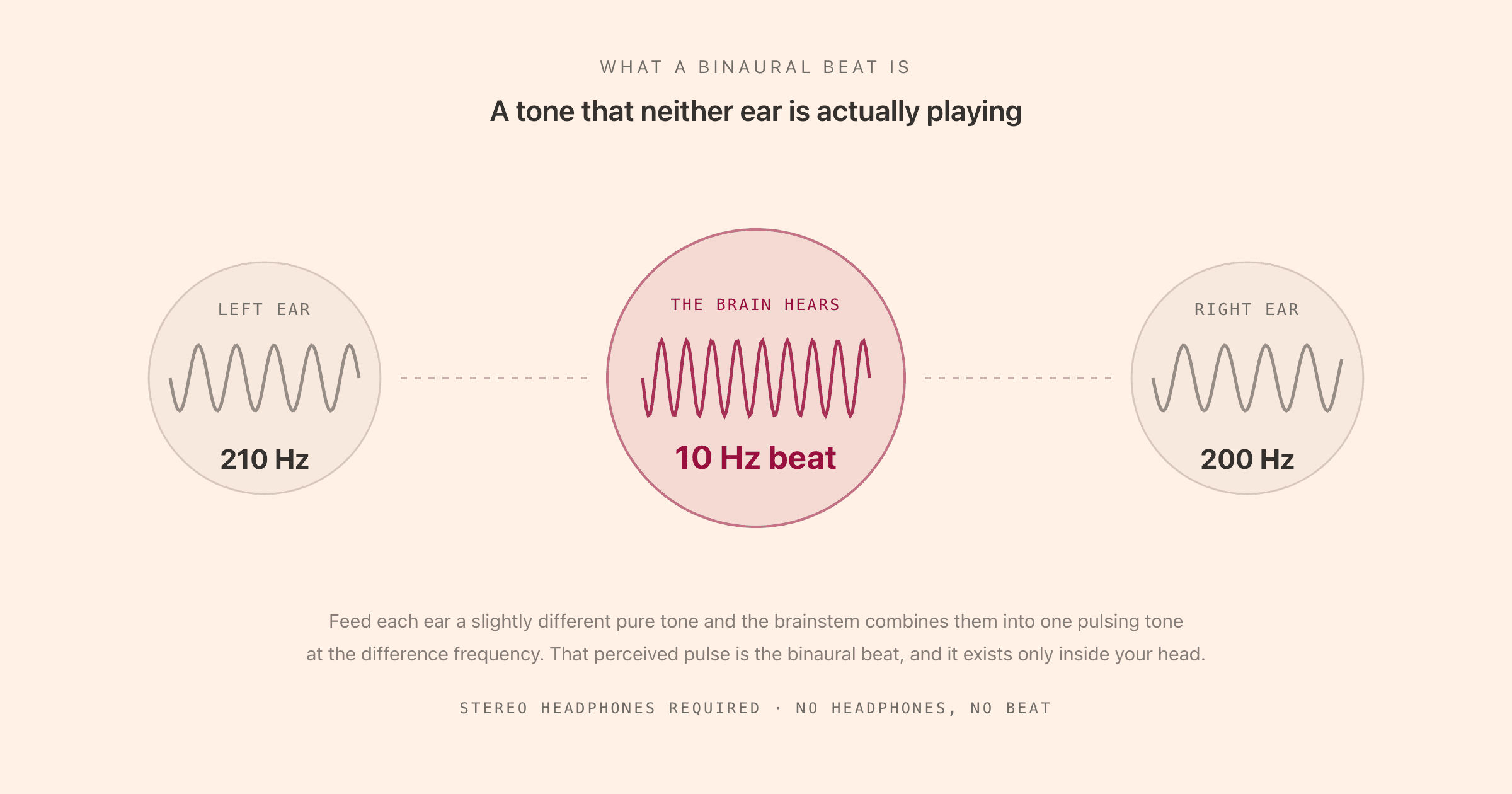
A binaural beat is an auditory illusion created by your brain. Play one pure tone at one frequency into your left ear, and a slightly different pure tone into your right ear, and you do not hear two separate tones. Instead your brain perceives a single tone that pulses, or beats, at a rate equal to the difference between the two.
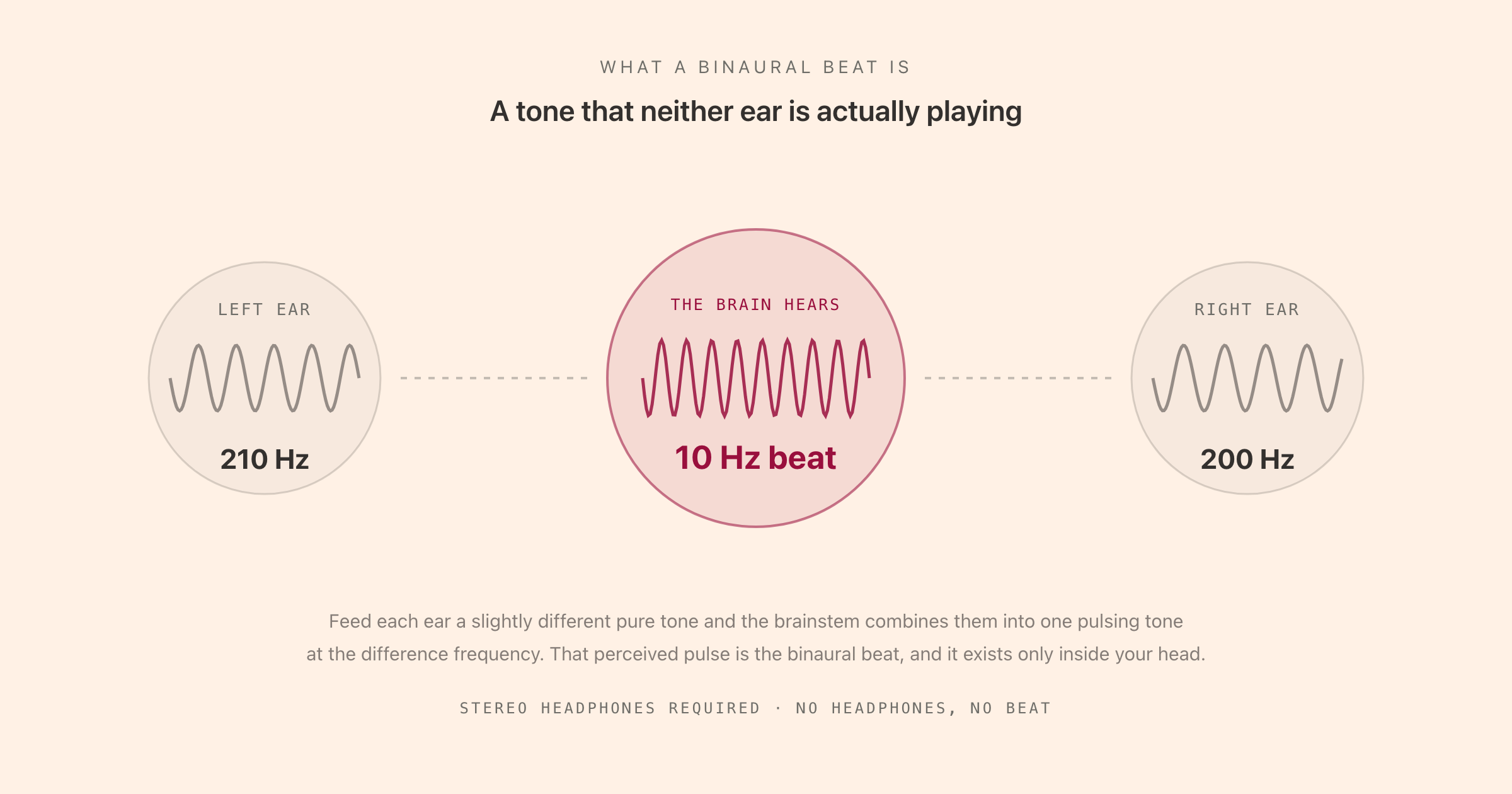
If your left ear gets 210 Hz and your right ear gets 200 Hz, you perceive a 10 Hz beat. That 10 Hz pulse is not present in the air, and neither speaker is producing it. It is constructed inside your auditory system when the brainstem combines the two signals. This is the single most important fact about binaural beats, and it has a practical consequence: you need stereo headphones. If you play both tones through a speaker, the frequencies blend in the air into an ordinary acoustic beat and the binaural illusion never forms. Each ear has to receive its own tone in isolation.
The difference frequency is what everything else is built on. A 10 Hz difference gives a 10 Hz beat, a 4 Hz difference gives a 4 Hz beat, and so on. The carrier tones (the 200-ish Hz pitches themselves) barely matter; it is the gap between them that defines the beat.
How Do Binaural Beats Work?
The mechanism people hope is at work is called the frequency-following response, or brainwave entrainment. The idea is that when you expose the brain to a steady rhythmic stimulus, populations of neurons begin to synchronise their firing to that rhythm. This is a measurable effect: feed the brain a rhythmic sound and you can detect a matching signal in the EEG, known as the auditory steady-state response.
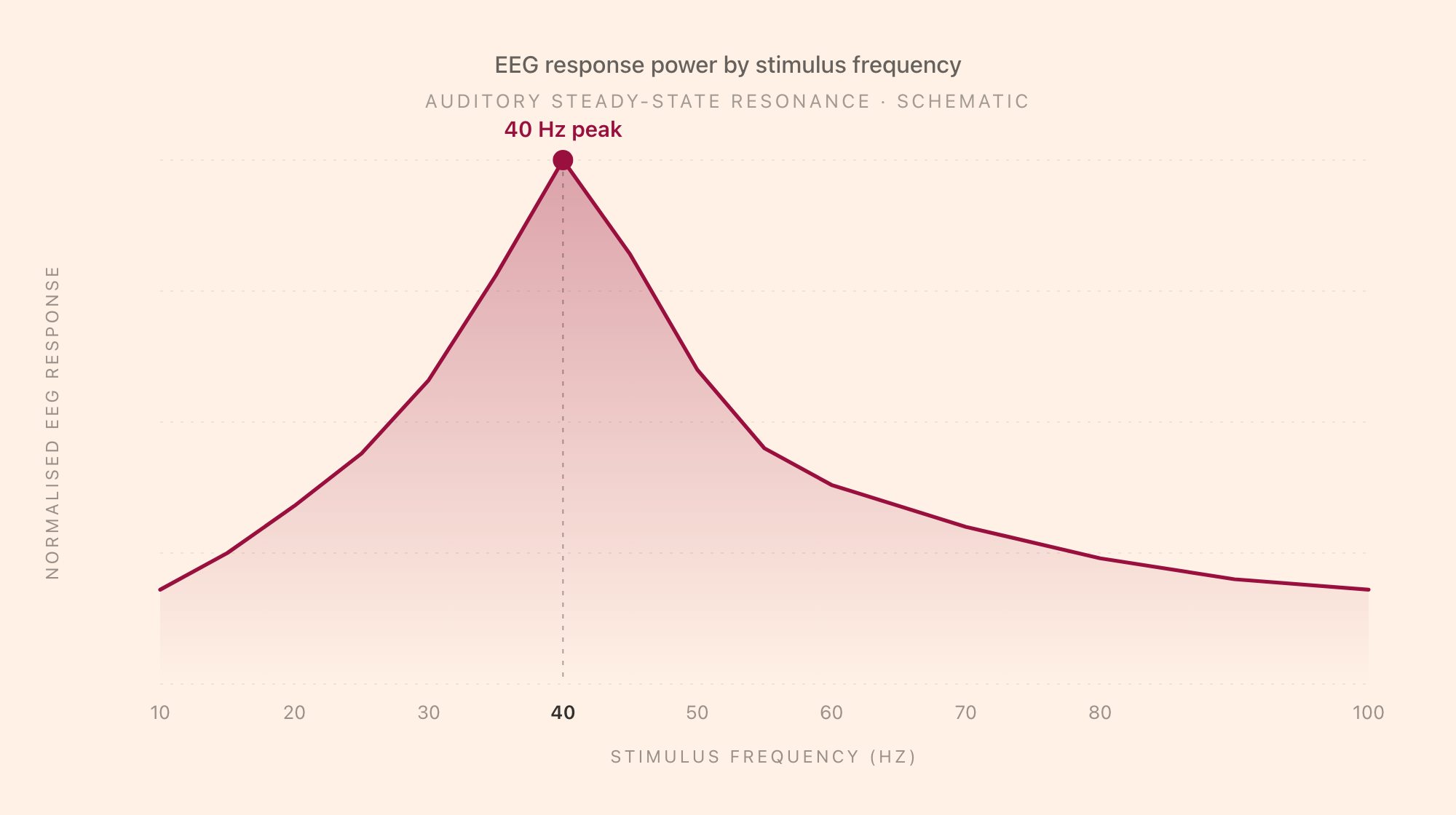
The brain genuinely does track rhythmic sound, and that part is not in dispute. The leap that the marketing makes is from "the brain tracks the rhythm" to "therefore the brain adopts the whole mental state associated with that rhythm." Those are not the same claim. Tracking a stimulus in the auditory cortex is a long way from pulling your entire brain into, say, a deep-sleep state on command. Whether binaural beats can reliably shift global brain states, rather than just producing a localised steady-state response, is exactly the question the research has struggled to answer cleanly. Keep that distinction in mind, because it explains why the evidence below is more "promising and mixed" than "proven."
The Frequency Map: Which Beat for Which State
The reason different binaural tracks aim at different frequencies is the brainwave map. Your EEG runs at different dominant frequencies depending on your state, from slow delta waves in deep sleep up to fast gamma waves during intense concentration. Binaural tracks set their difference frequency to match the band associated with the state you want.
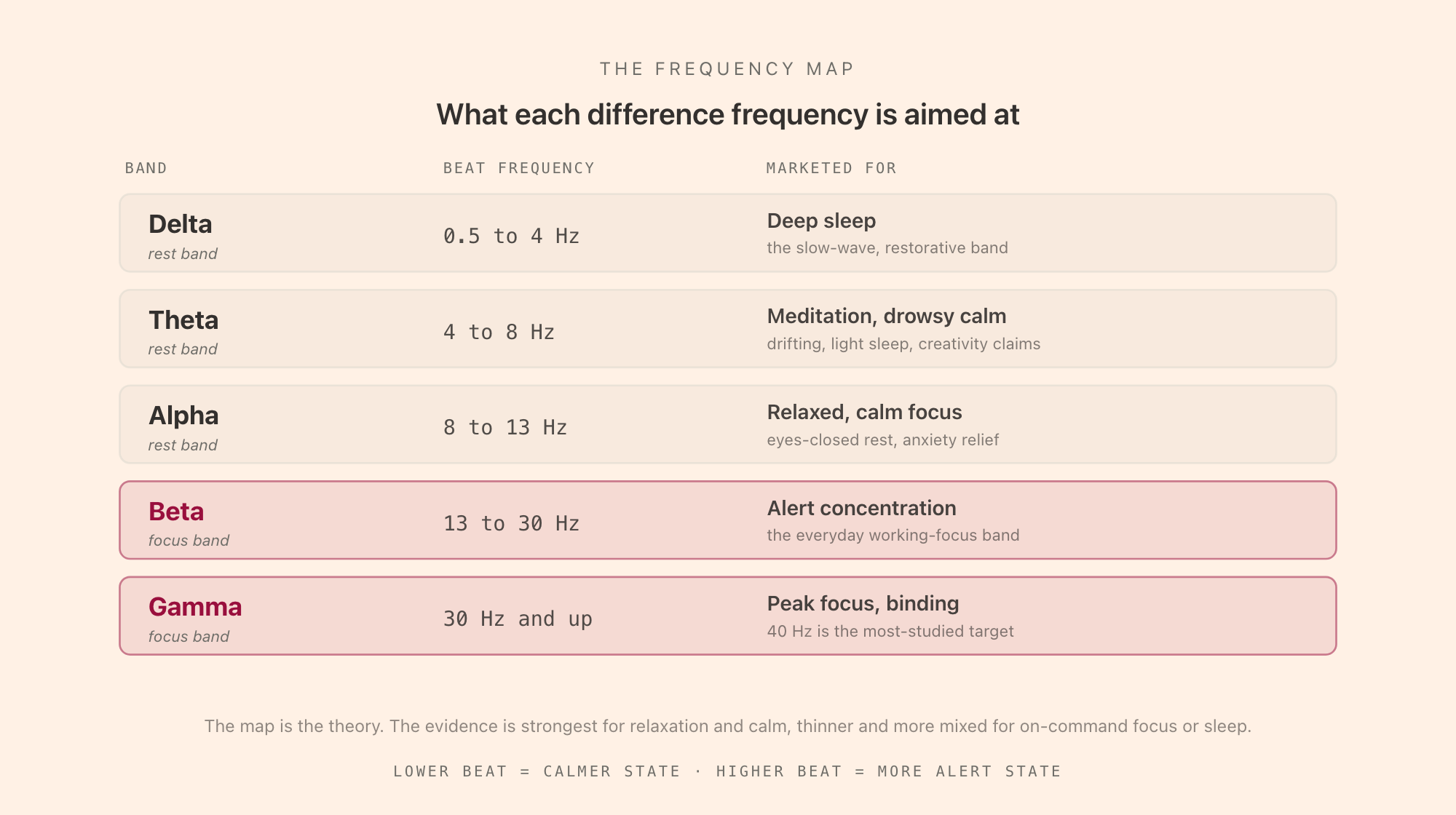
The general logic is that lower beat frequencies aim at calmer states and higher ones at more alert states:
- Delta (0.5 to 4 Hz) is the deep-sleep band, which is why sleep tracks aim here. We cover this in depth in the guide to binaural beats for sleep.
- Theta (4 to 8 Hz) is associated with drowsy calm, meditation, and the edge of sleep.
- Alpha (8 to 13 Hz) is the relaxed, eyes-closed band linked to calm and reduced anxiety, and to a gentle, unforced kind of focus. See how alpha waves relate to focus.
- Beta (13 to 30 Hz) is the everyday working-focus band, the rhythm of alert, engaged concentration. More in beta waves and focus.
- Gamma (30 Hz and up) is the fast band tied to peak concentration and feature-binding, and the 40 Hz target is the most-studied of all. See 40 Hz gamma waves.
The map is the theory. How well the practice matches it is the next question.
Do Binaural Beats Actually Work?
The honest answer is: it depends what you want them to do, and the evidence is uneven across uses. The research base is made up largely of small studies, often without rigorous controls, so confidence should be moderate. With that caveat, a few patterns hold up better than others.
For relaxation and anxiety, the evidence is relatively encouraging. Several studies have found that listening to binaural beats lowered self-reported anxiety and increased feelings of calm. This is probably the most credible benefit, and it makes sense, because a steady, predictable, low tone is a natural focus for a restless mind.
For sleep, the strongest signal is subjective: people report falling asleep more easily and feeling more rested, with weaker and more contested evidence for measurable changes in sleep architecture. Much of the benefit may actually be the anxiety reduction above, which helps you wind down.
For focus and cognitive performance, the evidence is genuinely mixed. Some studies show small benefits to attention or working memory, others show none, and a few even show beta-frequency beats hurting performance on certain tasks. Part of the issue is that focus is fragile and easily disrupted, and an audible tone can be either a helpful anchor or a distraction depending on the person and the task.
So "do binaural beats work?" is best answered as: plausibly yes for calm and relaxation, possibly yes and at least harmless for sleep, and genuinely uncertain for raw focus. The most useful framing is that binaural beats are a low-cost, low-risk thing to experiment with, not a guaranteed cognitive switch.
Binaural Beats vs Other Methods
Binaural beats are one of several audio approaches that get lumped together, and it helps to know the differences.
Isochronic tones use a single tone switched rapidly on and off, rather than two different tones. Because the pulse is physically present in the sound, isochronic tones do not require headphones and produce a stronger, more obvious rhythmic stimulus. We compare them directly in isochronic tones vs binaural beats.
Solfeggio frequencies are a set of specific pitches (like 528 Hz) claimed to have special properties. These are a different and far less evidence-based idea than binaural beats, and we untangle the two in binaural beats vs solfeggio frequencies.
The short version is that isochronic tones are the closest cousin and arguably a stronger stimulus, while solfeggio frequencies are a separate and much shakier claim that often gets bundled in by marketers.
How to Use Binaural Beats
If you want to try them, a few rules give the effect its best chance:
- Use stereo headphones. Non-negotiable. The illusion cannot form without a separate tone in each ear.
- Match the frequency to the goal. Lower beats (delta, theta, alpha) for calm and sleep, higher beats (beta, gamma) for alertness. Use the frequency map above as your guide.
- Keep the volume low. You are giving your auditory system a steady rhythm to track, not trying to drown out the room.
- Give it a real trial. Use the same track for a couple of weeks and judge it on outcomes (did you focus, did you fall asleep) rather than on whether you "feel your brainwaves changing," which you will not.
- Treat it as one input. Binaural beats stack on top of good habits; they do not replace sleep, a sensible schedule, or a quiet environment.
Are Binaural Beats Safe?
For the vast majority of people, binaural beats are completely safe. They are just quiet sound. The main practical caution is the ordinary one for any headphone audio: keep the volume moderate to protect your hearing. There is one group who should be more careful, people with epilepsy or a seizure history, who should talk to a doctor first, since any rhythmic sensory stimulation warrants caution. We cover the full picture in the binaural beats safety guide.
The Bottom Line
Binaural beats are a real auditory illusion with a real mechanism, a plausible theory linking beat frequency to brain state, and honest, mixed evidence that is strongest for calm and relaxation, reasonable for sleep, and uncertain for focus. They are not magic, and any source promising guaranteed results is overselling. But they are cheap, safe, and easy to try, and many people find they genuinely help set the right mental tone.
That is the philosophy behind Tomatoes: real signal processing that generates clean binaural and noise-based audio for focus and for winding down, with an honest account of what the sound is doing and no mystical claims. If you would rather have a properly built tool than a random autoplaying loop, see the Tomatoes pricing and try it for yourself. And if you want to go deeper on any piece, follow the links above into the specific guides, starting with the apps worth using in our best binaural beats app comparison.