Metacognition is thinking about your own thinking: the mind's capacity to monitor what it knows, judge how well it knows it, and steer its own cognition accordingly. It is the layer that sits above learning and decides whether to keep studying or move on, whether you actually understand a paragraph or only feel like you do, and which strategy to reach for next. The reason it matters so much is that learning is only as good as the judgments that steer it, and those judgments are systematically unreliable. A learner with accurate metacognition studies the right things for the right amount of time; a learner with poor metacognition pours hours into material that feels learned and is not.
This piece is the cognitive-science version of metacognition: a precise definition (John Flavell's 1979 framing), the two components of knowledge and regulation, the Nelson and Narens monitoring-and-control loop that is the discipline's organising diagram, what judgments of learning are and why calibration matters, the fluency illusion that quietly corrupts those judgments, and the metacognitive strategies that actually improve learning. Tomatoes is a focus tool built for the working block where this kind of self-regulated study happens. The app is free for 3 days, then $4.99/week, $29.99/year, or $39 lifetime.
What Metacognition Actually Is
The metacognition definition that anchors the field comes from John Flavell, the developmental psychologist who introduced the term in his 1979 paper "Metacognition and Cognitive Monitoring." Flavell defined it as "cognition about cognitive phenomena," or more plainly, knowledge and cognition about cognitive objects. The shorthand "thinking about thinking" is accurate as far as it goes, but it undersells the point. Metacognition is not idle introspection; it is the regulatory system that takes the output of your own mind as its input and feeds decisions back down.
To answer the common question directly, what is metacognition in practice: it is everything you do that treats your own cognition as something to be observed and managed. Noticing that you have read the same sentence three times without absorbing it is metacognition. Deciding that you understand chapter four well enough to stop and that chapter five needs another pass is metacognition. Predicting, before an exam, which topics you would fail on is metacognition. The thinking is the object level; the noticing, judging, and deciding about that thinking is the meta level.
Crucially, metacognition is largely a learnable skill rather than a fixed trait. Reviews of classroom interventions consistently find that teaching students to plan, monitor, and evaluate their own learning produces some of the largest and most cost-effective gains in education. The Education Endowment Foundation's evidence syntheses rank metacognition and self-regulation among the highest-impact, lowest-cost strategies available, on the order of several additional months of progress. That is the practical stakes: metacognitive skills are trainable, and training them pays off more than almost anything else a learner can change.
The Two Components: Knowledge and Regulation
The standard model splits metacognition into two parts, a division that traces from Flavell through Ann Brown and into the widely used Metacognitive Awareness Inventory (Schraw and Dennison, 1994).
Metacognitive knowledge is what you know about cognition in general and your own cognition in particular. Flavell broke it into three kinds of variable. Person knowledge is what you believe about yourself and people as cognitive processors ("I retain diagrams better than prose," "everyone forgets names under pressure"). Task knowledge is what you know about how task demands shape difficulty ("recalling a definition cold is harder than recognising it in a list"). Strategy knowledge is what you know about which strategies work and when ("self-testing beats rereading for durable retention"). Metacognitive knowledge is the declarative layer, the model you carry of how your own mind works.
Metacognitive regulation is what you do with that knowledge: the active control of cognition while a task is underway. It is conventionally described as a cycle of three operations. Planning happens before the task: setting a goal, choosing a strategy, allocating time. Monitoring happens during: tracking comprehension and progress, asking "is this making sense, am I on track?" Evaluating happens after: judging how well the strategy worked and what to change next time. Knowledge without regulation is inert (you know testing beats rereading but reread anyway), and regulation without knowledge is blind (you monitor diligently but misread the signals). The two have to operate together.
The Monitoring-and-Control Loop
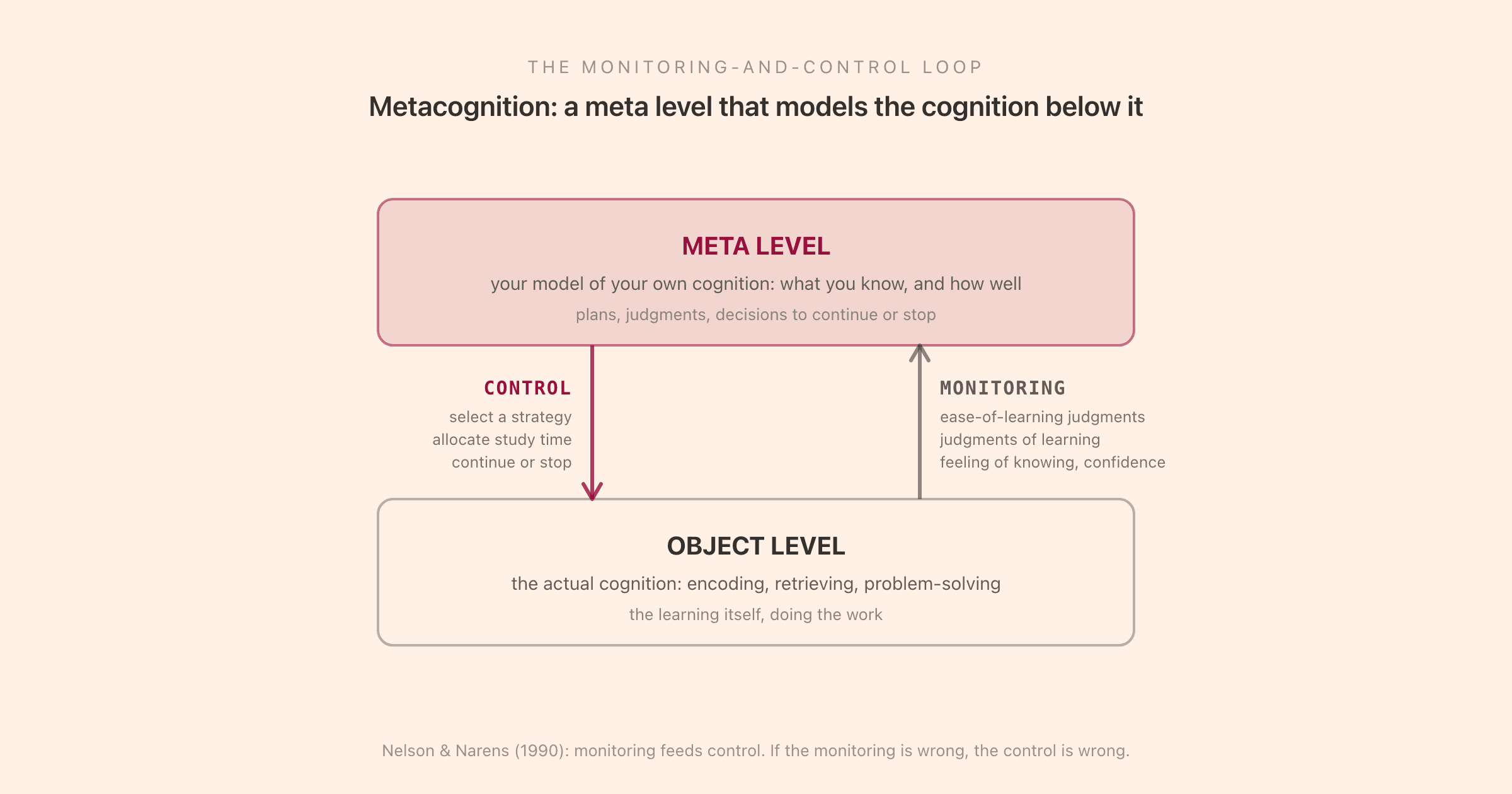
The most influential formalisation of metacognition is Thomas Nelson and Louis Narens's 1990 framework, and it is the diagram at the top of this article. It models the mind as two levels in constant communication.
The object level is ordinary cognition: the actual perceiving, encoding, retrieving, and problem-solving. The meta level holds a model of the object level, an internal representation of what the object level is doing and how well. The two levels are connected by two directions of information flow, and getting these two words right is the whole framework.
Monitoring is the flow of information upward, from the object level to the meta level. It is how the meta level stays informed about the state of cognition. Its outputs are the family of metacognitive judgments: ease-of-learning judgments (made before study, predicting what will be hard), judgments of learning (made during or after study, predicting future recall), feeling-of-knowing judgments (the sense that an unrecalled item would be recognised, the tip-of-the-tongue state), and confidence judgments (made after retrieval, rating how sure you are an answer is right).
Control is the flow downward, from the meta level to the object level. It is how the meta level changes what cognition does: selecting a strategy, allocating or withdrawing study time, deciding to continue, terminate, or restart. Control actions are driven by the readouts that monitoring provides.
The loop is the key idea. Monitoring feeds control: you decide how long to keep studying a topic (control) based on your judgment of how well you have learned it (monitoring). If the monitoring is accurate, the control is well-targeted and study time flows to where it is needed. If the monitoring is wrong, the control is wrong no matter how disciplined you are, because you are allocating effort against a faulty map. This is why the accuracy of metacognitive monitoring, not just its presence, is the thing that determines whether self-regulated learning works.
Judgments of Learning and the Problem of Calibration
A judgment of learning (JOL) is a prediction, made while or after studying an item, of how likely you are to recall it later. The quality that matters is calibration: the match between your judged learning and your actual performance. Perfectly calibrated learners are as confident as they are correct. Most learners are not perfectly calibrated, and the direction of the error is usually overconfidence.
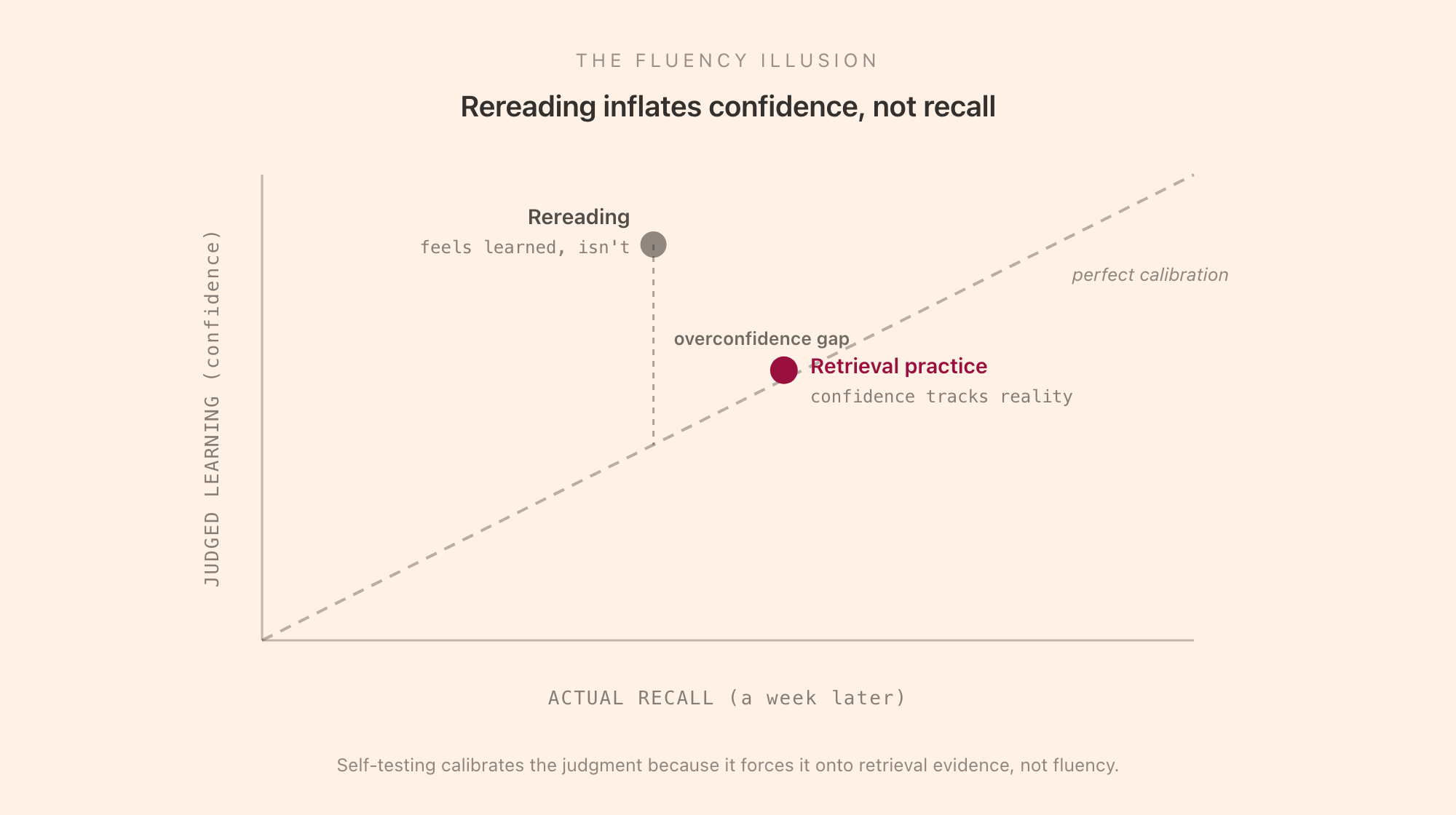
The miscalibration is not random; it has a specific cause, and the cause is the central practical lesson of this article. When information is easy to process, the mind reads that processing fluency as evidence of learning. Asher Koriat's cue-utilisation account (1997) showed that JOLs are inferential: we do not have direct access to the strength of a memory, so we base our judgments on cues, and fluency is a heavily weighted, frequently misleading cue. Material you have just reread is highly fluent (familiar, smooth, easy), so you judge it well learned. But fluency at the moment of study is a poor predictor of retrieval a week later, which is why rereading produces strong confidence and weak durable memory.
There is a clean fix that the science also identifies. Nelson and Dunlosky's 1991 "delayed-JOL effect" found that judgments of learning made after a short delay, rather than immediately after study, are dramatically more accurate, because a delayed judgment has to be based on an actual retrieval attempt rather than on the lingering fluency of just-read text. In other words, the way to calibrate is to test, not to reread and rate. This connects metacognition directly to active recall: self-testing is not only the best way to strengthen a memory, it is also the best way to measure it, because it forces the judgment onto retrieval evidence instead of fluency.
The Fluency Illusion in Practice
The fluency illusion (also called the illusion of competence or illusion of knowing) is the everyday face of poor calibration, and it explains why the least effective study methods are the most popular. Rereading and highlighting feel productive precisely because they manufacture fluency: the text gets easier to process each pass, the mind misreads ease as mastery, and the JOL climbs while actual storage barely moves. Students consistently rate rereading and highlighting as top strategies, and the large 2013 review by Dunlosky and colleagues rated both as low-utility, while practice testing and distributed practice came out on top. The gap between what feels effective and what is effective is a metacognitive failure.
The illusion has a well-known extreme. Kruger and Dunning (1999) framed the overconfidence of poor performers as a metacognitive deficit: the same lack of skill that produces poor performance also removes the ability to recognise it, because evaluating your own competence requires the very competence you lack. Whatever the finer statistical debates about that effect, the underlying point is sound and general: monitoring your own knowledge is itself a skill, and where it is weak, confidence detaches from accuracy.
The defence against the illusion is to stop trusting the feeling of fluency and start generating hard evidence. Any judgment of learning based on "this looks familiar" is contaminated; a judgment based on "I just produced this from a blank page" is not.
Metacognitive Strategies That Actually Work
The point of all this is operational. Here are the metacognitive strategies, and the metacognition examples that make them concrete, that the evidence supports.
- Plan before you start. Set a specific goal for the session, choose the strategy deliberately (retrieval, not rereading), and decide roughly how to allocate time across topics based on what you already know is weak. A student who looks at a practice-test result and routes the next session to the three worst topics is doing data-driven control.
- Monitor while you work. Run periodic comprehension checks: pause at the end of a section and try to summarise it from memory. The moment you cannot is a monitoring signal that the section is not learned, and the correct control response is to restudy it now, not to read on.
- Calibrate with low-stakes testing. Use frequent self-testing as your monitoring instrument, because it produces accurate JOLs where rereading produces inflated ones. Make your judgments of learning after a retrieval attempt and, ideally, after a delay.
- Self-explain. Ask "why is this true, how does it connect to what I already know?" Self-explanation forces the meta level to inspect the depth of understanding rather than its surface fluency, surfacing gaps that rereading hides.
- Evaluate afterward. After the session, review what worked: which topics still failed, which strategy paid off, what to change. This is the evaluating phase that turns one session's monitoring into next session's better plan.
The unifying logic is to replace fluency-based judgments with retrieval-based ones at every step. Metacognitive skill is not vague self-awareness; it is the disciplined habit of generating honest evidence about your own knowledge and acting on it.
Where Metacognition Meets Working Memory and Executive Function
Metacognition does not run on free resources. Monitoring and control are themselves effortful cognitive operations that compete for the same limited capacity as the task they oversee. The meta level runs through the executive function system, the prefrontal control machinery that handles goal maintenance, monitoring, and the inhibition needed to override a habitual but ineffective strategy. And it leans on working memory: holding the goal, the current progress, and the standard you are checking against all occupy the same small workspace that the object-level task is using.
This has a real consequence. When the object-level task is hard enough to consume all available working memory, there is little capacity left for monitoring, and metacognition degrades exactly when you most need it. It is part of why people fail to notice they have stopped understanding a difficult text: the difficulty has eaten the resources that would have flagged the failure. Reducing extraneous load, so that some capacity remains free for the meta level to do its job, is therefore not a luxury. It is a precondition for accurate self-monitoring.
How Metacognition Fits a Focus Block
A structured focus block is a good container for metacognitive practice because it builds the plan-monitor-evaluate cycle into the cadence of the work. A pomodoro-style block begins with a planning step (decide what this block is for and which strategy it will use), runs as a protected window of monitored work (with the rule that the activity is retrieval, not rereading), and ends with a natural evaluation point at the break (what got learned, what failed, what the next block should target). The boundaries of the block prompt the metacognitive operations that an unstructured study session lets slide.
It also pairs cleanly with spaced repetition: the data from each block's self-testing is the monitoring signal that schedules what to revisit and when. Metacognition decides what needs review; spacing decides when the review lands; retrieval is what the review consists of. The three are one system seen from three angles.
How Tomatoes Fits
Tomatoes does not do your metacognition for you. No app can monitor your understanding or calibrate your judgments; those are operations only the learner can run. What a focus tool can do is protect the conditions under which the meta level has the spare capacity to work: a stable acoustic environment (focus music, brown noise, or binaural beats) that reduces the extraneous load competing for working memory, a timer that imposes the plan-monitor-evaluate cadence, and a deliberately distraction-free surface that makes it easier to notice when attention has drifted, which is itself a monitoring act.
The fit is honest and narrow. The judgments, the strategy choices, and the discipline to test rather than reread are yours. The app holds the block in which you can do them without the environment fighting you. Tomatoes is free for 3 days, then $4.99/week, $29.99/year, or $39 lifetime. It runs locally as a desktop app with a system menu-bar companion, generates the audio in real time, and is built for working blocks of a few hours a day.
The Short Version
Metacognition is the monitoring-and-control layer that sits above cognition and steers it. Flavell's 1979 framing splits it into metacognitive knowledge (what you know about how your mind works) and metacognitive regulation (the plan-monitor-evaluate cycle that manages cognition in real time). The Nelson and Narens 1990 model formalises it as two levels: an object level that does the cognition and a meta level that models it, joined by monitoring (information flowing up) and control (decisions flowing down). The system only works if the monitoring is accurate, and it usually is not: judgments of learning are inferred from cues, and processing fluency is a powerful but misleading cue, which is the fluency illusion that makes rereading feel like mastery while building little durable memory. The fix is to base judgments on retrieval rather than fluency, ideally after a delay, which is why self-testing both strengthens and measures learning. Metacognitive skill is trainable and high-leverage: plan deliberately, monitor with self-testing, calibrate against hard evidence, self-explain, and evaluate afterward. It runs on the same working memory and executive function the task uses, so protecting those resources is what lets the meta level do its job. Watch your own mind work, and trust the test over the feeling.