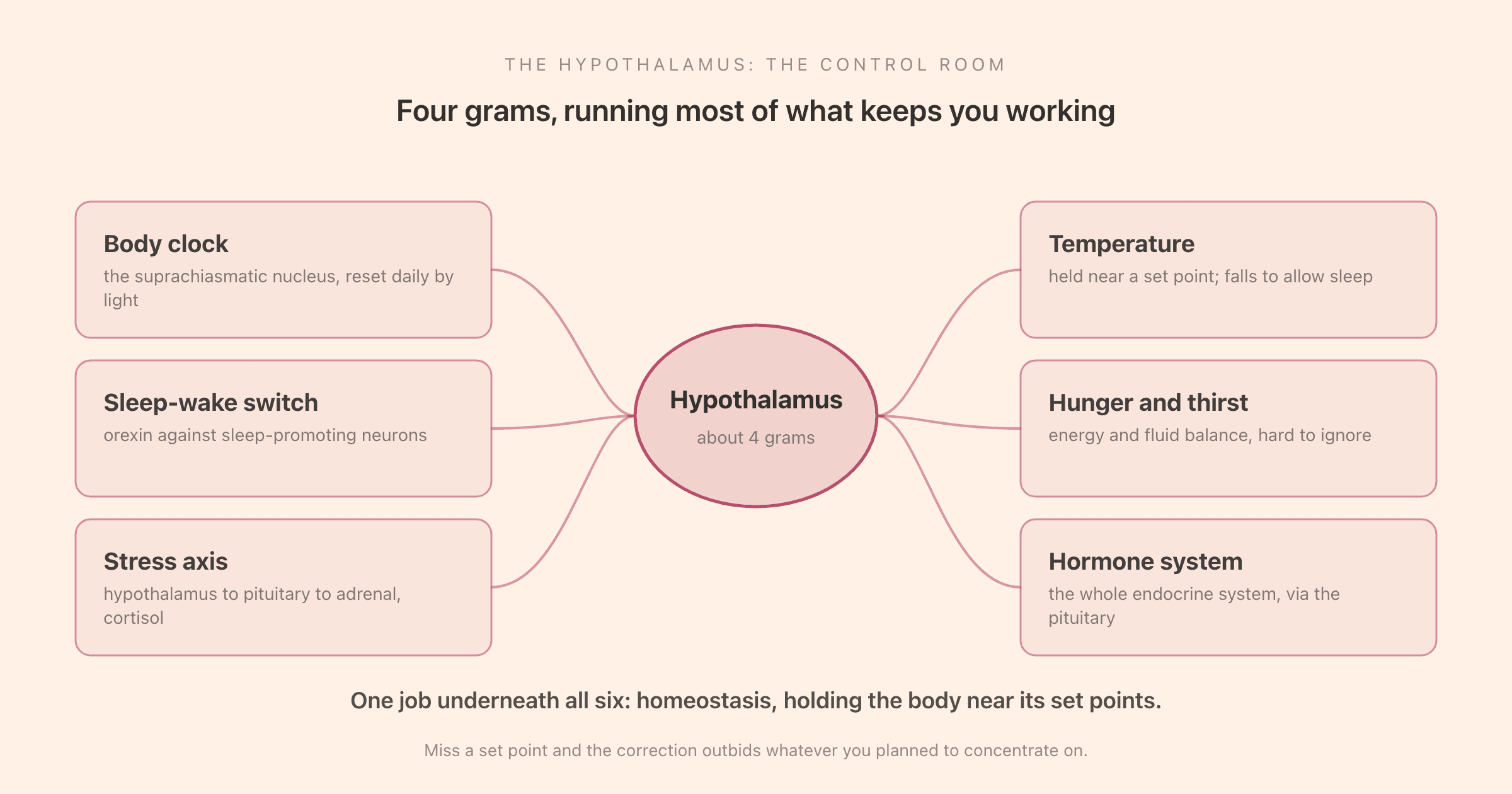
The hypothalamus is about the size of an almond and weighs roughly four grams, which makes it one of the smallest structures in the brain and easily one of the most important. It sets the time on your body clock, throws the switch between sleeping and waking, launches your stress response, holds your temperature within a degree of where it should be, tells you when you are hungry and when you have had enough, and directs the entire hormonal system through the gland sitting just beneath it. If the cortex is where you do your thinking, the hypothalamus is the control room that keeps the building running, and when it is out of balance no amount of willpower upstairs makes much difference.
This article covers what the hypothalamus is, the single job that unifies everything it does, how it runs your body clock and your sleep-wake switch, its role in the stress response, why hunger and temperature affect your concentration more than you would expect, and what actually supports it.
What Is the Hypothalamus?
The hypothalamus sits at the base of the brain, just below the thalamus (its name simply means "under the thalamus") and directly above the pituitary gland, to which it is physically connected. It is part of the limbic system, and despite its size it is not one uniform structure but a cluster of small nuclei, each with a distinct job, packed into a very small volume.
Its position explains its power. It sits at the junction of three systems that otherwise speak different languages: the nervous system, which it reads and commands directly; the endocrine system, which it controls by instructing the pituitary; and the internal state of the body, which it monitors continuously through blood temperature, hormone levels, glucose, and salt concentration. Very few structures can sense the state of the body and act on it through both nerves and hormones. The hypothalamus is the main one that can.
Homeostasis: The Job in One Word
Everything the hypothalamus does serves one function: homeostasis, keeping the body's internal conditions within the narrow range where things work. Temperature, fluid balance, energy supply, salt concentration, hormone levels, and the daily cycle of activity and rest all have to stay near a set point, and the hypothalamus is the regulator that holds them there.
The mechanism is a thermostat, more or less literally. The hypothalamus holds a set point, monitors the current value, and triggers corrective action when the two diverge. Too warm and it initiates sweating and vasodilation; too cold and it triggers shivering and vasoconstriction. Low energy and it generates hunger; enough and it generates the feeling of fullness. Dehydration and it produces both thirst and a hormone that makes the kidneys conserve water.
This is worth grasping because it reframes a lot of what feels like willpower or mood. Being unable to concentrate when you are too hot, too hungry, or badly slept is not a discipline failure. It is a regulator reporting that a set point has been missed, and prioritising the correction over whatever you had planned to do with your afternoon.
Your Body Clock Lives Here
Deep in the hypothalamus sits the suprachiasmatic nucleus, a cluster of around twenty thousand neurons that functions as the master clock for the entire body. It generates a roughly 24-hour rhythm on its own, and it keeps every other clock in your organs and tissues synchronised with it.
Left alone, that internal rhythm does not run to exactly 24 hours, so it has to be reset daily. The reset signal is light. The suprachiasmatic nucleus receives a direct connection from the retina, which is why light exposure, and specifically its timing, is the strongest influence on your circadian rhythm. Morning light advances the clock and anchors the day; bright light late in the evening delays it and pushes sleepiness later.
From there the clock governs far more than sleepiness. It drives the daily cycle of body temperature, the morning rise in cortisol, the evening rise in melatonin (which it triggers via the pineal gland), and the daily rhythm in alertness that makes the same task noticeably easier at some hours than others. When people talk about working with their body clock rather than against it, this cluster of neurons is what they are talking about.
The Sleep-Wake Switch
The hypothalamus does not just time sleep, it switches it. Two opposing populations of neurons, both hypothalamic, work against each other like a flip-flop switch.
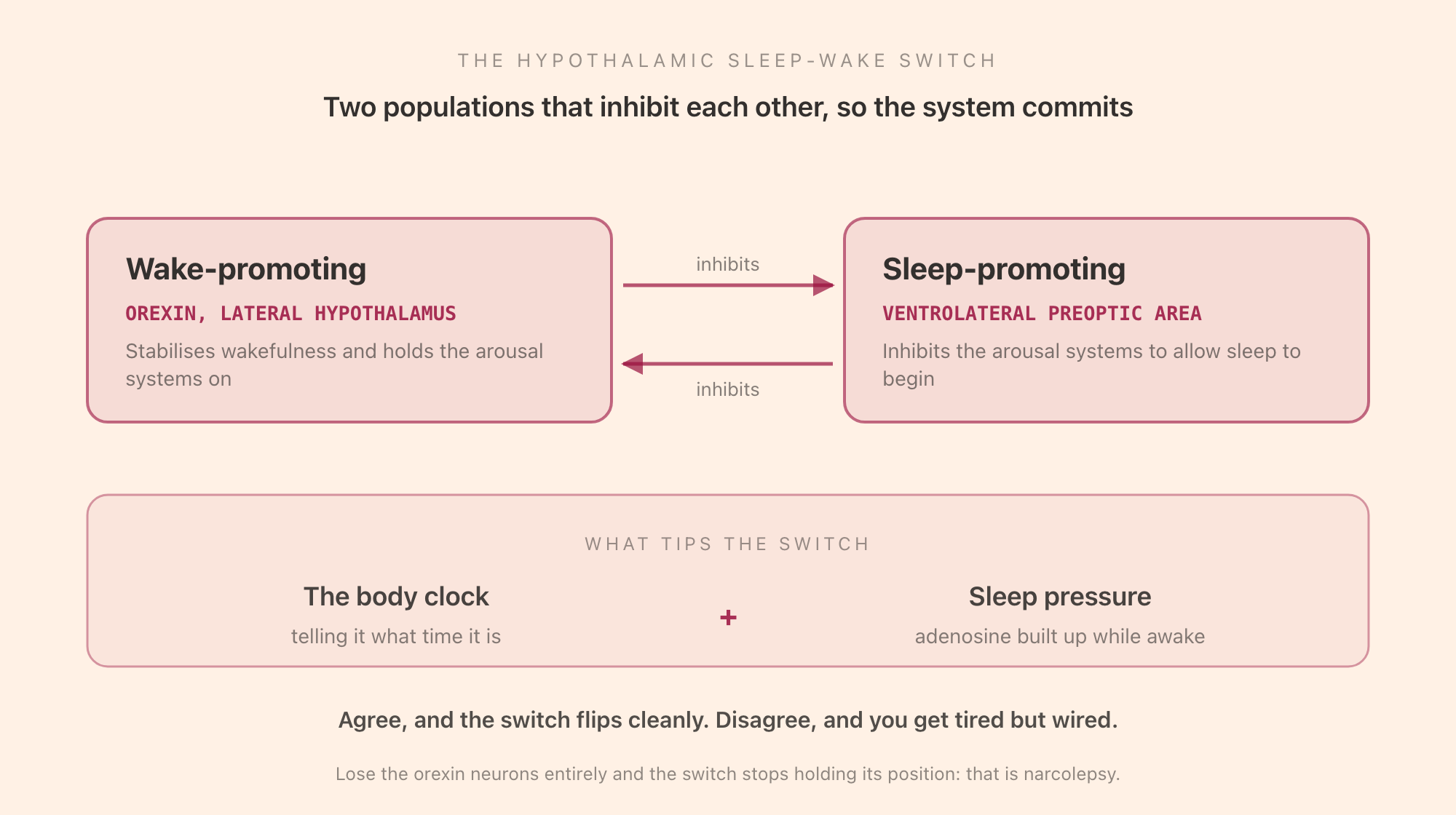
Wake-promoting neurons in the lateral hypothalamus produce orexin (also called hypocretin), a neuropeptide that stabilises wakefulness and holds the arousal systems on. Sleep-promoting neurons in the ventrolateral preoptic area do the opposite, inhibiting the arousal systems to allow sleep. Crucially, each side inhibits the other, and that mutual inhibition is what produces a switch rather than a dimmer: whichever side gains the upper hand suppresses its opponent, and the system flips cleanly into one state or the other.
The value of that design is stability. You do not want to hover in a half-asleep condition, so the circuit is built to commit. What tips it is the interaction between the body clock, telling it what time it is, and sleep pressure, the accumulated adenosine that builds through every waking hour. When both point the same way, the switch flips easily. When they disagree, you get the familiar tired-but-wired experience of a body that wants sleep and a clock that insists it is still daytime.
The importance of orexin is demonstrated dramatically by what happens without it: narcolepsy is caused by the loss of orexin-producing neurons, and the result is precisely a switch that no longer holds its position, with intrusions of sleep into wakefulness and fragmented sleep at night.
The Stress Axis
The hypothalamus also starts the slower arm of the stress response. When a threat is perceived, it releases a hormone that instructs the pituitary, which in turn signals the adrenal glands to produce cortisol. This chain, hypothalamus to pituitary to adrenal, is the HPA axis, and it is one of the most studied circuits in physiology.
It is worth distinguishing this from the fast route. The rapid, seconds-scale response that produces a pounding heart is driven by adrenaline through the sympathetic nervous system. The HPA axis is slower, unfolding over minutes, and its job is mobilising energy and sustaining the response to a longer challenge. Both begin in the hypothalamus, but they operate on different timescales and do different work.
The system is designed to switch itself off: rising cortisol feeds back to the hypothalamus and pituitary and shuts down the signal that produced it. Chronic stress is, in large part, a failure of that feedback, and because the hypothalamus is both the initiator and part of the off switch, prolonged stress disrupts the very regulator that is meant to end it. That is one mechanism behind the way sustained stress disturbs sleep, appetite, and temperature regulation all at once. They are not separate symptoms; they are one control room under strain.
Hunger, Temperature, and Focus
Two more hypothalamic jobs affect concentration more than most people credit.
Hunger and fullness. The hypothalamus integrates hormonal signals about energy stores and recent eating, and produces the sensations of hunger and satiety. Sharp swings in blood glucose and the resulting hunger signalling pull attention insistently towards food, which is why trying to do difficult work while genuinely hungry is such a losing battle. The signal is designed to be hard to ignore.
Temperature. The hypothalamus holds core temperature near its set point, and this interacts directly with sleep and alertness. Body temperature follows a daily rhythm, falling in the evening, and that fall is part of how sleep begins, which is the real reason a cool bedroom helps: it assists a drop the hypothalamus is already trying to produce. Being too warm impairs both sleep onset and daytime alertness.
The general point is that the hypothalamus does not negotiate. When a set point is missed it escalates the signal until you act on it, and cognitive work is what gets displaced in the meantime.
The Focus Connection
The hypothalamus is not a thinking structure, and it does not direct attention. What it does is set the conditions in which attention is either easy or nearly impossible.
Almost every prerequisite for good concentration is under hypothalamic control. Whether you slept well depends on the clock and the sleep-wake switch. Whether you are calm enough to think depends in part on the stress axis. Whether you are comfortable, fed, hydrated, and at a reasonable temperature depends on the regulatory systems it runs. When these are in order, focus feels available and you credit your discipline. When they are not, focus feels impossible and you blame your character, when what has actually happened is that a regulator is signalling loudly enough to outbid whatever you were trying to concentrate on.
This is the useful reframe. Rather than trying to force attention against a body that is reporting a problem, it is far more efficient to fix the underlying condition: sleep, light, stress, food, temperature. The hypothalamus is remarkably cooperative once its set points are being met, and remarkably difficult to override when they are not. Persistent brain fog is very often several of its set points being missed at once.
How to Support It
The interventions are unglamorous and reliable.
Give it consistent light and timing. Morning daylight and dim evenings are the strongest signals available to the master clock, and a steady wake time is what keeps the whole schedule anchored. This is the core of good sleep hygiene, and it works directly on the suprachiasmatic nucleus.
Do not fight the sleep-wake switch. Aligning your sleep opportunity with what your clock and sleep pressure are already indicating makes the switch flip easily. Late caffeine and late bright light both make it fight itself.
Interrupt chronic stress. The HPA axis is built for episodes, not for permanence. Anything that reliably ends the response, exercise, recovery time, slow breathing, matters more than managing stress in the moment.
Eat and drink at sensible intervals. Not a diet prescription, just an acknowledgement that hunger and dehydration signalling will win any contest with a difficult task.
Keep your working and sleeping spaces cool. Slightly cool supports both the evening temperature drop and daytime alertness.
Where Focus Music Fits
There is a common thread through all of this: the hypothalamus responds to a stable, predictable environment, and works badly in a chaotic one. Consistent light, consistent timing, consistent temperature, and a reliable degree of calm all make its regulatory job easier, and an easier regulatory job leaves more capacity for the work you actually want to do.
Your sound environment is part of that stability. Tomatoes provides focus music designed to give you a calm, consistent backdrop for deep work, which supports the settled state that concentration needs rather than the unpredictable interruptions that keep the arousal systems switched on. It is free to try for 3 days, then from $4.99 a week, $29.99 a year, or $39 for lifetime access. If you want to build working conditions your body cooperates with, try Tomatoes free for 3 days.
For a structure the size of an almond, the hypothalamus carries an unreasonable share of the load: the clock, the sleep switch, the stress axis, the thermostat, the appetite signal, and the command line to the entire hormonal system. It never asks for attention directly, which is why it is easy to overlook, but it is quietly deciding whether your afternoon will be productive long before you sit down to work. Feed it consistent light, consistent sleep, genuine recovery, and reasonable comfort, and most of what you think of as focus turns out to have been available all along.