Neurotransmitters are the chemical messengers your brain uses to talk to itself. Every thought, movement, memory, and mood involves them, because neurons do not actually touch: where one ends and the next begins there is a tiny gap, and a chemical has to carry the signal across it. That crossing happens somewhere in the order of a hundred trillion times over, continuously, in the roughly 1.4 kilograms of tissue behind your eyes. Understanding neurotransmitters is the closest thing there is to reading the brain's operating manual, and it clears away a surprising amount of the nonsense written about focus, mood, and motivation.
This article explains what a neurotransmitter is, how neurotransmission actually works, the difference between excitatory and inhibitory signalling, what the main neurotransmitters each do, why the popular "chemical imbalance" story is misleading, and what genuinely influences your neurochemistry day to day.
What Is a Neurotransmitter?
A neurotransmitter is a chemical released by one neuron to influence another. There are more than a hundred known, and they fall into a few broad families: small-molecule transmitters like glutamate, GABA, and dopamine; neuropeptides like the endorphins, which are short chains of amino acids; and a few unusual cases such as nitric oxide, a gas.
The essential idea is that the brain runs on a hybrid system. Within a single neuron, signals travel electrically, fast, along the cell's length. Between neurons, signals travel chemically, across the synapse. That chemical step looks like an inefficiency, and electrically it is, but it is also what makes the brain more than a wiring diagram. A chemical gap is a place where a signal can be amplified, dampened, blocked, or modulated by something else entirely, and it is where learning, drugs, and most of the brain's flexibility operate.
One distinction is worth making early, because it is constantly muddled: a neurotransmitter acts across a synapse onto a specific target, while a hormone is released into the bloodstream and acts on the body at large. Some molecules do both jobs. Adrenaline is a hormone when the adrenal glands pour it into your blood and a neurotransmitter when neurons release it in the brain. Cortisol, by contrast, is a hormone only, despite frequently appearing on lists of "brain chemicals".
How Neurotransmission Actually Works
The sequence is the same for almost every transmitter, and it is worth knowing because it explains how most psychoactive drugs work.
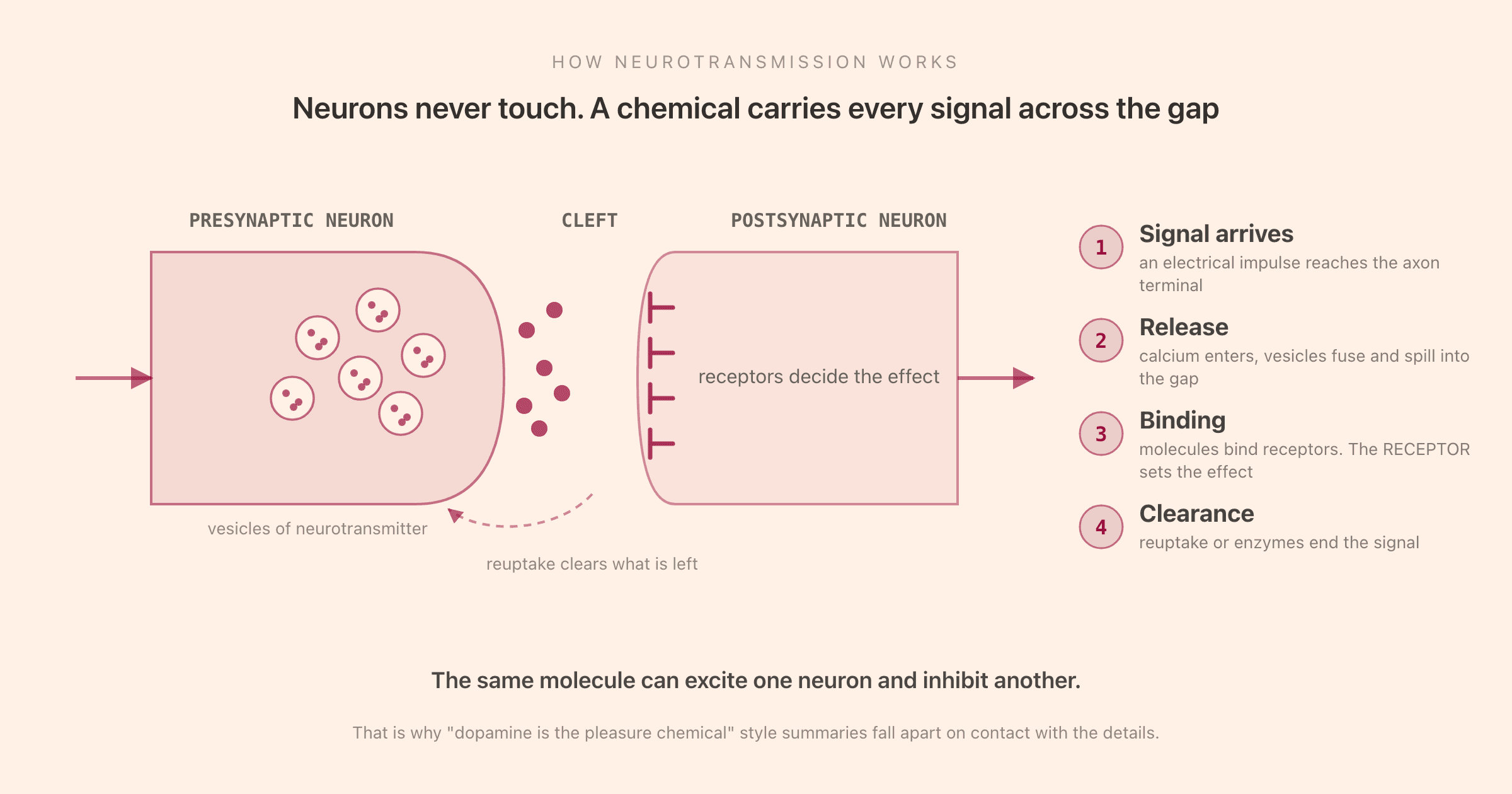
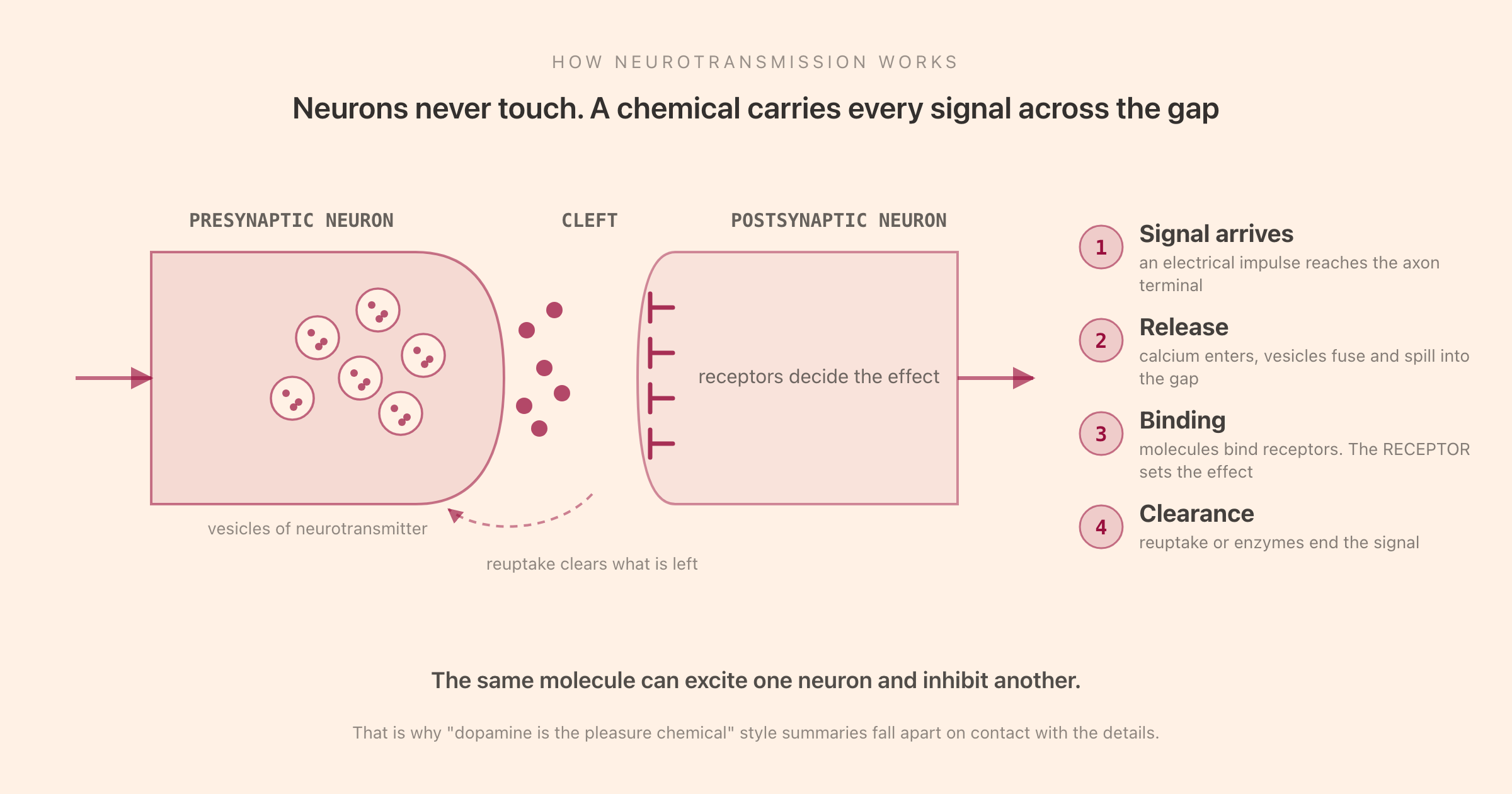
1. Synthesis and storage. The neuron manufactures the transmitter and packages it into small membrane sacs called vesicles, waiting in the axon terminal.
2. The signal arrives. An electrical impulse travels down the neuron and reaches the terminal.
3. Release. Calcium floods in, vesicles fuse with the cell membrane, and their contents spill into the synaptic cleft, the gap between the two neurons.
4. Binding. Molecules diffuse across the gap and bind to receptors on the receiving neuron. This is the key point: the effect depends on the receptor, not just the transmitter. The same molecule can excite one cell and inhibit another, because they carry different receptors. This is why "dopamine is the pleasure chemical" style summaries fall apart on contact with the details.
5. Clearance. The signal has to be ended, or the receiver would be stuck in one state. Leftover transmitter is either pumped back into the releasing neuron (reuptake), broken down by enzymes, or absorbed by nearby support cells.
That final step is where a great many medications act. SSRIs block the reuptake of serotonin, leaving more of it in the synapse for longer. Stimulants act on dopamine and norepinephrine transport. Caffeine works differently again, by blocking a receptor rather than altering release: it occupies adenosine receptors so that the sleepiness signal cannot land.
Excitatory and Inhibitory: The Two Basic Jobs
Underneath the variety, most brain signalling comes down to two opposing forces.
Glutamate is the main excitatory transmitter, making the receiving neuron more likely to fire. It is involved in the great majority of fast signalling in the brain and is central to learning and memory. GABA is the main inhibitory transmitter, making the receiving neuron less likely to fire. It is the brake, and the reason your brain does not simply run away with itself.
The balance between them is fundamental. Too little inhibition and activity spreads uncontrollably, which is the situation in a seizure. Too much and everything is sedated. Most of what feels like calm alertness is this balance sitting in the right place, and several common substances work directly on it, alcohol and benzodiazepines both enhance GABA's inhibitory effect, which is why both are sedating.
Everything else you read about, dopamine, serotonin, acetylcholine, is layered on top of this excitatory and inhibitory foundation. Those are largely modulators: rather than carrying the message, they adjust how the system carrying it behaves. That is a useful mental model, because it explains why no single transmitter is ever really "responsible" for a mood or a behaviour.
The Main Neurotransmitters and What They Do
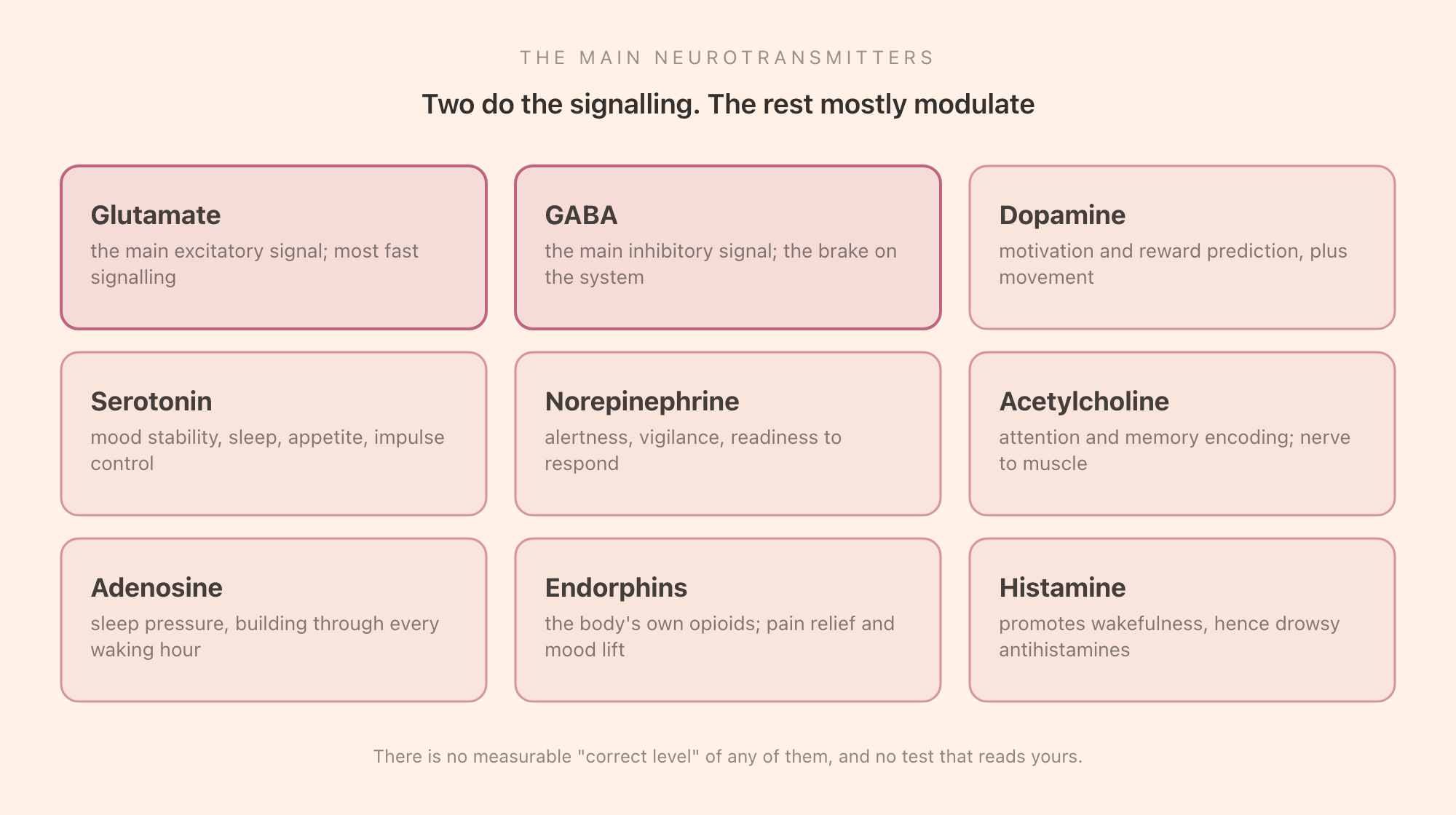
Dopamine drives motivation, reward prediction, and movement. It is persistently mislabelled the pleasure chemical; it is closer to the wanting chemical, involved in pursuing a reward rather than enjoying it. It also has a central role in motor control, which is why its loss in specific circuits produces Parkinson's disease.
Serotonin contributes to mood stability, sleep, appetite, and impulse control. Notably, the large majority of the body's serotonin is in the gut, not the brain, doing an entirely different job in digestion.
Norepinephrine (noradrenaline) governs alertness, vigilance, and the readiness to respond. It is the transmitter of the brain's arousal system and rises sharply under stress or urgency.
Acetylcholine supports attention, learning, and memory encoding in the brain, and is also the transmitter at every junction between nerve and muscle in the body.
Glutamate and GABA, as above, are the excitatory and inhibitory workhorses that everything else modulates.
Adenosine accumulates through the waking day and builds sleep pressure, acting as a brake on arousal. It is the reason you get sleepier the longer you are awake.
Endorphins are the body's own opioids, neuropeptides that dampen pain and produce the mood lift that follows hard effort.
Histamine promotes wakefulness in the brain, which is why older antihistamines, which cross into the brain, make people drowsy.
The Chemical Imbalance Story Is Misleading
You will still see mood and focus explained as a matter of being low on one chemical and needing to top it up. The reality is considerably more interesting, and it is worth being honest about.
There is no established "correct level" of any neurotransmitter that can be measured and corrected, and no clinical test that reads your brain's dopamine or serotonin. The simple serotonin-deficiency account of depression, in particular, is not supported by the evidence and has been substantially revised by researchers, even though antidepressants that act on serotonin do help many people. That combination confuses people, but it is not contradictory: a drug can work without the original explanation of why being correct.
What the evidence supports is a systems picture. What matters is not the amount of a chemical but the interaction of transmitters, receptor densities and sensitivities, the circuits involved, and how all of that changes over time. Two people with identical transmitter levels can differ enormously if their receptors differ. This is also why the supplement logic of "take more of the precursor, get more of the effect" so rarely does anything: the brain regulates these systems tightly and adjusts to compensate.
The practical upshot is not defeatist. It just means the honest levers are behavioural rather than chemical, and behavioural levers work on the whole system rather than on one number.
Neurotransmitters and Focus
Concentration is not a single-chemical phenomenon. It is what emerges when several systems line up.
Acetylcholine supports the encoding of what you are attending to. Norepinephrine sets arousal, and needs to be in a middle band: too little and you are drowsy, too much and you are anxious and scattered, the inverted-U relationship described in the piece on adrenaline. Dopamine supplies the motivational pull that makes a task worth persisting with, which is why a genuinely uninteresting task feels physically difficult to start. GABA and glutamate keep the overall excitation in a workable range. Adenosine steadily pushes against all of it as the day goes on.
Focus, in other words, is a state that several systems have to agree on, and this is exactly why it cannot be forced. You can raise your odds of it by managing what those systems respond to, sleep, light, movement, stress, stimulants, and the environment you work in, but there is no single dial. The good news is that the same handful of behavioural inputs affect all of them at once.
What Actually Influences Your Neurochemistry
The honest list is short, familiar, and effective.
Sleep. The single largest influence. Sleep clears adenosine, restores receptor sensitivity, and resets the balance of the arousal systems. Nothing else on this list compensates for losing it, which is why sleep hygiene is the foundation.
Exercise. Affects nearly every system discussed here, and does so more reliably than any supplement. Aerobic exercise is among the best-evidenced interventions for mood and cognition that exists.
Light and daily rhythm. The timing of light sets the body clock, which in turn drives the daily rhythm of the arousal systems. Alertness is scheduled, not summoned.
Stress, and recovery from it. Acute stress sharpens; chronic unrelieved stress degrades the same systems it initially mobilised.
Stimulants, honestly accounted for. Caffeine genuinely works, by blocking adenosine, but it hides accumulating tiredness rather than removing it, and tolerance develops.
Food and hydration. Not through exotic precursor loading, but through the plain fact that stable energy and hydration are prerequisites for any of these systems working properly.
Where Focus Music Fits
The theme running through all of this is that you do not control your neurochemistry directly. You control the inputs, and the environment is one of the most controllable inputs there is. A working environment full of interruptions keeps the arousal systems repeatedly triggered, which is the opposite of the steady, middling arousal that sustained concentration needs.
That is the job Tomatoes is built for: focus music designed to give you a calm, consistent sound environment, so your attention systems can settle rather than being repeatedly pulled back to baseline. It is free to try for 3 days, then from $4.99 a week, $29.99 a year, or $39 for lifetime access. If you want to work with your neurochemistry rather than against it, try Tomatoes free for 3 days.
Neurotransmitters are a genuinely satisfying thing to understand, partly because the mechanism is so concrete, a vesicle, a gap, a receptor, a clean-up, and partly because knowing it inoculates you against most of what gets sold on the strength of these words. There is no pleasure chemical, no simple imbalance to correct, and no supplement that reliably shortcuts the system. What there is is a set of interacting systems that respond, consistently and measurably, to sleep, movement, light, stress, and the conditions you choose to work in. That is less exciting than a hack, and far more dependable.